
West Bengal moves to rename itself ‘Paschim Banga’
West Bengal’s Chief Minister Suvendu Adhikari said the State wants to be called “Paschim Banga”, as it is known in Bengali. The new name will be used in English too, written exactly as “Paschim Banga”. A resolution will be moved in the State Assembly on 9 December. After it passes, it will go to the Union Government. The final change needs a law passed by Parliament. The State leadership says the name recalls history: at Partition, one part of Bengal became East Bengal, now Bangladesh. Earlier, the Assembly had passed a resolution in 2018 for the name “Bangla”, but the Union Government did not approve it. Read it to revise Article 3, the President’s recommendation, and why a State’s views are not binding on Parliament.
- The proposed name
- Paschim Banga, to be used in English in that exact spelling
- The next step
- An Assembly resolution on 9 December, then the Union Government
- The final step
- A law passed by Parliament under Article 3
- An earlier attempt
- A 2018 resolution for the name “Bangla” was not approved by the Union Government
What has West Bengal proposed, and what still has to happen?
A State cannot rename itself by an Assembly resolution alone. West Bengal has chosen a name, fixed a date to vote on it, and the rest of the journey still runs through the Union Government and Parliament.
- West Bengal’s Chief Minister Suvendu Adhikari said the State wants to be called “Paschim Banga”, as it is known in Bengali.
- The new name will be used in English too, written exactly as “Paschim Banga”.
- A resolution will be moved in the State Assembly on 9 December. After it passes, it will go to the Union Government.
- The final change needs a law passed by Parliament.
- The State leadership says the name recalls history. At Partition, one part of Bengal became East Bengal, now Bangladesh.
- Earlier, the Assembly had passed a resolution in 2018 for the name “Bangla”, but the Union Government did not approve it.
How does a State’s name actually get changed?
The names and boundaries of States are a Union subject in the constitutional sense that Parliament has the power to act. Article 3 allows Parliament to form a new State, change the area or boundary of a State, or change its name. A law under Article 3 is passed by a simple majority, and Article 4 says that such a law is not an amendment of the Constitution under Article 368.
The Bill can be introduced in Parliament only on the recommendation of the President. The President refers it to the State Legislature for its views. Those views are not binding, and there is no requirement of a referendum or of the State’s formal consent. That is the procedure an examiner wants, and it is why an Assembly resolution, however important politically, is only a first step.
West Bengal’s present plan is to move a resolution on 9 December for the name Paschim Banga, use that spelling in English as well, and then send it to the Union Government. Only a later Act of Parliament would complete the change. In 2018 the Assembly had already asked for the name Bangla, and the Union Government did not approve it. That earlier failure is part of this story, not a footnote.
The State leadership links the new name to Partition. In 1947, Bengal was divided: the western part remained in India as West Bengal, and the eastern part became East Bengal, later East Pakistan, and then Bangladesh. A still older partition of Bengal, in 1905, is the other historical fact students often revise beside this topic, even though it is not the immediate cause of this 2026 proposal.
India has renamed States before without treating the change as a constitutional amendment. Uttaranchal was renamed Uttarakhand in 2007, and Orissa was renamed Odisha in 2011. Those precedents show the path; they do not decide whether Parliament will accept Paschim Banga.
The legal path, and the political steps so far
| Step | What it means |
|---|---|
| Assembly resolution | Planned on 9 December, for the name Paschim Banga |
| Union Government | The resolution, once passed, is to be sent here |
| Parliament | Must pass a law; this is the step that changes the name |
| President’s recommendation | Required before the Bill is introduced in Parliament |
| State’s views | Sought, but not binding |
| Earlier attempt | 2018 resolution for “Bangla” was not approved |
Which Articles and earlier renamings apply?
- Article 3 empowers Parliament to change the name of a State, as well as to form a new State or change its area or boundary.
- A Bill under Article 3 can be introduced only on the recommendation of the President. The President refers it to the State Legislature for its views, which are not binding.
- The Bill is passed by a simple majority. Article 4 says such a law is not an amendment of the Constitution under Article 368.
- Uttaranchal was renamed Uttarakhand in 2007, and Orissa was renamed Odisha in 2011.
- A State Assembly resolution is a political and formal request. It does not, by itself, change the name in law.
Why does West Bengal’s plan to rename itself Paschim Banga matter?
| Angle | What to note |
|---|---|
| Prelims | Article 3; President’s recommendation; State views not binding; simple majority; not an Article 368 amendment. |
| GS-II: federalism | A State can ask; Parliament decides. |
| History | The proposed name is tied to the 1947 partition of Bengal; a 2018 bid to use “Bangla” was not approved. |
| Precedents | Uttaranchal to Uttarakhand in 2007; Orissa to Odisha in 2011. |
What are the problems with West Bengal’s plan to rename itself Paschim Banga?
- A resolution planned for 9 December has not yet been passed, and the Union Government has not yet taken a view on this proposal.
- The 2018 “Bangla” attempt shows that an Assembly vote does not guarantee approval.
- A change of name does not, by itself, settle any other political or administrative question in the State.
- Public use of a name in one language is not the same as a legal change in the official name of the State.
What should be done next on West Bengal’s plan to rename itself Paschim Banga?
- Watch the 9 December resolution, and then whether a Bill is actually recommended and introduced in Parliament.
- Keep the procedure exact: President’s recommendation, reference to the State, views not binding, simple majority, Article 4.
- Do not describe this as a constitutional amendment under Article 368.
- Revise the two modern precedents: Uttarakhand in 2007 and Odisha in 2011.
What can Prelims ask on West Bengal’s plan to rename itself Paschim Banga?
Prelims probability: High. Article 3 is a basic Polity area: the the State paper asked it in 2020, and UPSC asked about changing a State’s name in 2012. Testable facts: Parliament’s power under Article 3, the President’s recommendation, views of the State not binding, simple majority.
- West Bengal plans an Assembly resolution on 9 December to rename the State Paschim Banga, using that spelling in English as well.
- The final change needs a law passed by Parliament. A State Assembly resolution is not enough.
- Under Article 3, a Bill to change a State’s name can be introduced only on the President’s recommendation.
- The State Legislature’s views are sought but are not binding. The Bill is passed by a simple majority.
- Article 4 says such a law is not an amendment of the Constitution under Article 368.
- In 2018 the Assembly passed a resolution for the name “Bangla”, which the Union Government did not approve. Uttaranchal became Uttarakhand in 2007, and Orissa became Odisha in 2011.
How to write about West Bengal’s plan to rename itself Paschim Banga in Mains
Practice question (15 marks, 250 words): West Bengal plans to seek a change of its name to Paschim Banga. Explain the constitutional procedure for renaming a State and why an Assembly resolution is not the final step.
- Open with the proposal: Paschim Banga, to be used in English in that spelling, and a resolution planned on 9 December.
- State the law: Article 3 gives Parliament the power to change a State’s name.
- Set out the procedure: President’s recommendation, reference to the State Legislature, views not binding, simple majority.
- Add Article 4: the law is not an amendment under Article 368, and cite Uttarakhand (2007) and Odisha (2011).
- Close with the 2018 “Bangla” attempt, which shows that Union approval is still required after an Assembly vote.
Ready lines for your answer
- A State can choose a name; only Parliament can make it the law of the land.
- The difference between a request and a renaming is the whole of Article 3.
Quotable data pointThe Hindu, 24 November 2026: West Bengal to move a 9 December Assembly resolution for the name Paschim Banga; Parliament must pass a law; 2018 “Bangla” resolution was not approved by the Union Government.
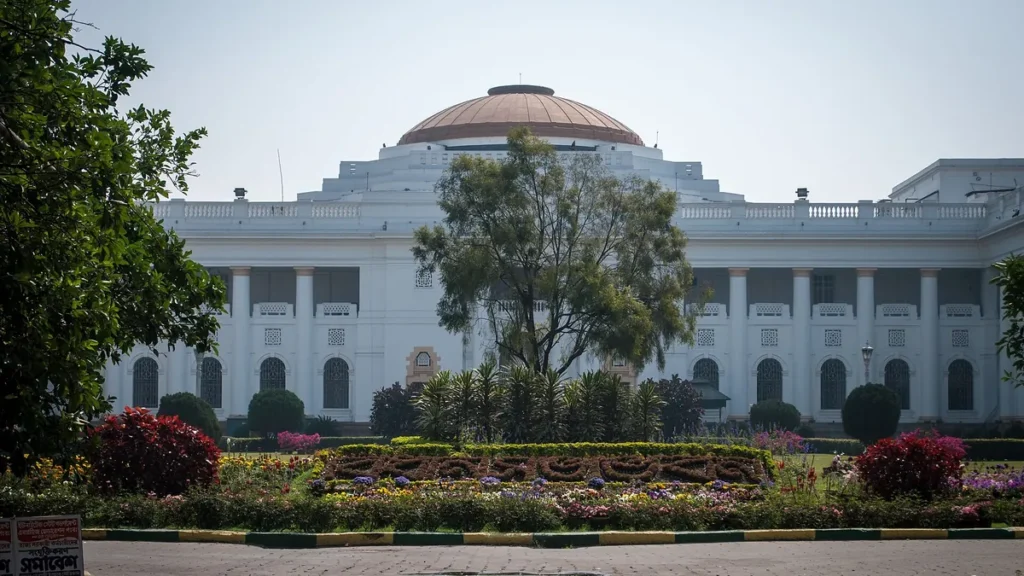
Photo: Sujay25, CC BY-SA 4.0, via Wikimedia Commons
Exam angle
Prelims: Article 3, the President’s recommendation, views of the State not binding, simple majority, and Article 4. · Mains GS-II: the Union’s power over the names and boundaries of States, and the politics of renaming.
Practice MCQs
Original practice questions (not PYQs).
Under Article 3 of the Constitution, a Bill to change the name of a State can be introduced in Parliament only
Answer (a) & explanation
The Bill needs the President's recommendation; the President refers it to the State Legislature for its views, which are not binding, and it is passed by simple majority.
Consider the following statements:
1. Uttaranchal was renamed Uttarakhand in 2007.
2. Orissa was renamed Odisha in 2011.
3. A law changing the name of a State is treated as an amendment of the Constitution under Article 368.
How many of the above statements are correct?
Answer (b) & explanation
Statements 1 and 2 are correct. Article 4 says such laws are not amendments under Article 368.
Questions students ask about this
What name has West Bengal proposed?
Paschim Banga, to be used in English in that exact spelling as well.
What happens on 9 December?
A resolution is to be moved in the State Assembly. After it passes, it is to go to the Union Government.
Who has the final legal power to change the name?
Parliament, by passing a law under Article 3.
Are the State Legislature’s views binding?
No. They are sought, but they are not binding.
Has the State tried to change the name before?
Yes. In 2018 the Assembly passed a resolution for the name “Bangla”, which the Union Government did not approve.