
UPSC Prelims 2024 · GS Paper I: With reference to revenue collection by Cornwallis, consider the following statements :1. Under the…
With reference to revenue collection by Cornwallis, consider the following statements :
- 1. Under the Ryotwari Settlement of revenue collection, the peasants were exempted from revenue payment in case of bad harvests or natural calamities.
- 2. Under the Permanent Settlement in Bengal, if the Zamindar failed to pay his revenues to the state, on or before the fixed date, he would be removed from his Zamindari.
Which of the statements given above is/are correct ?
No official answer (question dropped) & notes
UPSC dropped this question, so no answer was counted. Learn the facts anyway. Statement 1 is wrong in its premise: the Ryotwari system was the work of Thomas Munro and Alexander Read in Madras (and later Bombay), not Cornwallis, and it did not give peasants a fixed remission for bad harvests. Statement 2 is right: under Cornwallis's Permanent Settlement (1793) in Bengal, a zamindar who missed the payment date, under the "sunset law", lost his estate at auction. On the facts, option (b) would fit.
Notice the third system: the Mahalwari settlement, made with whole village communities, by Holt Mackenzie in the North-Western Provinces. The harsh sunset law ruined many old zamindar families within a few decades.
UPSC did not evaluate this question, so no official answer exists. Use it for practice only.
UPSC dropped this question from evaluation; there is no official answer.
Same theme in UPSC Mains
- MAINS UPSC Mains 2026 · GS Paper I · Q20Evaluate the impact of globalization on Indian youths with reference to social, political, economic and cultural spheres.
- MAINS UPSC Mains 2024 · GS Paper III · Q6What is the technology being employed for electronic toll collection on highways? What are its advantages and limitations? What are the proposed changes that will make…
Related questions from other years
The artificially fixed rupee-sterling exchange rate prescribed by the Hilton-Young Commission (1926) was adopted by the British Government for which one of the following reasons ?
Answer (a) & explanation
The rate helped remittances and India's creditworthiness (a). The Hilton-Young Commission (1926) fixed the rupee at 1s 6d, against the 1s 4d Indian business wanted. A dearer rupee made the Home Charges and other remittances to Britain cheaper to pay in rupees and kept India's credit good in London. Option (c) is wrong: Indian exporters, cotton included, lost out, since a dear rupee makes exports costly. Option (b) is wrong: helping Indian importers was not the aim. Option (d) is wrong: the issue was the sterling rate, not gold.
Notice the nationalist anger: Purshotamdas Thakurdas wrote a dissent, and the "ratio controversy" fed economic nationalism. The commission also proposed a central bank, leading to the RBI (1935).
Answer as per the official UPSC answer key.
Which one of the following statements about the Eka Movement and Bardoli Satyagraha is correct ?
Answer (c) & explanation
Option (c) is the correct description (c). Bardoli (1928, Surat district) was Vallabhbhai Patel's no-revenue campaign against a 22% land revenue hike. The Eka (unity) movement of 1921–22 rose against rents charged above the recorded amount. Option (a) is wrong: Congress started Eka, but under Madari Pasi it moved outside Congress control. Option (b) is wrong: Eka was led by peasants against taluqdars, and Bardoli was by landholding peasants. Option (d) is wrong: Eka was in Hardoi, Bahraich and Sitapur, and Bardoli is in Gujarat, not Saurashtra.
Notice that Bardoli's women gave Patel the title "Sardar". The Maxwell-Broomfield inquiry cut the hike to 6.03%, a clear win for the peasants.
Answer as per the official UPSC answer key.
Which of the following factors contributed to the formation of the Forward Bloc by Subhas Chandra Bose in 1939 ?
- 1. Bose failed to win the confidence of Mahatma Gandhi.
- 2. The Congress Left was disunited and failed to support Bose.
- 3. The Communists did not support Bose in his endeavours.
- 4. The supporters of M.N. Roy and socialist leaders like Jayaprakash Narayan preferred Congress unity to supporting Bose.
Select the answer using the code given below :
Answer (b) & explanation
Factors 1, 2 and 4 contributed (b). Bose beat Gandhi's choice, Pattabhi Sitaramayya, at Tripuri (1939). Factor 1 is right: Gandhi then held back, Bose could not form a Working Committee, and he resigned. Factor 2 is right: the Congress Left was split and did not back him. Factor 4 is right: CSP leaders like Jayaprakash Narayan and M.N. Roy's supporters put Congress unity first. Factor 3 is not in UPSC's key. So in May 1939 Bose founded the Forward Bloc inside Congress.
Notice what came next: Rajendra Prasad became Congress president. Bose escaped India in 1941, went to Germany and Japan, and led the Indian National Army (Azad Hind Fauj) from 1943.
Answer as per the official UPSC answer key.
Consider the following statements regarding the British policy in Awadh immediately after its annexation in 1856 :
- 1. The taluqdars were dispossessed of their estates but allowed to retain their arms and forts.
- 2. A Summary Revenue Settlement was made in 1856 assuming that the taluqdars were outsiders.
- 3. The British believed in taking revenue directly from the peasants by removing the taluqdars.
Which of the statements given above is/are correct ?
Answer (a) & explanation
Statements 2 and 3 are correct (a). Statement 2 is right: the Summary Settlement of 1856 treated taluqdars as middlemen, outsiders with no real claim to the land. Statement 3 is right: the British settled revenue directly with the village holders, removing taluqdars. Statement 1 is wrong: taluqdars were disarmed and their forts pulled down, not allowed to keep them. So options (b), (c) and (d) fail.
Notice the result: many angry taluqdars then led the 1857 revolt in Awadh, where Begum Hazrat Mahal led the fight at Lucknow. Awadh was annexed by Dalhousie in 1856 on the ground of "misgovernment", not the Doctrine of Lapse. After 1857, the British reversed course and restored taluqdars.
Answer as per the official UPSC answer key.
In the news since
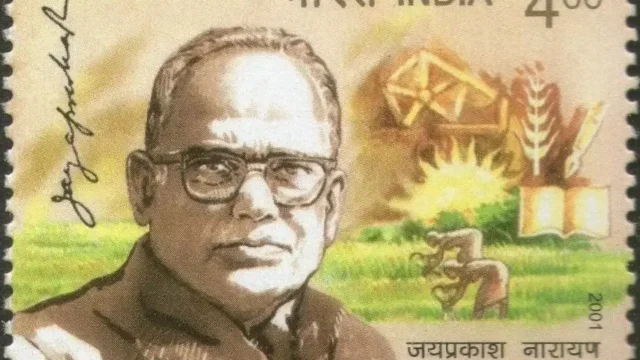
Birth anniversaries: Jayaprakash Narayan and Nanaji Deshmukh
11 October is the birth anniversary of Loknayak Jayaprakash Narayan and Nanaji Deshmukh, both Bharat Ratna awardees. The Prime Minister recalled JP's voice during the Emergency and his concern for good governance, and Nanaji's work in rural development and community participation. Treat this as a personality note for Prelims.
11 Oct 2026
ASI and Denmark museum to search for 1619 Danish shipwreck Oresund off Karaikal
The Archaeological Survey of India's Underwater Archaeology Wing and the National Museum of Denmark (Njord Centre, Copenhagen) signed an MoU to locate and document the Danish ship Oresund, wrecked off Karaikal, Puducherry, in 1619 CE. It is described as the first Danish ship known to have reached India.
15 Jun 2026
Veer Bal Diwas and the Rashtriya Bal Puraskar
The PM announced the day on 9 January 2022 and the first Veer Bal Diwas was held on 26 December 2022 [PMO].
26 Dec 2025