
57th GST Council: arrest provisions to go, prosecution threshold raised to ₹5 crore
UPSC has already asked about this. Read the story with these questions in mind.
The 57th GST Council meeting on 8 October 2026 focused on process reform rather than rates. It recommended removing arrest powers under GST, raising the prosecution threshold from ₹1 crore to ₹5 crore, cutting the general penalty from ₹25,000 to ₹10,000, no notices below ₹10,000 tax, wider input tax credit and refunds, and limits on interception of goods in transit.
- Meeting
- 57th GST Council
- Date
- 8 Oct 2026
- Arrest power
- To be withdrawn
- Prosecution bar
- ₹1 cr → ₹5 cr
57th GST Council meeting: what happened?
The 56th meeting cut and simplified rates. This one turns to how the tax is run: registration, returns, refunds, disputes and enforcement. Most changes need amendments to the CGST and IGST Acts, so Parliament and State legislatures must act.
- Arrest powers under GST to be removed completely; prosecution only above ₹5 crore and mainly for fake input tax credit claims.
- Penalties: general penalty down to ₹10,000; no notices if tax involved is under ₹10,000; 5% reduced penalty in non-fraud cases paid within the deadline.
- Input tax credit: refund of accumulated ITC on capital goods and input services in more cases; blocked credits in Section 17(5) narrowed (for example insurance, outdoor catering, telecom towers).
- Goods movement: vehicles may be intercepted only on specific intelligence with a Joint Commissioner’s authorisation, and not in transit States.
- Small business: simpler registration for small e-commerce sellers; late fee waiver for turnover up to ₹5 crore if filed within the month; in-principle approval for an optional Annual Return Quarterly Payment scheme for B2C sellers up to ₹5 crore.
What is the GST Council?
- A constitutional body under Article 279A, added by the Constitution (101st Amendment) Act, 2016.
- Members: Union Finance Minister (chair), Union MoS Finance, and the Finance Ministers of all States (and UTs with legislatures).
- It recommends; Parliament and States then change their laws. Decisions need three-fourths of weighted votes: the Centre has one-third weight, the States together two-thirds.
Which laws will change?
- CGST Act, 2017: Sections 17(5), 54, 68, 69, 73, 74, 74A, 107, 112, 125, 129, 130, 132 and Schedule II, as listed by PIB.
- IGST Act, 2017: export of services definition and place-of-supply rules.
- State GST Acts must mirror these changes.
What changes for taxpayers?
| Area | Before | Recommended |
|---|---|---|
| Arrest | Allowed under Section 69 | Removed |
| Prosecution threshold | ₹1 crore | ₹5 crore |
| General penalty (s.125) | up to ₹25,000 | up to ₹10,000 |
| Minimum tax for show cause notice | none | ₹10,000 |
| Pre-deposit cap (penalty-only appeals) | no cap | ₹40 crore (₹20 cr CGST + ₹20 cr SGST) |
| Interception of goods | wider | specific intelligence + JC authorisation; not in transit States |
How does a GST Council decision become law?
- Council recommends (Art. 279A)
- Centre drafts amendments to CGST/IGST Acts
- Parliament passes; States amend SGST Acts
- Rules and circulars notified
- Portal changes go live (some from April 2027)
Why does 57th GST Council meeting matter?
| Angle | What to note |
|---|---|
| Economic | Faster refunds and fewer blocked credits ease working capital. |
| Governance | Moves from fear-based to trust-based tax administration; fewer petty notices. |
| Federal | Shows cooperative federalism: Centre and States agree in one forum. |
| Exports | Clearer rules for export of services help IT and service firms. |
What are the challenges in 57th GST Council meeting?
- Removing arrest may weaken deterrence against fake invoice rackets; prosecution is kept for fake ITC.
- Many changes need legislative amendments and portal work, so relief comes with a lag.
- States must pass matching laws.
What should be done next on 57th GST Council meeting?
- Pass CGST/IGST amendments early and publish FAQs, as the Council said.
- Watch data on fake ITC cases after the change.
What can Prelims ask on 57th GST Council meeting?
- GST Council: Article 279A; 101st Amendment, 2016.
- Weight: Centre one-third, States two-thirds; decisions by three-fourths.
- Section 69 CGST Act (arrest) to be omitted.
- Prosecution threshold ₹5 crore; general penalty ₹10,000.
How to write about 57th GST Council meeting in Mains
Practice question (10 marks, 150 words): The 57th GST Council shifted focus from rates to trust-based processes. Examine the significance and the risks of this shift.
- Intro: 56th = rates, 57th = process.
- Measures: arrest, prosecution, penalties, ITC, e-way.
- Gains: ease of business, working capital.
- Risks: deterrence, delay.
- Conclusion: trust with data-based enforcement.
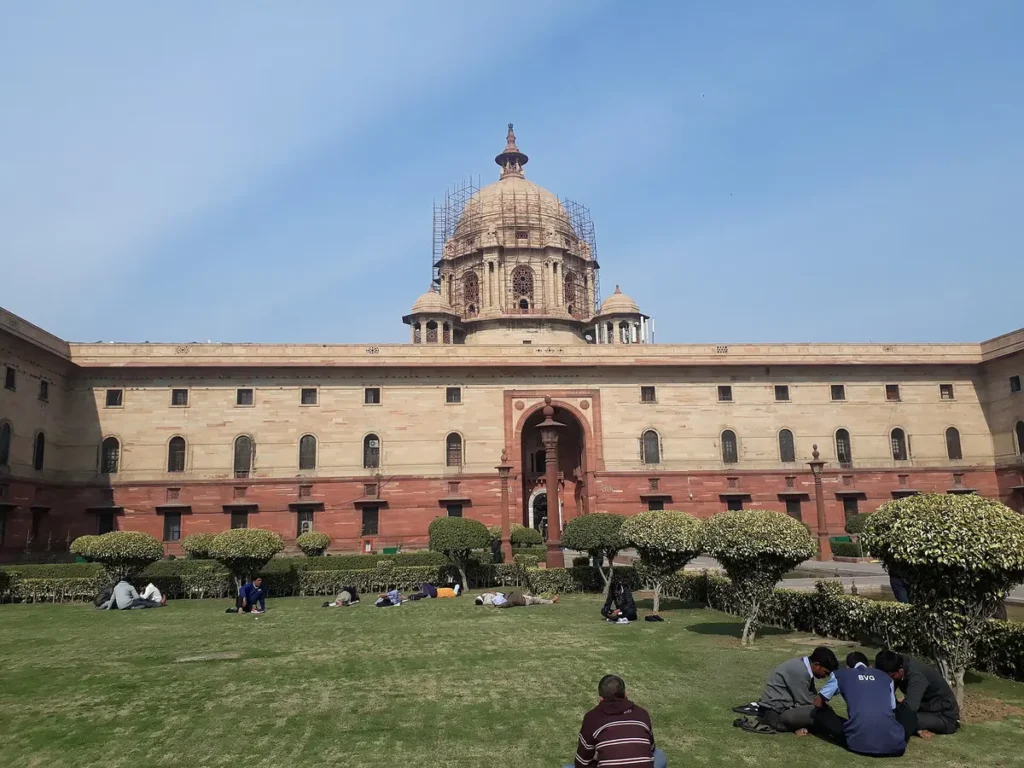
Image: Pinakpani, Wikimedia Commons, CC BY-SA 4.0
How to use this in Mains
If asked: Decriminalisation of tax law improves ease of doing business. Discuss with reference to GST. (GS-III)
Quote: “Arrest powers under GST to be removed completely; prosecution only above ₹5 crore and mainly for fake input tax credit claims.”
Use it: Your headline reform point; balance it with the need to tackle fake ITC.
Exam angle
Prelims: GST Council structure, Article 279A. · Mains GS-III: indirect tax reform; GS-II: fiscal federalism.
Practice MCQs
Original practice questions (not PYQs).
Consider the following about the 57th GST Council recommendations:
1. Arrest powers under GST are to be withdrawn.
2. The prosecution threshold rises to ₹5 crore.
3. GST rates on all goods were cut.
Which are correct?
Answer (a) & explanation
The 57th meeting dealt with process reform; rate cuts were the focus of the 56th meeting.
In the GST Council, the weight of the Central Government's vote is
Answer (b) & explanation
Article 279A(9): Centre one-third, all States together two-thirds; decisions need three-fourths of weighted votes.
Questions students ask about this
What did the 57th GST Council recommend on arrests?
Complete withdrawal of arrest powers under GST by omitting Section 69 of the CGST Act.
What is the new GST prosecution threshold?
₹5 crore, raised from ₹1 crore.
Under which Article is the GST Council set up?
Article 279A, inserted by the Constitution (101st Amendment) Act, 2016.
What is the ARQP scheme?
An optional Annual Return Quarterly Payment scheme, approved in principle, for B2C taxpayers with turnover up to ₹5 crore.
Keep studying
Go deeper
Official source: PIB, Ministry of Finance: Recommendations of the 57th GST Council, 8 Oct 2026
facts from cited sources only; faculty review pending