
Money Laundering: Stages, PMLA 2002, Enforcement Directorate Powers, FATF Evaluation and Judicial Debate (UPSC Notes + PYQs)
UPSC has already asked about this. Read the story with these questions in mind.
- Prelims 2021Which one of the following effects of creation of black money in India has been the main cause of worry to the Government of…Solve it below ↓
- Mains 2026 · GS3Discuss counterfeit currency and money laundering as major sources of terror funding in India. State the actions being taken at International level to check…See model answer →
Stages
- Placement: dirty cash enters the financial system (cash deposits split to avoid reporting, buying jewellery).
- Layering: moving money through shell companies, trade invoices, hawala and crypto to hide the trail.
- Integration: funds return as apparently clean income, through property, businesses or loans.
PMLA in brief
Offence under Section 3; “scheduled offences” listed in the Act trigger it. The ED can attach property, search, arrest and record statements. Section 45 sets “twin conditions” for bail. Banks and intermediaries must keep records and report suspicious transactions to the Financial Intelligence Unit-India (FIU-IND).
The judicial debate
In Vijay Madanlal Choudhary (2022) the Supreme Court upheld the ED’s wide powers, the twin bail conditions and the reverse burden of proof, and held that an ECIR need not be given to the accused. A review is pending. Critics point to low conviction rates (the government told Parliament of a few dozen convictions against thousands of cases since 2005) and the long jail time before trial. Later rulings stressed that “bail is the rule” even under PMLA in cases of long delay (Manish Sisodia, 2024).
FATF and India
The Financial Action Task Force (1989, Paris) sets global standards against laundering and terror financing. India joined in 2010. Its 2024 Mutual Evaluation praised India’s results on tackling illicit finance, while asking for faster prosecutions and better oversight of non-profits. Pakistan was on the grey list from 2018 to 2022.
Emerging channels
Crypto assets (brought under PMLA in 2023), online gaming and betting apps, trade-based laundering, hawala, and benami property. The Black Money Act, 2015 and the Benami Transactions Amendment Act, 2016 are related laws.
Money Laundering: UPSC angle
For UPSC CSE
Prelims: stages, FATF, FIU-IND, PMLA facts. Mains GS-III: money laundering as a security threat, ED powers and civil liberties.
Money Laundering UPSC PYQs (Prelims)
Questions UPSC has actually asked, from the official papers. Pick an option to check yourself.
In a class, 60% of students are from India and 50% of the students are girls. If 30% of the Indian students are girls, then what percentage of foreign students are boys ?
Black money is income hidden from the tax authorities. All four options are real effects, but the government’s main worry is the loss of tax revenue, which shrinks its capacity to spend on public needs. The White Paper on Black Money (2012) stresses this point. Answer as per the official UPSC key · Battle IAS PYQ bankAnswer (d) & why
Mains PYQs on this topic
Questions from the official UPSC Mains papers (2023-2026 in the Battle IAS Mains bank), newest first. Each links to a model answer.
- UPSC Mains 2026 · GS Paper III · Q20 · 15 marks
Discuss counterfeit currency and money laundering as major sources of terror funding in India. State the actions being taken at International level to check these menaces. Highlight the role of Financial Action Task Force (FATF) and methods of compliance by its member states in preventing terror funding.
- UPSC Mains 2023 · GS Paper III · Q20 · 15 marks
Give out the major sources of terror funding in India and the efforts being made to curtail these sources. In the light of this, also discuss the aim and objective of the ‘No Money for Terror (NMFT)’ Conference recently held at New Delhi in November 2022.
Quick quiz
Moving money through shell companies to hide its origin is the stage of
Middle stage.Answer (b)
Suspicious transaction reports in India go to
Under the Finance Ministry.Answer (b)
India became a full member of FATF in
After observer status in 2006.Answer (b)
FAQs
What is a “scheduled offence” under PMLA?
A predicate crime listed in the Act’s schedule; laundering its proceeds attracts PMLA.
What are the twin conditions for bail?
The court must believe the accused is not guilty and is not likely to commit an offence on bail.
What is the FATF grey list?
Increased monitoring for countries with strategic deficiencies.
Are crypto exchanges covered by PMLA?
Yes, since a March 2023 notification.
Spotted an error? Tell us. We correct within 48 hours.
Image: Ravi Dwivedi, Wikimedia Commons, CC BY-SA 4.0
How to use this in Mains
If asked: UPSC Mains 2026, GS-III: Discuss counterfeit currency and money laundering as major sources of terror funding in India. State the actions being taken at International level to check these menaces. Highlight the role of Financial Action Task Force (FATF) and methods of compliance by its member states in preventing terror funding.
Quote: “In Vijay Madanlal Choudhary (2022) the Supreme Court upheld the ED’s wide powers, the twin bail conditions and the reverse burden of proof, and held that an ECIR need not be given to the accused.”
Use it: Use as the legal-debate point when discussing the ED's powers.
In the news
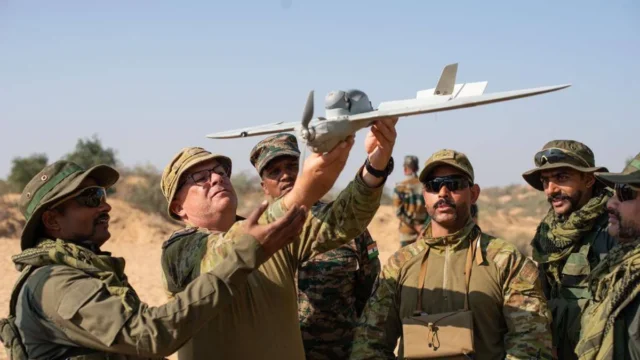
AUSTRAHIND 2026: fifth India–Australia Army exercise begins in Thiruvananthapuram
The fifth edition of the India–Australia joint military exercise AUSTRAHIND began on 19 October 2026 at the Foreign Training Node, Thiruvananthapuram, and runs till 1 November. About 120 soldiers from each army will train for sub-conventional operations in island and coastal terrain under a UN Chapter VII mandate. For the first time, New Zealand has sent observers.
20 Oct 2026
CCPA acts against online sale of explosives: 3,940 sellers delisted from seven platforms
The Central Consumer Protection Authority (CCPA) said on 19 October 2026 that 3,940 sellers of regulated explosives such as ammonium nitrate, picric acid and PETN have been delisted from seven online platforms after its action. It has fined Dial4Trade and ExportersIndia ₹10 lakh per order, and other cases are under hearing or investigation.
19 Oct 2026
Supreme Court: children have a right to the internet, and platforms must block child abuse material
In a judgment of 15 October 2026, the Supreme Court said that the right to access and use the internet is a fundamental right of every person, children included, under Article 21 read with Article 19(1)(a). So the answer to online danger is not to lock children out but to go after the abusive content and the platforms that fail to remove it. The Court ordered a National Hash and URL List Database, two-hour reporting of unknown abuse material, and loss of revenue for platforms that profit from it through paywalls.
18 Oct 2026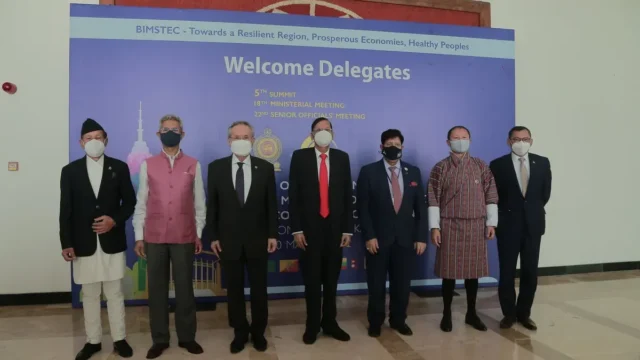
First BIMSTEC Home Ministers Meeting adopts Delhi Declaration on security
India hosted the first BIMSTEC Home Ministers Meeting in New Delhi on 13 October 2026. The seven member States adopted the Delhi Declaration, condemning terrorism including cross-border terrorism, and called for full use of the BIMSTEC anti-terror and mutual legal assistance conventions. A Disaster Management Centre is planned in Jamnagar, Gujarat.
13 Oct 2026