
UPSC Mains 2014 GS Paper 2 Q11: model answer
Do government’s schemes for up-lifting vulnerable and backward communities by protecting required social resources for them, lead to their exclusion in establishing businesses in urban economies?
What the question wants
Discuss whether schemes that protect resources for vulnerable communities end up keeping them out of urban business.
How to structure it
Answer the 'do they?': explain the paradox, give evidence, suggest a way out.
- Protective design
- How it can exclude
- How it may not
- Way forward
How to think it through
Protecting tribal land from sale keeps it safe, but that land cannot be mortgaged, so tribal entrepreneurs get no collateral. Reservation in government jobs pulls the educated into safe jobs, not risky business. That is the paradox. Then Stand-Up India and DICCI show a different route.
Model answer
Tribal land in Fifth Schedule areas cannot usually be sold to non-tribals, a rule meant to stop dispossession. But a bank will not lend against land that cannot be sold. A young tribal entrepreneur from Jharkhand who wants to open a shop in Ranchi often finds that the very law that protects his family keeps him from capital.
Protective schemes
Land transfer restrictions (Fifth Schedule, State laws such as the Chotanagpur Tenancy Act, 1908), reservation in jobs and education, and subsidies for traditional occupations.
How they can lead to exclusion from urban business
- No collateral: protected land cannot be mortgaged, so credit is scarce.
- Job preference: educated SCs and STs move into secure government jobs rather than business.
- Occupation-linked schemes keep people in traditional crafts rather than modern enterprise.
- Networks: urban business runs on caste and kin networks; Dalit entrepreneurs face discrimination from suppliers and customers.
Why the claim is only partly true
- Exclusion from business has older causes: caste discrimination, lack of capital and education.
- Without protection, many would have lost land and livelihood entirely.
- Reservation built a middle class that is now entering business.
Way forward
- Stand-Up India (2016): bank loans of ₹10 lakh to ₹1 crore for SC/ST and women entrepreneurs.
- Public procurement quota of 4% for SC/ST-owned MSEs.
- DICCI and venture funds for SC entrepreneurs.
- Credit guarantees in place of land collateral.
- Skilling and incubation in cities.
Protection should be a floor, not a ceiling: schemes must move from guarding resources to building capability.
Draw: A fence around land (protection) with a locked gate marked 'credit'; the key is labelled 'guarantees and skills'.
Keywords, cases and data to drop in
Fifth Schedule, CNT Act 1908, collateral constraint, Stand-Up India 2016, 4% SC/ST procurement (MSE policy), DICCI, Venture Capital Fund for SCs 2014, Credit Enhancement Guarantee Scheme.
Where most answers lose marks
- Arguing against protection. The question asks whether it has an unintended effect, not whether it should exist.
Related Mains PYQs
- Can the constitutional mandate of rights-based welfare be effectively realised in the context of non-integrated governance and minimal public investment? Examine. UPSC 2026 · GS-II
- Civil Society Organizations are often perceived as being anti-State actors than non-State actors. Do you agree? Justify. UPSC 2025 · GS-II
- The National Commission for Protection of Child Rights has to address the challenges faced by children in the digital era. Examine the… UPSC 2025 · GS-II
- Public charitable trusts have the potential to make India’s development more inclusive as they relate to certain vital public issues. Comment. UPSC 2024 · GS-II
Fresh examples from current affairs
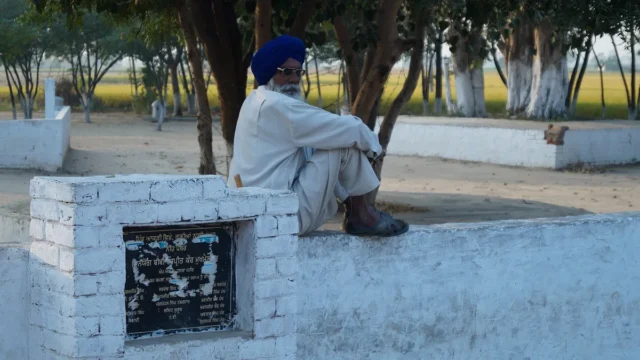
Cabinet extends NSAP to 2030-31 and renames it Pradhan Mantri Samajik Sahayata Yojana
On 14 October 2026 the Union Cabinet extended the National Social Assistance Programme for five years, 2026-27 to 2030-31, with Rs. 53,428 crore. It is renamed Pradhan Mantri Samajik Sahayata Yojana. The disability pension now needs 40% benchmark disability instead of 80%, starts from birth, and pays Rs. 375 or Rs. 625 a month.
UPSC angle: Prelims: launch date, new names, outlay, 40% benchmark, Article 41. · Mains GS-II: welfare schemes for vulnerable sections; DPSPs; rights of persons with disabilities.
14 Oct 2026
EPFO Amnesty Scheme 2026: deadline 28 December for PF Trust regularisation
EPFO is reminding establishments that the Amnesty Scheme, 2026 for retrospective regularisation of Provident Fund Trust exemption status closes on 28 December 2026. It covers trusts recognised under the Income Tax Act but without a formal exemption order under the EPF Act or the Code on Social Security.
UPSC angle: Prelims: Amnesty dates and legal sections. · Mains GS-III: social security and labour compliance.
13 Oct 2026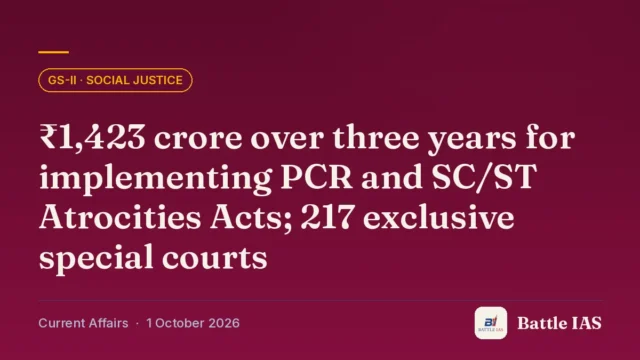
₹1,423 crore over three years for implementing PCR and SC/ST Atrocities Acts; 217 exclusive special courts
The Centre released ₹1,423.30 crore to States and UTs over 2022-23 to 2024-25 to implement the Protection of Civil Rights Act, 1955 and the SC/ST (Prevention of Atrocities) Act, 1989. States report 217 Exclusive Special Courts in 15 States and UTs. Yet 65,646 cases were registered in 2024 and 3,92,006 were pending trial at year end.
UPSC angle: Prelims: PCR Act year; Art. 17. · Mains: Why do atrocity cases see low conviction?
1 Oct 2026
PM-AJAY backgrounder: one merged scheme for Scheduled Caste development
Pradhan Mantri Anusuchit Jaati Abhyuday Yojana (PM-AJAY) is a 100 per cent centrally sponsored scheme of the Social Justice Ministry, launched in 2021-22. It merges three older schemes and works through Adarsh Gram, grants-in-aid and hostels. By 8 September 2026, 18,093 villages had been declared Adarsh Grams.
UPSC angle: Prelims: funding pattern; merged schemes.
28 Sep 2026Learn the concept
Question text as printed in the official UPSC Civil Services (Main) question paper. The model answer is original Battle IAS work; use it to learn structure, not to memorise.
Want every PYQ in one place? See the Battle IAS PYQ Book.