
Chapter 3 · Topic 3.3 · Prelims + Mains3 of 3
British Expansion: The whole chapter
Key points
- Ranjit Singh and the Sikh wars.
- Lapse; Awadh (Prelims 2026); Dalhousie (Mains 2013).
- Stages of paramountcy; 1858 (Prelims 2014).
Prelims box: facts and traps
| Ranjit Singh (1780–1839) | Key facts |
|---|---|
| 1799 | Took Lahore; united the Sikh misls |
| Treaty of Amritsar (1809) | With the British; the Sutlej became the boundary |
| Army | Khalsa army trained by European officers such as Ventura and Allard |
| Conquests | Multan (1818), Kashmir (1819), Peshawar (1834). |
- Other annexations: Sindh (1843, Ellenborough and Charles Napier) and Lower Burma (1852, Second Burma War).
- The Treaty of Yandabo (24 February 1826) ended the First Anglo-Burmese War under Lord Amherst; the second war (1852) ended without any treaty, as Dalhousie annexed Pegu by proclamation (1853).
- Trap (UPSC Prelims 2014): “To regulate East India Company’s trade with India” is incorrect.
- Trap (UPSC Prelims 2026): “The taluqdars were dispossessed of their estates but allowed to retain their arms and forts” is incorrect.
On this page (3 sections)
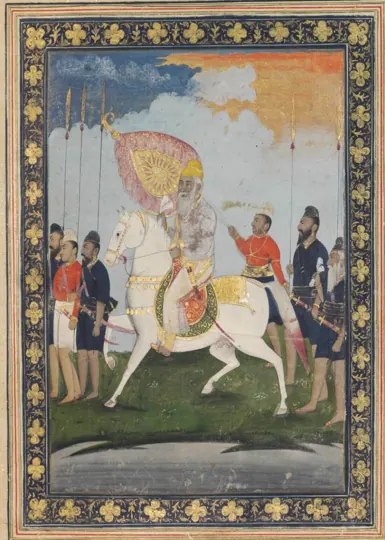
Ranjit Singh and the Anglo-Sikh Wars
| Ranjit Singh (1780–1839) | Key facts |
|---|---|
| 1799 | Took Lahore; united the Sikh misls |
| Treaty of Amritsar (1809) | With the British; the Sutlej became the boundary |
| Army | Khalsa army trained by European officers such as Ventura and Allard |
| Conquests | Multan (1818), Kashmir (1819), Peshawar (1834) |
| War | Key facts |
|---|---|
| First (1845–46) | Battles of Mudki, Ferozeshah, Aliwal, Sobraon; Treaty of Lahore (1846): Jalandhar Doab taken; Kashmir sold to Gulab Singh (Treaty of Amritsar, 1846) |
| Second (1848–49) | Revolt at Multan; Chillianwala, then Gujrat; Punjab annexed by Dalhousie (1849); Duleep Singh pensioned |
Dalhousie: the doctrine of lapse and annexations
Under the doctrine of lapse, a dependent state whose ruler died without a natural heir passed to the British; an adopted son could inherit the ruler’s private property but not the kingdom. Lord Dalhousie (1848–56) applied it widely.
| State | Year |
|---|---|
| Satara | 1848 |
| Jaitpur and Sambalpur | 1849 |
| Baghat | 1850 |
| Udaipur (Chhattisgarh) | 1852 |
| Jhansi | 1853 |
| Nagpur | 1854 |
Awadh was annexed in 1856 on the ground of misgovernment, and Nawab Wajid Ali Shah was exiled to Calcutta. Berar was taken from the Nizam in 1853 for unpaid debts. Pensions and titles, such as Nana Saheb’s, were stopped.
Prelims 2026 asked about British policy in Awadh immediately after its annexation in 1856. Correct: ‘A Summary Revenue Settlement was made in 1856 assuming that the taluqdars were outsiders ‘, and the British wanted to take revenue directly from peasants. Wrong: that taluqdars kept their arms and forts (they were disarmed and their forts pulled down).
Consider the following statements regarding the British policy in Awadh immediately after its annexation in 1856 : 1. The taluqdars were dispossessed of their estates but allowed to retain their arms and forts. 2. A Summary Revenue Settlement was made in 1856 assuming that the taluqdars were outsiders. 3. The British believed in taking revenue directly from the peasants by removing the taluqdars. Which of the statements given above is/are correct ?
- 2 and 3 only
- 1 and 3 only
- 1, 2 and 3
- 2 only
Show answer
Answer: (a) · UPSC provisional key (final key awaited)
Mains 2013: ‘“In many ways, Lord Dalhousie was the founder of modern India. Mains 2013 ” Elaborate.’ Balance railways (1853), the telegraph, the postal reform (1854), the Public Works Department and Wood’s Despatch (1854) against the annexations that fed the revolt of 1857.
“In many ways, Lord Dalhousie was the founder of modern India.” Elaborate.
Stages of British paramountcy
| Stage | Policy |
|---|---|
| Ring fence (Warren Hastings, 1770s–80s) | Defend neighbours’ borders to protect Company lands |
| Subsidiary alliance (Wellesley, 1798–1805) | Bring states under British protection and control |
| Subordinate isolation (Lord Hastings, from 1813) | States subordinate; British paramount |
| Annexation (Dalhousie, 1848–56) | Lapse, misgovernment, war: Punjab, Awadh |
| Subordinate union (after 1858) | No more annexation; princes loyal partners of the Crown |
Other annexations: Sindh (1843, Ellenborough and Charles Napier) and Lower Burma (1852, Second Burma War).
Prelims 2014 asked the objects of Queen Victoria’s Proclamation (1858). Two were correct: ‘To disclaim any intention to annex Indian States ‘ and to place the administration under the Crown. Regulating the Company’s trade was not one (that trade had ended in 1833).
What was/were the object/objects of Queen Victoria’s Proclamation (1858)? 1. To disclaim any intention to annex Indian States 2. To place the Indian administration under the British Crown 3. To regulate East India Company’s trade with India Select the correct answer using the code given below.
- 1 and 2 only
- 2 only
- 1 and 3 only
- 1, 2 and 3
Show answer
Answer: (a) · UPSC official key
Mains box: analysis and answer points
- Under the doctrine of lapse, a dependent state whose ruler died without a natural heir passed to the British; an adopted son could inherit the ruler's private property but not the kingdom.
- Awadh was annexed in 1856 on the ground of misgovernment, and Nawab Wajid Ali Shah was exiled to Calcutta.
- Likely next angle: Punjab annexed 1849
- Asked: Mains 2013 (GS Paper I, 10 marks): In many ways, Lord Dalhousie was the founder of modern India." Elaborate.
Practice
Practice MCQs (8)
After early British setbacks in the Anglo-Nepal War, including the death of General Rollo Gillespie at Nalapani, which commander's campaigns forced the Gorkha general Amar Singh Thapa to surrender and Nepal to accept the Treaty of Sugauli?
Answer (d) & explanation
The war began in 1814 with a four-column British advance. Gillespie was killed on the first day of the siege of Nalapani near Dehradun, and other columns were checked. David Ochterlony, commanding in the western hills, advanced slowly, cut off supplies and brought up heavy guns until Amar Singh Thapa surrendered at Malaun in 1815. When Kathmandu delayed ratifying the peace, Ochterlony led a new campaign in February 1816 by a little-used pass towards Makwanpur, and Nepal then accepted the Treaty of Sugauli. He also saw the value of Nepalese soldiers, and the Nasiri battalion was raised in 1815, the beginning of Gurkha recruitment.
Consider the following pairs: Treaty : War it concluded
1. Treaty of Sugauli : Anglo-Nepal War
2. Treaty of Yandabo : Second Anglo-Burmese War
3. Treaty of Lahore (March 1846) : First Anglo-Sikh War
Which of the pairs given above is/are correctly matched?
Answer (d) & explanation
The Treaty of Sugauli (initialled December 1815, signed 4 March 1816) ended the Anglo-Nepal War fought under Lord Hastings. The Treaty of Yandabo (24 February 1826) ended the First Anglo-Burmese War under Lord Amherst; the second war (1852) ended without any treaty, as Dalhousie annexed Pegu by proclamation (1853). The Treaty of Lahore (9 March 1846), signed for the boy Maharaja Duleep Singh, ended the First Anglo-Sikh War after Sobraon and imposed a heavy war indemnity. So pairs 1 and 3 are correct.
The Tripartite Treaty of 1838, concluded under Lord Auckland before the First Anglo-Afghan War, was signed by the British, Ranjit Singh and
Answer (c) & explanation
Auckland decided to replace the Amir Dost Mohammad, whom he suspected of leaning towards Russia, with the exiled Shah Shuja. The Tripartite Treaty (1838) among the Company, Ranjit Singh and Shah Shuja set the stage for the First Anglo-Afghan War (1839-42), which ended in disaster and Dost Mohammad's return.
After the annexation of the Punjab in 1849, the boy Maharaja Duleep Singh
Answer (a) & explanation
Duleep Singh, Ranjit Singh's youngest son, had been placed on the throne as a child and reigned under regents and then a British Resident after 1846. When Dalhousie annexed the Punjab on 29 March 1849, the ten-year-old was deposed, given a pension and stripped of state property, including the Koh-i-Noor diamond. He was sent from Lahore to Fatehgarh in the care of Dr John Login, became a Christian and went to England in 1854, where he lived for most of his life.
After the First Anglo-Sikh War, the Treaty of Amritsar of March 1846 transferred Kashmir to Gulab Singh of Jammu on payment of a large sum. The Governor-General who concluded it was
Answer (d) & explanation
Lord Hardinge I (1844-48) fought the First Anglo-Sikh War (1845-46). By the Treaty of Lahore the Sikhs ceded the Jalandhar Doab, and by the Treaty of Amritsar (1846) Kashmir was transferred to Gulab Singh for 75 lakh rupees, creating the princely state of Jammu and Kashmir.
After the revolt of 1857, the Doctrine of Lapse was in practice given up. The step by which Lord Canning reassured the Indian princes on this point was that he
Answer (a) & explanation
The Queen's Proclamation promised to respect the rights and dignity of the princes. To make this concrete, Canning issued sanads of adoption (1860-62) to the major rulers, recognising their right to adopt an heir. The princes became pillars of the empire, but annexed states such as Jhansi or Nagpur were not restored, and the Chamber of Princes came only in 1921.
Consider the following pairs of territories annexed during Lord Dalhousie's tenure and the ground or means of annexation:
1. Punjab : Conquest after the Second Anglo-Sikh War
2. Lower Burma (Pegu) : The Second Anglo-Burmese War
3. Berar : The Doctrine of Lapse
4. Nagpur : The Doctrine of Lapse
How many of the pairs given above are correctly matched?
Answer (c) & explanation
Dalhousie annexed Punjab (1849) by conquest and Lower Burma (1852) after the Second Anglo-Burmese War. Nagpur (1854) was taken under the Doctrine of Lapse after Raghuji III died without a natural heir. Berar was not a lapse case: in 1853 the Nizam was made to assign it to the Company to meet the arrears due for the Hyderabad Contingent. So three pairs are correct.
With reference to the Treaty of Sugauli (1816), consider the following statements:
1. Nepal gave up the hill territories west of the Kali river, including Garhwal and Kumaon.
2. Nepal agreed to accept a British Resident at Kathmandu.
3. Nepal was allowed to keep the whole of the Terai lowlands.
Which of the statements given above is/are correct?
Answer (a) & explanation
The Gorkha state had expanded west to Garhwal and Kumaon and pressed into the Terai, which brought it into conflict with the Company. After early reverses, Ochterlony's campaigns forced Nepal to terms. By the Treaty of Sugauli, signed on 4 March 1816, Nepal ceded the hill territories west of the Kali, which became its western boundary, and agreed to a permanent British Resident in Kathmandu. It also had to give up the Terai; part of these lowlands was later returned as a concession, but the treaty did not leave Nepal the whole Terai.
0 / 0 correct
Write an answer
In 150 words, explain the significance of British Expansion with one recent example.
Flashcards (7)
Treaty of Amritsar 1809?
Ranjit Singh and the British; Sutlej boundary.
Punjab annexed?
1849, Dalhousie.
First state taken under lapse?
Satara, 1848.
Ground for annexing Awadh?
Misgovernment, 1856.
Dalhousie's modernising steps?
Railways (1853), telegraph, postal reform (1854), PWD.
Policy of ring fence?
Warren Hastings.
Sindh annexed?
1843, Ellenborough and Napier.
In the news
 Next chapter · 4. Constitutional Development →Constitutional Development: Company acts and Crown rule
Syllabus: GS-I · Modern Indian history from about the middle of the eighteenth century until the…