
UPSC Prelims 2013 · GS Paper I: With reference to the history of Indian rock-cut architecture, consider the following statements :1.…
With reference to the history of Indian rock-cut architecture, consider the following statements :
- 1. The caves at Badami are the oldest surviving rock-cut caves in India.
- 2. The Barabar rock-cut caves were originally made for Ajivikas by Emperor Chandragupta Maurya.
- 3. At Ellora, caves were made for different faiths.
Which of the statements given above is/are correct?
Answer (c) & explanation
Statement 3 only is correct (c). Ellora (Maharashtra) has 34 caves of three faiths side by side: Buddhist, Hindu (including the Kailasa temple) and Jain (3). Statement 1 is wrong: the Badami caves (6th century CE, Chalukyas) are much later; the Barabar caves of Bihar (3rd century BCE) are the oldest. Statement 2 is wrong: the Barabar caves were given to the Ajivikas by Ashoka, and the nearby Nagarjuni caves by his grandson Dasharatha, not by Chandragupta Maurya. So (a), (b) and (d) fail.
Notice the highlights: the Lomas Rishi cave's arched doorway imitates wooden architecture, and the Kailasa temple at Ellora was carved under the Rashtrakuta king Krishna I. Ellora and Ajanta became World Heritage Sites in 1983. Trap: the right caves are given to the wrong Mauryan king.
Answer as per the official UPSC answer key.
Same theme in UPSC Mains
Related questions from other years
The Hallisalasya painting in the Bagh Caves represents :
Answer (a) & explanation
The Hallisalasya painting shows a joyous folk dance (a). The Bagh caves in Madhya Pradesh have murals close in style to Ajanta. The best-known panel shows hallisaka: women dancing in a ring around a male dancer while others play music. Hallisaka is an old folk dance named in Sanskrit texts, and lasya means graceful dance. Option (b) is wrong: it is not the Buddha meditating. Option (c) is wrong: Shiva and Parvati on Kailasha is a theme at Ellora. Option (d) is wrong: it is not Samudramanthan.
Notice Bagh's features: Buddhist caves of the 5th–6th centuries, cut in soft sandstone, near the Bagh river. Many paintings were damaged; some are now kept in the Gwalior museum. The town is also known for Bagh print textiles.
Answer as per the official UPSC answer key.
Which one of the following Carnatic music ragas is similar to Raga Bilawal in Hindustani music ?
Answer (d) & explanation
Dheera Shankarabharanam matches Raga Bilawal (d). Bilawal is the Hindustani thaat with all seven notes natural (shuddha), the same scale as the Western major scale. Its Carnatic twin is Dheera Shankarabharanam, the 29th melakarta. Option (a) is wrong: Nat Bhairavi matches Asavari. Option (b) is wrong: Kamavardhini (Pantuvarali) matches Purvi. Option (c) is wrong: Hanumatodi matches the Hindustani Bhairavi.
Notice the two systems: Hindustani music has ten thaats, classified by V.N. Bhatkhande, while Carnatic music has 72 melakartas, organised by Venkatamakhin. Another easy pair: Kalyan (Yaman) matches Mechakalyani (Kalyani). Trick: match the notes, not the names, since some names, like Bhairavi, mean different scales in the two systems.
Hanumatodi sounds like Todi, but the Carnatic Todi scale is the Hindustani Bhairavi thaat, not Bilawal.
Answer as per the official UPSC answer key.
Which of the following temples has/have a Nagara-style shikhara ?
- 1. Malegitti Shivalaya, Badami
- 2. Huchimalligudi Temple, Aihole
- 3. Dashavatara Temple, Deogarh
- 4. Virupaksha Temple, Pattadakal
Select the answer using the code given below :
Answer (b) & explanation
Huchimalligudi and Deogarh have Nagara-style shikharas (b). Item 3 is right: the Dashavatara temple at Deogarh (Gupta period) had an early northern-style shikhara. Item 2 is right: at Aihole, the Huchimalligudi temple carries a curved Nagara (rekha) tower over its sanctum. Items 1 and 4 are wrong: Malegitti Shivalaya at Badami and the Virupaksha temple at Pattadakal are Dravida temples with stepped vimanas. So options (a), (c) and (d) fail.
Notice why the Chalukya sites matter: Aihole, Badami and Pattadakal were a laboratory where both styles stood side by side. Pattadakal, a UNESCO site, has Nagara temples like Papanatha next to Dravida ones. Vesara later blended the two.
The Chalukyan sites have both styles side by side. Do not mark a temple Dravida only because it stands in Karnataka.
Answer as per the official UPSC answer key.
Which of the following statements on the Amaravati Stupa and its relief sculpture is/are correct ?
- 1. It was located in the lower Krishna valley.
- 2. In India, it was next only to the Sanchi Stupa in size.
- 3. The Amaravati school of sculpture made a lasting impact on the later South Indian sculpture, and its products were carried to Sri Lanka and South-east Asia.
Select the answer using the code given below :
Answer (b) & explanation
Statements 1 and 3 are correct (b). Statement 1 is right: Amaravati stands on the lower Krishna valley in Andhra Pradesh. Statement 3 is right: its fine limestone reliefs shaped later South Indian art, and pieces in its style reached Sri Lanka and South-east Asia. Statement 2 is wrong: Amaravati was one of the largest stupas in India, bigger than the Great Stupa at Sanchi, not second to it. So options (a), (c) and (d) fail.
Notice the patrons: the Satavahanas and later the Ikshvakus, who built Nagarjunakonda. Many Amaravati panels were taken to the British Museum and Chennai museum. Andhra Pradesh's new capital is named Amaravati after it.
Answer as per the official UPSC answer key.
In the news since
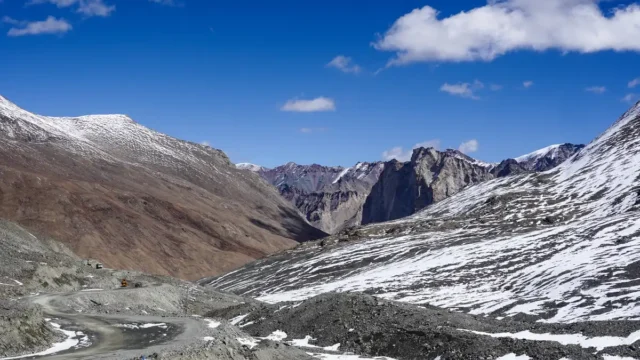
PM inaugurates five Ladakh projects: Nimmu–Padum–Darcha road, Leh terminal, Hanu hydro
On 15 October 2026 the Prime Minister inaugurated, by video conference, five projects worth about ₹3,350 crore in Ladakh: a new passenger terminal at Leh's Kushok Bakula Rimpochee Airport, the 298-km Nimmu–Padum–Darcha road built by BRO, the 9 MW Hanu small hydro project with a 66 kV line, India's first Petroglyph Conservation Park at Sindhu Ghat, and 40 water bodies under Project Him Sarovar.
15 Oct 2026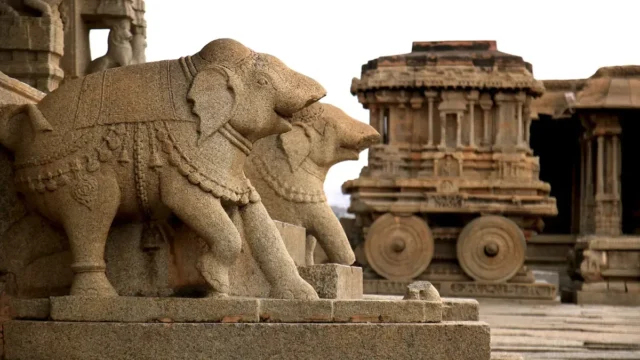
HAL, NCF and ASI sign MoA for Hampi, Taj Mahal and Bekal Fort
On 13 October 2026 HAL, the National Culture Fund and ASI signed an MoA for conservation and visitor works at Hampi, the Taj Mahal and Bekal Fort. HAL has approved about ₹23.60 crore in CSR support over three years; NCF facilitates the projects and ASI supervises them technically.
14 Oct 2026
Centres of Excellence approved for five newer classical languages
On 3 October 2026 the Ministry of Education approved five Centres of Excellence for Classical Assamese, Bengali, Marathi, Pali and Prakrit, hosted by Tezpur University, Visva-Bharati, Deccan College Pune, Central University of Odisha and Central University of Gujarat. These five got classical status in October 2024, taking India's total to 11 classical languages.
3 Oct 2026