
73rd Constitutional Amendment Act, 1992: Part IX, Compulsory and Voluntary Provisions, Eleventh Schedule and Gaps (UPSC Notes + PYQs)
UPSC has already asked about this. Read the story with these questions in mind.
- Prelims 2011The Constitution (Seventy-Third Amendment) Act, 1992, which aims at promoting the Panchayati Raj Institutions in the country, provides for which of the following ?Solve it below ↓
- Prelims 2013Consider the following statements: National Development Council is an organ of the Planning Commission. …Solve it below ↓
Why it was needed
Article 40 (a Directive Principle) asked States to organise village panchayats, but for four decades panchayats were superseded at will, elections were skipped and funds were thin. The Balwantrai Mehta (1957), Ashok Mehta (1978) and L.M. Singhvi (1986) committees all pushed for stronger local bodies. The 64th Amendment Bill (1989) failed in the Rajya Sabha; the P.V. Narasimha Rao government passed the 73rd in 1992. 24 April is National Panchayati Raj Day.
Compulsory provisions
- Gram Sabha in every village (Article 243A).
- Three tiers: village, intermediate, district; States with population below 20 lakh may skip the middle tier.
- Direct election of members at all levels.
- Reservation for SCs and STs in proportion to population, and not less than one-third of seats and chairperson posts for women.
- Five-year term; fresh elections within six months of dissolution.
- State Election Commission (243K) and State Finance Commission every five years (243I).
- Minimum age of 21 to contest.
- Gram SabhaAll adult voters of the village
- Gram PanchayatVillage level
- Panchayat SamitiBlock level
- Zila ParishadDistrict level
- SECElections (243K)
- SFCFinances (243I)
Voluntary provisions
Left to States: reservation for backward classes, giving MPs and MLAs a place in panchayats, how chairpersons of the middle and top tiers are chosen, devolution of the 29 subjects, and powers to tax. More than 20 States have raised women’s reservation to 50%.
Exempted areas and PESA
Part IX does not apply to Nagaland, Meghalaya, Mizoram, hill areas of Manipur, and Scheduled and tribal areas (Article 243M). Parliament extended it to Fifth Schedule areas with changes through PESA, 1996, which gives the Gram Sabha power over minor forest produce, land alienation and local plans.
Panchayat finances: where the money comes from
A panchayat is only as strong as its purse. Article 243H lets State legislatures authorise panchayats to levy taxes, duties, tolls and fees and to receive grants, and Article 243-I requires a State Finance Commission every five years to recommend how State revenue should be shared with them. In practice, most panchayats raise very little of their own money; property tax and fees on markets or water are often not collected at all, because elected heads fear losing votes. The bulk of their funds comes from above: grants under the Union Finance Commission, which since the 14th Commission have gone directly to gram panchayats, and money tied to central schemes such as MGNREGA, the Jal Jeevan Mission and Swachh Bharat. The 15th Finance Commission allotted about ₹2.36 lakh crore to rural local bodies for 2021-26, with a large share “tied” to water and sanitation. Many States have delayed constituting their State Finance Commissions or ignored their reports, a point the Comptroller and Auditor General and the Ministry of Panchayati Raj have repeatedly noted. Without steady untied funds, panchayats end up as agents that implement schemes rather than governments that set their own priorities.
The “three Fs” test
Experts judge devolution by whether States have handed panchayats the three Fs: functions (the 29 subjects of the Eleventh Schedule), funds to perform them, and functionaries, the staff to do the work. The Ministry of Panchayati Raj’s devolution index ranks States on these. Kerala, which transferred about a third of its plan budget and many staff to local bodies in its 1996 People’s Plan Campaign, usually leads, with Karnataka, Maharashtra and Tamil Nadu close behind. States that devolve functions on paper but keep staff and money with line departments score poorly. The index is a useful frame for Mains answers on why panchayats remain weak despite constitutional status.
- 1957Balwantrai Mehta Committee
- 1959Nagaur, Rajasthan: first panchayat system
- 1978Ashok Mehta Committee
- 198964th Amendment Bill fails in Rajya Sabha
- 199273rd Amendment passed
- 1993In force, 24 April
- 1996PESA extends Part IX to Scheduled Areas
Gaps after three decades
The “three Fs” (functions, funds, functionaries) are still weakly devolved in most States. Panchayats raise little own revenue, State Finance Commission reports are delayed, and “sarpanch-pati” (husbands acting for elected women) persists, though many elected women have become effective leaders.
The committees behind the amendment
| Committee (year) | Key recommendation |
|---|---|
| Balwantrai Mehta (1957) | Three-tier “democratic decentralisation”; Rajasthan first (Nagaur, 2 October 1959) |
| Ashok Mehta (1977-78) | Two tiers (Zila Parishad and Mandal Panchayat); party participation |
| G.V.K. Rao (1985) | District as the key unit for planning |
| L.M. Singhvi (1986) | Constitutional recognition of panchayats |
| P.K. Thungon (1988) | Constitutional status, five-year term |
Article map of Part IX
243 definitions; 243A Gram Sabha; 243B three tiers; 243C composition; 243D reservation; 243E duration; 243F disqualifications; 243G powers and responsibilities (with the Eleventh Schedule); 243H taxes and funds; 243I Finance Commission; 243J audit; 243K State Election Commission; 243L UTs; 243M exempted areas; 243N continuance of existing laws for one year; 243O bar on courts in electoral matters.
What the data shows
About 2.6 lakh gram panchayats and roughly 31 lakh elected representatives, of whom around 14 lakh are women, sit in Indian panchayats. The 15th Finance Commission gave rural local bodies ₹2.36 lakh crore for 2021-26, 60% of it “tied” to water and sanitation. Studies, including the Ministry of Panchayati Raj’s devolution index, show large gaps between States: Kerala, Karnataka and Maharashtra devolve much more than most northern States.
Judgments
- K. Krishna Murthy (2010): reservation for backward classes in local bodies is valid but needs empirical data.
- Vikas Kishanrao Gawali (2021): the “triple test” (dedicated commission, quantification, 50% ceiling) before OBC reservation in local bodies.
- Rajbala v State of Haryana (2015): educational and toilet conditions for candidates upheld.
Way forward
Devolve the three Fs in activity maps, give panchayats a fixed share of State revenue, build cadres of panchayat staff, hold timely SFC reports, use e-Gram Swaraj and audits to build trust, and end proxy representation through training and social pressure.
PYQ trend
Prelims asks mandatory provisions (2011), constitutional planning roles (2013) and PESA. Mains asks about local governance in general; prepare one answer on “three Fs” with data.
73rd Amendment: UPSC angle
For UPSC CSE
Prelims: articles, schedule, compulsory vs voluntary provisions, exempted areas. Mains GS-II: devolution, fiscal health of panchayats, women’s leadership.
73rd Amendment UPSC PYQs (Prelims)
Questions UPSC has actually asked, from the official papers. Pick an option to check yourself.
The Constitution (Seventy-Third Amendment) Act, 1992, which aims at promoting the Panchayati Raj Institutions in the country, provides for which of the following ?
– 1. Constitution of District Planning Committees.
– 2. State Election Commissions to conduct all panchayat elections.
– 3. Establishment of State Finance Commissions.
Select the correct answer using the codes given below :
The 73rd Amendment provides State Election Commissions (Article 243K) and State Finance Commissions (Article 243I) for panchayats. District Planning Committees come from the 74th Amendment (Article 243ZD, in the municipalities part). So 2 and 3 only. Answer as per the official UPSC key · Battle IAS PYQ bankAnswer (c) & why
Consider the following statements :
– 1. National Development Council is an organ of the Planning Commission.
– 2. The Economic and Social Planning is kept in the Concurrent List in the Constitution of India.
– 3. The Constitution of India prescribes that Panchayats should be assigned the task of preparation of plans for economic development and social justice.
Which of the statements given above is/are correct?
Economic and social planning is Entry 20 of the Concurrent List, and Art. 243G lets States give panchayats the task of preparing plans for economic development and social justice. The NDC was a separate body set up in 1952, not an organ of the Planning Commission. Answer as per the official UPSC key · Battle IAS PYQ bankAnswer (b) & why
Mains PYQs on this topic
No UPSC Mains question from 2023-2026 is directly on this topic. Older papers (2013-2022) will be added as the Mains bank grows.
Quick quiz
The Eleventh Schedule contains
The Twelfth has 18 for municipalities.Answer (b)
A State may skip the intermediate tier if its population is below
Article 243B.Answer (b)
Which is a voluntary provision of the 73rd Amendment?
States may provide it.Answer (c)
FAQs
When did the 73rd Amendment come into force?
On 24 April 1993.
Who conducts panchayat elections?
The State Election Commission, not the Election Commission of India.
What is the role of the State Finance Commission?
It reviews panchayat finances and recommends sharing of State taxes and grants, every five years.
Does the 73rd Amendment apply to all of India?
No. Some north-eastern States and Scheduled Areas are exempt, with PESA covering Fifth Schedule areas.
Who is a member of the Gram Sabha?
Every person on the electoral roll of the village panchayat area.
Is reservation for OBCs in panchayats compulsory?
No. It is left to States, subject to the triple test laid down by the Supreme Court.
Spotted an error? Tell us. We correct within 48 hours.
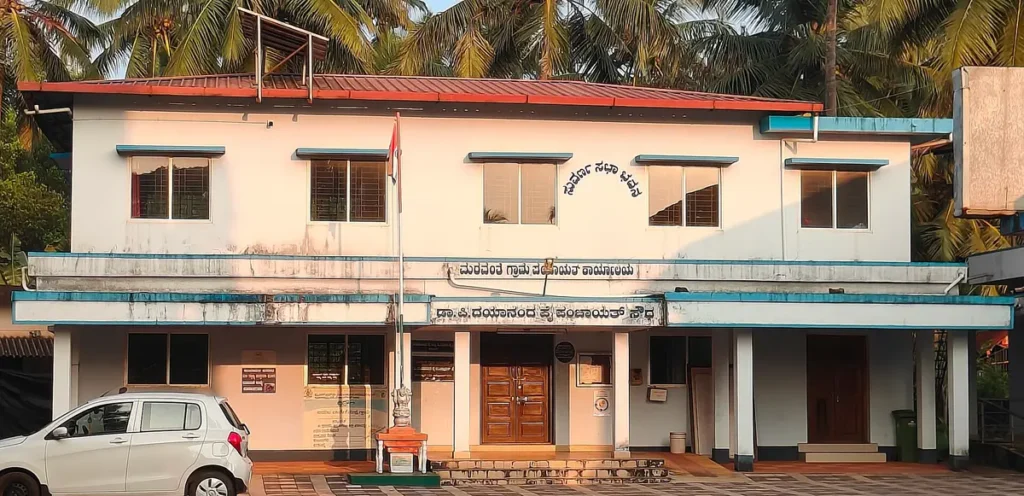
Image: Rohan Pinto, Wikimedia Commons, CC BY-SA 4.0
How to use this in Mains
If asked: Three decades after the 73rd Amendment, panchayats remain weak. Why? (GS-II)
Quote: “The “three Fs” (functions, funds, functionaries) are still weakly devolved in most States.”
Use it: Your central argument: the three Fs.
In the news
VB–G RAM G: 375 permissible rural works notified, 41% more than the previous scheme
The Rural Development Ministry has notified 375 permissible works under the VB-G RAM G Act, 2025, the law that replaced MGNREGA. That is 41% more than the 266 works earlier. Works fall under four pillars: water security (128), core rural infrastructure (111), livelihood infrastructure (98) and disaster preparedness (38), all planned through Gram Sabha-approved village plans.
6 Oct 2026
16th Finance Commission recommends ₹4.35 lakh crore for rural local bodies
The Sixteenth Finance Commission has recommended grants of ₹4,35,236 crore for rural local bodies in all 28 States for 2026-31, the Panchayati Raj Ministry told Rajya Sabha on 12 August 2026. Basic and performance grants are in the ratio 80:20. Half the basic grant is tied to sanitation and water; the rest is untied.
12 Aug 2026
SVAMITVA: drone mapping for rural property rights
SVAMITVA gives property owners in rural inhabited (abadi) areas a Record of Rights, the Panchayati Raj Minister told Rajya Sabha on 5 August 2026. Drone surveys with CORS technology create high-accuracy maps. Drone survey is complete in 3.30 lakh villages, and 11,147 loans worth ₹1,713 crore have been given against SVAMITVA property cards.
5 Aug 2026
Eight constitutional amendments in the last 12 years
The Law Ministry told Lok Sabha on 25 July 2026 that the Constitution was amended eight times in the last twelve years. The list runs from the 99th Amendment Act, 2014 (NJAC) to the 106th Amendment Act, 2023 (women's reservation in the Lok Sabha and State Assemblies).
25 Jul 2026