
UPSC Mains 2025 GS1 Q4: model answer
How are climate change and the sea level rise affecting the very existence of many island nations? Discuss with examples.
What the question wants
Show the threats sea-level rise and climate change pose to small island states, with named examples, and note responses.
How to structure it
Intro: SIDS emit little but face existential risk. Body: land loss, salinity, storms, economy, statehood and migration, with examples. Conclusion: adaptation and finance.
- 1Land loss
- 2Salinity
- 3Storms
- 4Economy
- 5Statehood and migration
- 6With examples
Model answer
Small island developing states (SIDS) emit under 1% of global greenhouse gases, yet many are only 1–3 metres above sea level. The IPCC projects further sea-level rise this century even in low-emission scenarios.
- Land loss: Tuvalu, Kiribati and the Marshall Islands face shrinking atolls and coastal erosion.
- Fresh water: seawater enters thin freshwater lenses; storm surges salt the soil (Kiribati, Maldives).
- Stronger cyclones: Cyclone Pam (2015) hit Vanuatu, damage near two-thirds of its GDP.
- Coral bleaching: weakens natural reef barriers and fisheries and tourism.
- Statehood and people: the Falepili Union (2023) gives Tuvaluans a migration pathway to Australia; Kiribati bought land in Fiji (2014) for food security.
Responses: the Maldives' raised island Hulhumalé, Tuvalu's digital nation project, the Loss and Damage Fund agreed at COP27, and the ICJ advisory opinion on states' climate duties (2025).
India can help through ISA, CDRI and its IRIS initiative for island resilience.
Keywords, cases and data to drop in
SIDS Tuvalu Falepili Union 2023 Kiribati land in Fiji Cyclone Pam 2015 freshwater lens Loss and Damage Fund CDRI-IRIS
Where most answers lose marks
- Writing about climate change generally without island examples.
- Only listing problems, with no response or way forward.
- Overstating precise sea-level numbers.
Fresh examples from current affairs

Pre-COP31 in Fiji: India seeks “flexibility, pragmatism and mutual respect” and scaled-up climate finance
At the Pre-COP31 meeting in Nadi, Fiji, India's Environment Minister asked for flexibility, pragmatism and mutual respect so that COP31 gives an ambitious and balanced result. India said higher ambition must come with climate finance, technology and capacity building, and that each country's path must be respected. COP31 is in Antalya, Türkiye, in November.
UPSC angle: Prelims: COP venues, Paris articles. · Mains GS-III: climate change; GS-II: international agreements.
8 Oct 2026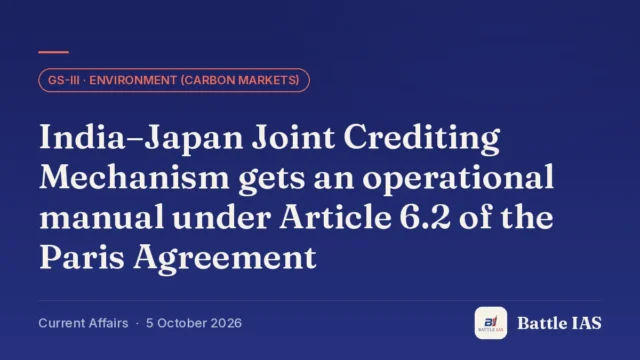
India–Japan Joint Crediting Mechanism gets an operational manual under Article 6.2 of the Paris Agreement
India and Japan launched the Operational Manual for their Joint Crediting Mechanism in New Delhi on 30 September 2026. Under Article 6.2 of the Paris Agreement, the mechanism lets Japanese low-carbon technology be deployed in India and the resulting emission cuts be issued as credits. The manual sets the full project cycle, from idea note to credit issuance.
UPSC angle: Prelims: Article 6 sub-parts. · Mains GS-III: carbon markets.
5 Oct 2026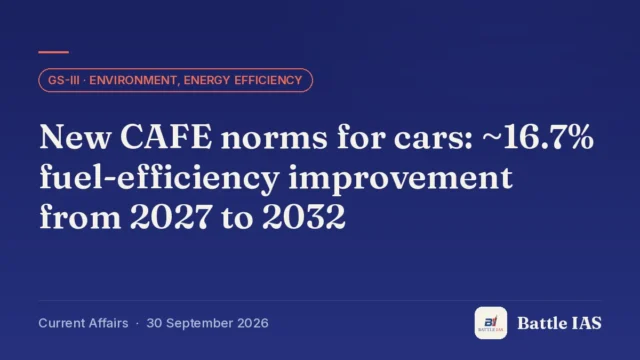
New CAFE norms for cars: ~16.7% fuel-efficiency improvement from 2027 to 2032
On 30 September 2026 the Ministry of Power notified new Corporate Average Fuel Economy (CAFE) norms for passenger vehicles, in force from 1 April 2027 to 31 March 2032. The fuel-use benchmark tightens from 3.996 to 3.3273 litres per 100 km, an improvement of about 16.7 per cent, and the reference weight rises to 1,229 kg.
UPSC angle: Prelims: CAFE notifying ministry (Power, under the Energy Conservation Act). · Mains: Fleet-average standards as a nudge to EVs and hybrids.
30 Sep 2026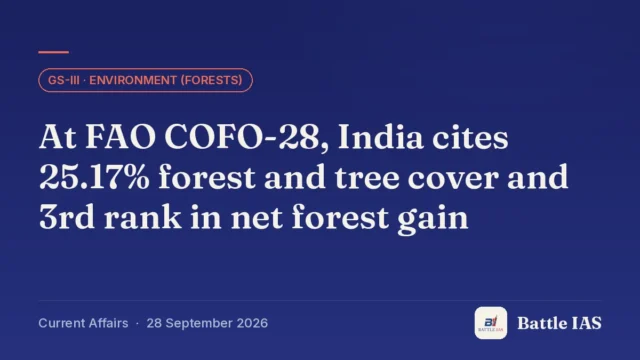
At FAO COFO-28, India cites 25.17% forest and tree cover and 3rd rank in net forest gain
At the 28th session of the FAO Committee on Forestry in Rome (28 September to 2 October 2026), India said its forest and tree cover is 82.74 million hectares, or 25.17 per cent of its area. FAO's Global Forest Resources Assessment 2025 ranks India 9th in forest area and 3rd in net annual forest gain.
UPSC angle: Prelims: forest cover %, FRA ranks. · Mains: Quality vs quantity of forest cover.
28 Sep 2026Learn the concept
Question text as printed in the official UPSC question paper: https://www.upsc.gov.in/sites/default/files/GENERAL-STUDIES-PAPER%20I-QP-CSM-25-010925.pdf The model answer is original Battle IAS work; use it to learn structure, not to memorise.