
Green Hydrogen: Colours of Hydrogen, Electrolysis, National Green Hydrogen Mission, Uses, Costs and Challenges (UPSC Notes + PYQs)

UPSC has already asked about this. Read the story with these questions in mind.
- Prelims 2023Consider the following heavy industries: Fertilizer plants …Solve it below ↓
- Prelims 2015With reference to ‘fuel cells’ in which hydrogen-rich fuel and oxygen are used to generate electricity, consider the following statementsSolve it below ↓
See all 5 PYQs
- Prelims 2019In the context of proposals to the use of hydrogen-enriched CNG (H-CNG) as fuel for buses in public transport, consider the following statementsSolve it below ↓
- Prelims 2026Which of the following statements with regard to Green Hydrogen is/are correct ?Solve with answer →
- Prelims 2023With reference to green hydrogen, consider the following statements: It can be used directly as a fuel for internal combustion. …Solve with answer →
Why hydrogen
Electricity from solar and wind can clean up much of the economy, but not all of it. Steel needs a chemical reducing agent, fertiliser plants need hydrogen to make ammonia, refineries use hydrogen to remove sulphur, and long-haul shipping and aviation need dense fuels. Hydrogen fits these “hard-to-abate” sectors: burnt or used in a fuel cell, it produces only water. It can also store surplus renewable power for later use. India already consumes about 6 million tonnes of hydrogen a year, almost all of it made from natural gas or coal, mainly in refineries and fertiliser units.
The colours of hydrogen
| Colour | How it is made | Emissions |
|---|---|---|
| Grey | Steam methane reforming of natural gas | High (about 9-12 kg CO2 per kg H2) |
| Brown / black | Gasification of coal or lignite | Highest |
| Blue | Grey hydrogen with carbon capture and storage | Lower, depends on capture rate |
| Green | Electrolysis powered by renewables, or biomass routes | Near zero |
| Pink | Electrolysis powered by nuclear energy | Near zero |
| Turquoise | Methane pyrolysis, leaving solid carbon | Low if the heat is clean |
India defined green hydrogen through the Green Hydrogen Standard (August 2023): well-to-gate emissions of not more than 2 kg CO2 equivalent per kg of hydrogen, averaged over 12 months. Hydrogen from biomass can also qualify.
Electrolysis basics
An electrolyser passes direct current through water, splitting it into hydrogen at the cathode and oxygen at the anode. Three types matter: alkaline (mature and cheaper), proton exchange membrane or PEM (compact, responds quickly to variable solar and wind but uses platinum-group metals), and solid oxide (high temperature, high efficiency, still early). Each kilogram of hydrogen needs about 50-55 kWh of electricity and about 9 litres of pure water in theory, more in practice after purification. Most of the cost of green hydrogen is the cost of the electricity and of the electrolyser, which is why cheap Indian solar power is seen as an advantage.
- 1Solar or wind power
- 2Electrolyser splits water
- 3Hydrogen stored or piped
- 4Combined with nitrogen to make ammonia
- 5Used in fertiliser, shipping or exported
National Green Hydrogen Mission
Approved by the Union Cabinet on 4 January 2023 and run by the Ministry of New and Renewable Energy, the Mission has an outlay of ₹19,744 crore up to 2029-30:
- SIGHT (Strategic Interventions for Green Hydrogen Transition), ₹17,490 crore: incentives for domestic manufacturing of electrolysers and for producing green hydrogen, awarded through competitive bids.
- Pilot projects, ₹1,466 crore: steel, mobility (buses and trucks), shipping, and decentralised uses.
- R&D, ₹400 crore, and other components, ₹388 crore.
Targets for 2030: 5 MMT of green hydrogen a year, about 125 GW of linked renewable capacity, over ₹8 lakh crore of investment, about 6 lakh jobs, a cut of about 50 MMT of CO2 a year and savings of over ₹1 lakh crore in fossil fuel imports. Green hydrogen hubs are planned at ports such as Deendayal (Kandla), Paradip and V.O. Chidambaranar (Tuticorin), where production can be tied to export as green ammonia.
- 5 MMTGreen hydrogen a year
- 125 GWLinked renewables
- ₹8 lakh croreInvestment
- 6 lakhJobs
- 50 MMTCO2 avoided a year
Uses
- Refineries and fertilisers: replace grey hydrogen directly; easiest first market.
- Green ammonia: fertiliser feedstock, shipping fuel and a way to carry hydrogen for export.
- Steel: direct reduction of iron ore with hydrogen instead of coke.
- Mobility: fuel-cell buses and trucks; hydrogen-blended CNG (H-CNG) was tested in Delhi.
- Power: long-duration storage and blending in gas turbines.
Challenges
- Cost: green hydrogen costs roughly USD 4-5 per kg against about USD 1.5-2 for grey hydrogen.
- Storage and transport: hydrogen is the lightest element; it must be compressed, liquefied at -253°C or converted to ammonia, and it can make steel pipelines brittle.
- Water in dry regions where solar is best.
- Electrolyser supply chain dominated by China and Europe.
- Demand: buyers sign long-term contracts only at lower prices; mandates are being considered for refineries and fertilisers.
- Safety: hydrogen is highly flammable and leaks easily; it is also an indirect greenhouse gas when leaked.
Way forward
Use demand mandates in a phased way, cut electricity costs through round-the-clock renewable supply and transmission waivers, build hubs that share infrastructure, back domestic electrolyser manufacturing, set safety codes, and sign export deals (Europe, Japan, Singapore) for green ammonia.
Green ammonia and exports
Hydrogen is hard to store and ship, so much of India’s green hydrogen is expected to travel as green ammonia or be used to make green steel and fertiliser at home. Ports such as Kandla, Paradip and Tuticorin are being developed as green hydrogen hubs, and the Solar Energy Corporation of India has run auctions for green ammonia supply to fertiliser plants. Europe, Japan and Singapore are potential buyers, provided India meets their certification standards.
PYQ trend
Prelims 2023 asked which heavy industries green hydrogen can decarbonise (fertilisers, refineries and steel: all three). Fuel cells (2015) and H-CNG (2019) were asked earlier. In Mains, use it in GS-III answers on energy transition and industrial policy.
Green Hydrogen: UPSC angle
For UPSC CSE
Prelims: colours, electrolysis, fuel cells, mission figures. Mains GS-III: energy transition, industrial decarbonisation, exports.
Green Hydrogen UPSC PYQs (Prelims)
Questions UPSC has actually asked, from the official papers. Pick an option to check yourself.
Consider the following heavy industries :
– 1. Fertilizer plants
– 2. Oil refineries
– 3. Steel plants
Green hydrogen is expected to play a significant role in decarbonizing how many of the above industries?
Fertilizer plants use hydrogen to make ammonia, and refineries use it to remove sulphur; both now use “grey” hydrogen from natural gas. Steel plants can use hydrogen in place of coking coal to reduce iron ore. Green hydrogen can cut emissions in all three. Answer as per the official UPSC key · Battle IAS PYQ bankAnswer (c) & why
With reference to ‘fuel cells’ in which hydrogen-rich fuel and oxygen are used to generate electricity, consider the following statements :
– 1. If pure hydrogen is used as a fuel, the fuel cell emits heat and water as by-products.
– 2. Fuel cells can be used for powering buildings and not for small devices like laptop computers.
– 3. Fuel cells produce electricity in the form of Alternating Current (AC).
Which of the statements given above is/are correct?
A hydrogen fuel cell combines H₂ and O₂ electrochemically and gives off only water and heat. Its output is direct current, which an inverter changes to AC. Fuel cells come in all sizes, from micro cells for laptops to megawatt units for buildings. Answer as per the official UPSC key · Battle IAS PYQ bankAnswer (a) & why
In the context of proposals to the use of hydrogen-enriched CNG (H-CNG) as fuel for buses in public transport, consider the following statements :
– 1. The main advantage of the use of H-CNG is the elimination of carbon monoxide emissions.
– 2. H-CNG as fuel reduces carbon dioxide and hydrocarbon emissions.
– 3. Hydrogen up to one-fifth by volume can be blended with CNG as fuel for buses.
– 4. H-CNG makes the fuel less expensive than CNG.
Which of the statements given above is/are correct?
H-CNG mixes about 18-20% hydrogen into CNG. Burning less carbon lowers CO2 and hydrocarbon emissions, and cuts carbon monoxide by up to about 70%, but does not remove it. Hydrogen costs more than natural gas, so the blend is dearer. Answer as per the official UPSC key · Battle IAS PYQ bankAnswer (b) & why
Mains PYQs on this topic
No UPSC Mains question from 2023-2026 is directly on this topic. Older papers (2013-2022) will be added as the Mains bank grows.
Quick quiz
Hydrogen produced from natural gas with carbon capture is called
Blue hydrogen is grey hydrogen with CCS.Answer (b)
India’s Green Hydrogen Standard sets a limit of
Well-to-gate, averaged over 12 months.Answer (b)
The production target of the National Green Hydrogen Mission for 2030 is
5 million tonnes per annum.Answer (c)
FAQs
Is green hydrogen a fuel or a carrier?
It is an energy carrier: energy from renewables is stored in it and released later.
What is SIGHT?
Strategic Interventions for Green Hydrogen Transition, the incentive part of the mission for electrolysers and green hydrogen output.
Why convert hydrogen into ammonia?
Ammonia is easier to store and ship and is itself a fertiliser and fuel.
Does a fuel cell burn hydrogen?
No. It combines hydrogen and oxygen electrochemically to make electricity, with water and heat as by-products.
Why is green hydrogen costly?
Mostly because of electricity and electrolyser costs; both are falling.
Spotted an error? Tell us. We correct within 48 hours.
Image: Solargis, Wikimedia Commons, Attribution
How to use this in Mains
If asked: What are the challenges to scaling up green hydrogen in India? (GS-III)
Quote: “Cost: green hydrogen costs roughly USD 4-5 per kg against about USD 1.5-2 for grey hydrogen.”
Use it: The opening challenge: cost gap with grey hydrogen.
In the news
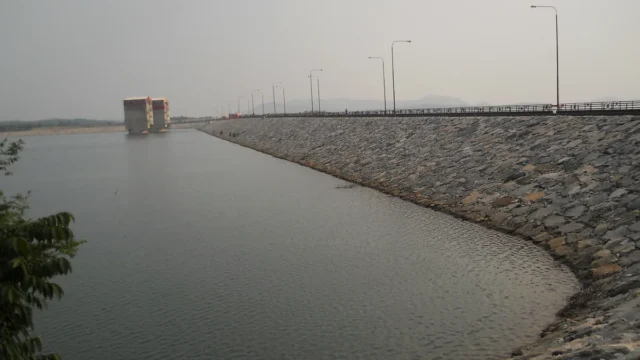
Pumped storage hydropower: India’s roadmap for 100 GW of ‘water batteries’ by 2035-36
A PIB backgrounder of 19 October 2026 explains how pumped storage projects (PSPs) will store solar and wind power for India’s grid. India runs 7.43 GW of pumped storage today, is building 15.87 GW more and has an assessed potential of 345.38 GW. A roadmap aims to add about 100 GW between 2025-26 and 2035-36.
19 Oct 2026
Oil companies bar sugar-based ethanol for 2026-27; maize incentive cut to ₹2.79 a litre
The oil marketing companies have kept sugar out of India’s ethanol programme for the coming year. The tender issued on 16 October 2026 seeks about 11 billion litres of ethanol for the 2026-27 supply year, but asks for none made from sugarcane juice, sugar syrup or B-heavy molasses, because the Government wants sugar diversion for ethanol cut to zero. Grain must now carry the load, and even the maize incentive has been cut. Read this as a live example of the food-versus-fuel trade-off.
18 Oct 2026
Pre-COP31 in Fiji: India seeks “flexibility, pragmatism and mutual respect” and scaled-up climate finance
At the Pre-COP31 meeting in Nadi, Fiji, India's Environment Minister asked for flexibility, pragmatism and mutual respect so that COP31 gives an ambitious and balanced result. India said higher ambition must come with climate finance, technology and capacity building, and that each country's path must be respected. COP31 is in Antalya, Türkiye, in November.
8 Oct 2026
Metal-free porous catalyst could cut cost of zinc–air batteries and fuel cells
Scientists from S.N. Bose Centre Kolkata, INST Mohali and SRM University Amaravati made a metal-free porous organic catalyst, TTT-DHTD, for the oxygen reduction reaction in zinc-air batteries. It reached about 96% of commercial platinum's performance and stayed stable for 120 hours. Replacing platinum could cut the cost of zinc-air batteries and fuel cells.
7 Oct 2026