
UPSC Mains 2024 GS3 Q11: model answer
Discuss the merits and demerits of the four ‘Labour Codes’ in the context of labour market reforms in India. What has been the progress so far in this regard?
What the question wants
The four codes, their pros and cons, and implementation status.
How to structure it
Intro: 29 laws merged into four codes. Body: (1) the four codes; (2) merits for workers and business; (3) demerits and union concerns; (4) progress of rules and notification. Conclusion: implement with social dialogue.
- 1(1) the four codes
- 2(2) merits for workers and business
- 3(3) demerits and union concerns
- 4(4) progress of rules and notification
Model answer
Based on the Second National Commission on Labour (2002), 29 central labour laws were merged into four codes in 2019–20.
The codes
- Code on Wages, 2019
- Industrial Relations Code, 2020
- Code on Social Security, 2020
- Occupational Safety, Health and Working Conditions Code, 2020
Merits
- Simpler compliance: single registration, licence and return.
- Universal minimum wage and a national floor wage.
- Social security for gig and platform workers for the first time.
- Fixed-term employment with equal benefits.
- Inspector-cum-facilitator; decriminalisation of minor offences.
- Women allowed in night shifts with safeguards.
Demerits
- Lay-off and closure need permission only in firms with 300+ workers (earlier 100); unions fear hire-and-fire.
- 60 days' strike notice in all establishments restricts the right to strike.
- Social security for informal workers depends on schemes not yet funded.
- Passed with little debate; trade unions opposed.
- Labour is in the Concurrent List, so State rules vary.
Progress
- Most States and UTs pre-published draft rules.
- e-Shram portal registered over 30 crore unorganised workers.
- The Union government brought all four codes into force on 21 November 2025.
The codes can formalise India's workforce if flexibility for firms is matched by real security for workers.
Keywords, cases and data to drop in
29 laws national floor wage gig workers 300 threshold e-Shram
Where most answers lose marks
- Not naming the four codes.
Fresh examples from current affairs
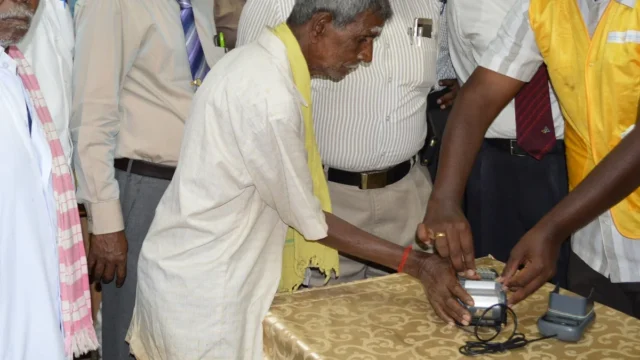
Financial inclusion saturation campaign in 2.70 lakh panchayats and ULBs from 21 October
The Department of Financial Services will run a nationwide campaign from 21 October to 31 December 2026 to saturate financial inclusion schemes in 2.70 lakh gram panchayats and urban local bodies. Bank camps will enrol people in PMJJBY, PMSBY and APY, open Jan Dhan accounts, finish re-KYC and nominations, and spread awareness on digital frauds and unclaimed deposits.
UPSC angle: Prelims: scheme parameters of PMJJBY, PMSBY, APY, PMJDY. · Mains GS-III: inclusive growth and financial inclusion.
20 Oct 2026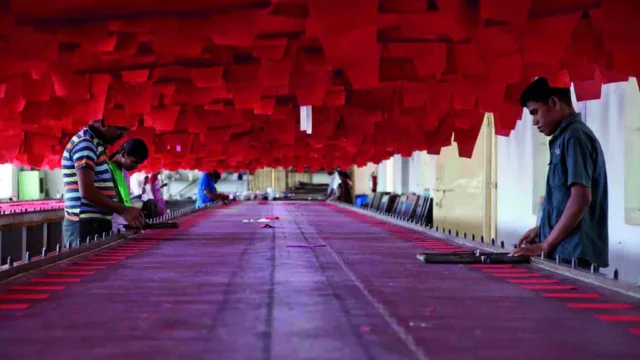
EPFO Amnesty Scheme 2026: deadline 28 December for PF Trust regularisation
EPFO is reminding establishments that the Amnesty Scheme, 2026 for retrospective regularisation of Provident Fund Trust exemption status closes on 28 December 2026. It covers trusts recognised under the Income Tax Act but without a formal exemption order under the EPF Act or the Code on Social Security.
UPSC angle: Prelims: Amnesty dates and legal sections. · Mains GS-III: social security and labour compliance.
13 Oct 2026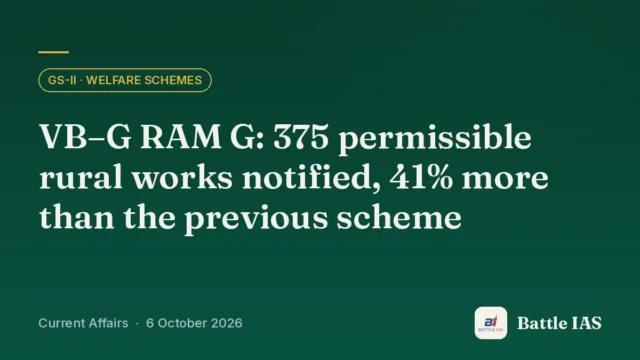
VB–G RAM G: 375 permissible rural works notified, 41% more than the previous scheme
The Rural Development Ministry has notified 375 permissible works under the VB-G RAM G Act, 2025, the law that replaced MGNREGA. That is 41% more than the 266 works earlier. Works fall under four pillars: water security (128), core rural infrastructure (111), livelihood infrastructure (98) and disaster preparedness (38), all planned through Gram Sabha-approved village plans.
UPSC angle: Prelims: Act name, 125 days, works count. · Mains GS-II: welfare schemes; GS-III: rural employment.
6 Oct 2026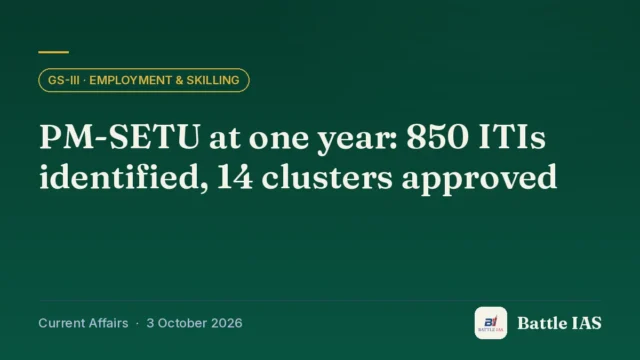
PM-SETU at one year: 850 ITIs identified, 14 clusters approved
PM-SETU, launched on 4 October 2025 to upgrade 1,000 Government ITIs through a hub-and-spoke model, has identified 850 ITIs and approved 14 ITI clusters worth ₹3446 crore in its first year. The scheme has a ₹60,000 crore outlay shared by the Centre, States and industry, and also upgrades five NSTIs.
UPSC angle: Prelims: PM-SETU expansion; hub-and-spoke. · Mains: Making ITIs industry-relevant.
3 Oct 2026Learn the concept
Question text as printed in the official UPSC question paper: https://www.upsc.gov.in/sites/default/files/QP_CSM_2024_GenStud_III_03102024.pdf The model answer is original Battle IAS work; use it to learn structure, not to memorise.