
Financial Inclusion in India: Meaning, Jan Dhan, Payments and Small Finance Banks, FI-Index and Gaps (UPSC Notes + PYQs)
UPSC has already asked about this. Read the story with these questions in mind.
- Prelims 2016The establishment of 'Payment Banks' is being allowed in India to promote financial inclusion. Which of the following statements is/are correct in this context?Solve it below ↓
- Mains 2026 · GS3Examine the view that financial inclusion is an integral part of social and economic inclusion in a country like India. Also throw light on…See model answer →
See all 5 PYQs
- Prelims 2017What is the purpose of setting up of Small Finance Banks (SFBs) in India ?Solve it below ↓
- Prelims 2015'Pradhan Mantri Jan-Dhan Yojana' has been launched forSolve it below ↓
- Prelims 2026Which one of the following correctly represents the three key sub-indices of the Financial Inclusion Index (FI-Index) of the Reserve Bank of India (RBI)…Solve it below ↓
Background: from bank nationalisation to Jan Dhan
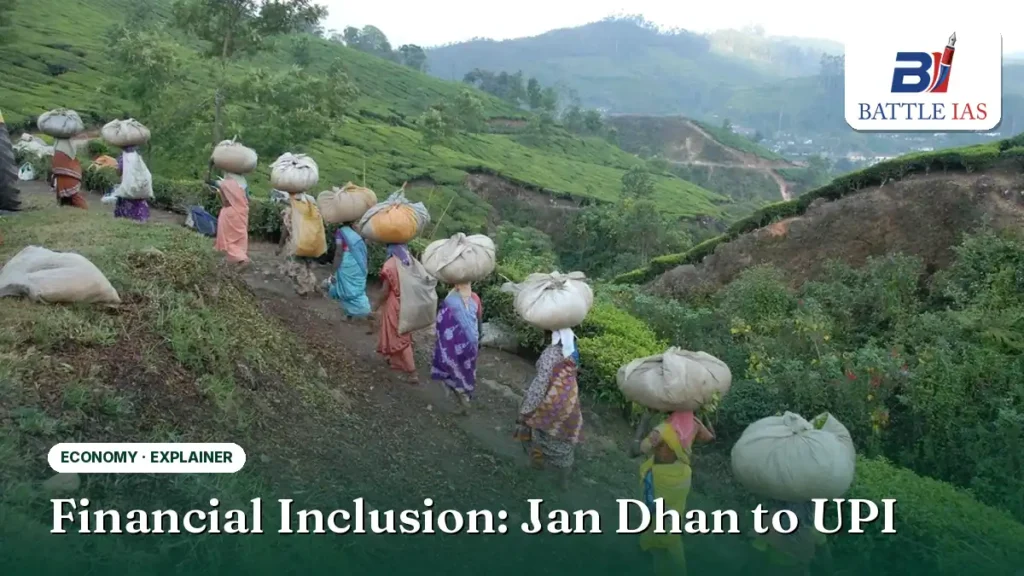
Financial inclusion means that every household and small business can use affordable, appropriate financial services: a safe account, payments, credit, insurance and pensions, delivered by regulated providers. India’s effort has a long history. The nationalisation of 14 major banks in 1969 and six more in 1980 pushed branches into rural areas. Priority sector lending targets, regional rural banks (1975) and NABARD (1982) followed. The SHG-Bank Linkage Programme of 1992 brought groups of poor women into formal credit. Yet by 2011 large numbers of adults still had no account. The real jump came with technology and a mission approach: Aadhaar for identity, business correspondents for last-mile reach, and the Pradhan Mantri Jan Dhan Yojana from August 2014, which opened accounts on a massive scale with a RuPay card and accident cover.
Why it matters
A household without a bank account borrows from moneylenders at high rates, keeps cash at risk, and cannot receive welfare money directly. Inclusion cuts leakage in transfers, mobilises savings and gives women assets in their own name.
- 1Beneficiary identified by scheme
- 2Aadhaar seeded to bank account
- 3Funds released through PFMS
- 4Money credited directly
- 5Cash out at branch, ATM or business correspondent
Key initiatives
- PMJDY (2014): zero-balance accounts with RuPay card and accident cover; well over 50 crore accounts, more than half held by women.
- JAM trinity and Direct Benefit Transfer.
- Social security: PMJJBY, PMSBY, Atal Pension Yojana.
- MUDRA loans for micro-enterprises; Stand-Up India.
- UPI (2016) and RuPay; India Post Payments Bank.
- Business correspondents in villages.
Payments banks vs small finance banks
| Point | Payments bank | Small finance bank |
|---|---|---|
| Lending | Not allowed | Allowed; 75% of credit to priority sector |
| Deposits | Up to ₹2 lakh per customer | No such cap |
| Capital | ₹100 crore | ₹200 crore (now higher for new licences) |
| Aim | Payments and remittances for migrants and small businesses | Credit to small units, farmers, unorganised sector |
- Jan DhanBank account for every household
- AadhaarUnique biometric identity
- MobilePhone-based payments and alerts
- ResultDirect Benefit Transfer
RBI’s Financial Inclusion Index
Launched in August 2021, scored 0-100, published every July. Weights: Access 35%, Usage 45%, Quality 20% (literacy, consumer protection, inequalities). It covers banking, investments, insurance, postal and pension sectors. The index was 64.2 in March 2024.
The four pillars of inclusion
| Pillar | What it covers | Indian instruments |
|---|---|---|
| Access | An account and a nearby touch point | PMJDY, business correspondents, India Post Payments Bank |
| Credit | Affordable loans for small needs | MUDRA loans, SHG linkage, Kisan Credit Card, PM SVANidhi |
| Insurance and pension | Protection against shocks and old age | PMJJBY, PMSBY, Atal Pension Yojana |
| Usage and literacy | Regular, informed use | UPI, financial literacy centres, grievance redress through the RBI Ombudsman |
The pillars show why access alone is not inclusion. A dormant account with no transactions, credit or insurance changes little in a family’s life. That is why the RBI’s index gives weight to usage and quality, not just access.
Gaps
Dormant accounts, low formal credit to tenant farmers and the North-East, a gender gap in digital use, digital fraud, and weak financial literacy. Usage, not account opening, is now the test.
Digital rails and the JAM trinity
The combination of Jan Dhan accounts, Aadhaar and mobile phones, called the JAM trinity, changed how the state reaches citizens. Direct Benefit Transfer sends subsidies and scholarships straight into beneficiary accounts, reducing leakages and middlemen. The Unified Payments Interface, launched by the National Payments Corporation of India in 2016, made instant, low-value payments cheap and simple, so a vegetable seller can accept money on a QR code. Aadhaar-enabled Payment Systems let people withdraw cash at a business correspondent using a fingerprint. Account Aggregators, regulated by the RBI, allow people to share their financial data with consent, which can help small borrowers without collateral get credit based on their cash-flow history. Together these make up a key part of India’s Digital Public Infrastructure.
Role of different institutions
| Institution | Role in inclusion |
|---|---|
| Scheduled commercial banks | Bulk of PMJDY accounts; priority sector lending |
| Regional rural banks | Credit to small farmers, labourers and artisans |
| Small finance banks | Loans to small units and the unserved; at least 75% of credit to priority sectors |
| Payments banks | Deposits and payments; cannot lend |
| Microfinance institutions (NBFC-MFIs) | Collateral-free loans to low-income households |
| Cooperatives | Rural credit through primary agricultural credit societies |
| NABARD and SIDBI | Refinance and development of rural and small-enterprise finance |
Gender, geography and the last mile
Inclusion figures hide gaps. Women hold a large share of Jan Dhan accounts, but many use them less and depend on family members for transactions. The north-eastern and hilly States have fewer branches and weaker connectivity. Small farmers still borrow from moneylenders when formal loans need land titles they lack. Digital fraud and weak financial literacy can drive new users away. Policy responses include women-focused SHG lending, the RBI’s National Strategy for Financial Inclusion, financial literacy camps, and rules that make banks responsible for unauthorised electronic transactions when the customer reports promptly. For Mains, link financial inclusion to social inclusion: an account in a woman’s name, safe savings and cheap credit raise her bargaining power and protect households from distress sales.
Writing a Mains answer
Define financial inclusion, show its link with poverty reduction and growth, and list the main schemes in a table. Then use the RBI’s Financial Inclusion Index, which measures access, usage and quality, to argue that inclusion must be judged by use, not just accounts. Discuss gaps: dormant accounts, the gender gap in usage, credit gaps for MSMEs, and digital fraud. Conclude with suggestions such as better literacy, grievance redress and consent-based data sharing for credit.
Financial Inclusion: UPSC angle
For UPSC CSE
Prelims: FI-Index sub-indices, payments vs small finance banks, PMJDY features. Mains GS-III: inclusive growth; inclusion vs social inclusion.
Financial Inclusion UPSC PYQs (Prelims)
Questions UPSC has actually asked, from the official papers. Pick an option to check yourself.
The establishment of 'Payment Banks' is being allowed in India to promote financial inclusion. Which of the following statements is/are correct in this context?
– 1. Mobile telephone companies and supermarket chains that are owned and controlled by residents are eligible to be promoters of Payment Banks.
– 2. Payment Banks can issue both credit cards and debit cards.
– 3. Payment Banks cannot undertake lending activities.
Select the correct answer using the code given below.
Under the RBI’s 2014 rules, resident-controlled telecom firms, supermarket chains, NBFCs and others can promote Payments Banks. They take deposits (now up to ₹2 lakh per customer) and issue debit cards, but they cannot lend or issue credit cards. Answer as per the official UPSC key · Battle IAS PYQ bankAnswer (b) & why
What is the purpose of setting up of Small Finance Banks (SFBs) in India ?
– 1. To supply credit to small business units
– 2. To supply credit to small and marginal farmers
– 3. To encourage young entrepreneurs to set up business particularly in rural areas.
Select the correct answer using the code given below :
The RBI’s 2014 guidelines say Small Finance Banks are meant for financial inclusion: savings services, and credit to small business units, small and marginal farmers, micro and small industries and the unorganised sector. At least 75% of their loans must go to the priority sector. Encouraging young entrepreneurs is not a stated purpose. Answer as per the official UPSC key · Battle IAS PYQ bankAnswer (a) & why
'Pradhan Mantri Jan-Dhan Yojana' has been launched for
PMJDY (August 2014) is the National Mission for Financial Inclusion: a zero-balance bank account for every household, with a RuPay card, accident insurance and an overdraft facility. With over 55 crore accounts, it became the base of the “JAM trinity” (Jan Dhan, Aadhaar, Mobile) for DBT. Answer as per the official UPSC key · Battle IAS PYQ bankAnswer (c) & why
Which one of the following correctly represents the three key sub-indices of the Financial Inclusion Index (FI-Index) of the Reserve Bank of India (RBI) ?
The RBI launched the FI-Index in August 2021. It covers banking, investments, insurance, postal services and pension, and gives a single value between 0 and 100. Its three parameters are Access (35%), Usage (45%) and Quality (20%). Usage has the largest weight, because an account that is never used does not mean inclusion. Answer as per the official UPSC key · Battle IAS PYQ bankAnswer (c) & why
Mains PYQs on this topic
Questions from the official UPSC Mains papers (2023-2026 in the Battle IAS Mains bank), newest first. Each links to a model answer.
- UPSC Mains 2026 · GS Paper III · Q2 · 10 marks
Examine the view that financial inclusion is an integral part of social and economic inclusion in a country like India. Also throw light on the usefulness of the R.B.I.'s Financial Inclusion Index.
Quick quiz
Which sub-index has the highest weight in RBI’s FI-Index?
45%.Answer (b)
Payments banks can
They cannot lend.Answer (c)
PMJDY was launched in
August 2014.Answer (b)
FAQs
What is the JAM trinity?
Jan Dhan accounts, Aadhaar and Mobile numbers, linked for direct transfers.
When was the FI-Index launched?
In August 2021 by the RBI.
Can a payments bank give loans?
No.
Is opening an account enough for inclusion?
No. Usage, credit access and quality of services matter more.
What is Direct Benefit Transfer?
A system that sends subsidies and benefits directly into the bank accounts of beneficiaries, usually linked to Aadhaar, to cut leakages and delays.
What is an Account Aggregator?
An RBI-regulated entity that lets a person share financial data from one institution with another, only with consent, helping access to credit.
Why do Jan Dhan accounts become dormant?
Low incomes, distance from access points, lack of literacy and little reason to transact. Linking DBT payments and small savings products to the account raises usage.
Spotted an error? Tell us. We correct within 48 hours.
How to use this in Mains
If asked: UPSC Mains 2026, GS-III: Examine the view that financial inclusion is an integral part of social and economic inclusion in a country like India. Also throw light on the usefulness of the R.B.I.'s Financial Inclusion Index.
Quote: “A household without a bank account borrows from moneylenders at high rates, keeps cash at risk, and cannot receive welfare money directly.”
Use it: A strong opening line on why inclusion matters.
In the news

China to impose export controls on tunnel boring machines from 18 November: what it means for India
On 19 October 2026 China’s Commerce Ministry announced export controls on tunnel boring machines (TBMs) and related items from 18 November, calling them clearly dual-use. India imports TBMs for metro, rail and border tunnels and has faced customs delays on Chinese machines since 2024. China also announced controls on some drones.
19 Oct 2026
Pumped storage hydropower: India’s roadmap for 100 GW of ‘water batteries’ by 2035-36
A PIB backgrounder of 19 October 2026 explains how pumped storage projects (PSPs) will store solar and wind power for India’s grid. India runs 7.43 GW of pumped storage today, is building 15.87 GW more and has an assessed potential of 345.38 GW. A roadmap aims to add about 100 GW between 2025-26 and 2035-36.
19 Oct 2026
Kufri Jamunia: ICAR-CPRI’s purple potato to fight hidden hunger
A PIB backgrounder of 18 October 2026 puts the spotlight on Kufri Jamunia, a purple-fleshed potato bred by ICAR’s Central Potato Research Institute and released in 2024. It has nearly twice the Vitamin C of a common potato and several times more zinc and iron, along with antioxidants called anthocyanins. The idea is clever: instead of asking people to change what they eat, make the food they already eat more nutritious. That is biofortification.
18 Oct 2026
Oil companies bar sugar-based ethanol for 2026-27; maize incentive cut to ₹2.79 a litre
The oil marketing companies have kept sugar out of India’s ethanol programme for the coming year. The tender issued on 16 October 2026 seeks about 11 billion litres of ethanol for the 2026-27 supply year, but asks for none made from sugarcane juice, sugar syrup or B-heavy molasses, because the Government wants sugar diversion for ethanol cut to zero. Grain must now carry the load, and even the maize incentive has been cut. Read this as a live example of the food-versus-fuel trade-off.
18 Oct 2026