
Allahabad HC stays murder conviction of man who wants to contest 2027 UP polls
A division bench of the Allahabad High Court has stayed the conviction and life sentence of Nandlal Rai alias Babloo Rai in a 2017 murder case in Varanasi, noting that he wishes to contest the 2027 UP Assembly election. Relying on the Supreme Court’s Afjal Ansari ruling, the court granted bail pending appeal. The order revives the debate on stay of conviction and disqualification under the Representation of the People Act.
- Bench
- Justices Siddharth, V.K. Dwivedi
- Order
- 5 Oct 2026
- Law
- Sec 389(1) CrPC
- Precedent
- Afjal Ansari (2023)
The Allahabad HC order: what happened?
Here is a case that will help you understand a fine legal point. A person convicted of a crime is barred from contesting elections. But what happens if a higher court puts that conviction on hold while the appeal is heard? This order is a live example.
- Nandlal Rai alias Babloo Rai was convicted and sentenced to life by a Varanasi court on 15 April 2025 for the 2017 murder of Pramod Kumar Nigam in Sigra (IE).
- In an order dated 5 Oct 2026, the HC stayed the conviction and sentence pending appeal (The Hindu, HT).
- The court noted he wished to contest the 2027 Assembly polls as an independent or on a party ticket.
- He got bail and was barred from selling or alienating immovable property without the court’s permission.
What is the law on disqualification after conviction?
- RPA 1951, Section 8(3): conviction with a sentence of two years or more disqualifies a person.
- The bar runs from the date of conviction and for six more years after release.
- Lily Thomas v Union of India (2013) struck down Section 8(4), which protected sitting legislators.
- Lok Prahari v Union of India (2018): disqualification ceases once an appellate court stays the conviction.
How does staying a sentence compare with staying a conviction?
| Point | Stay of sentence | Stay of conviction |
|---|---|---|
| Effect | Convict need not serve sentence for now | The conviction itself is kept in abeyance |
| Disqualification | Continues | Ceases during the stay |
| How common | Routine in appeals | Rare; only in exceptional cases |
| Legal basis | Section 389 CrPC / Section 430 BNSS | Same provision, read by courts |
Which constitutional and legal provisions apply?
- Article 191(1)(e): a person disqualified by a law made by Parliament cannot be an MLA.
- Section 8, Representation of the People Act, 1951.
- Section 389(1) CrPC (now Section 430 BNSS): suspension pending appeal.
- Article 21: the court linked the stay to the right to livelihood.
How does a convict regain eligibility to contest?
From conviction to eligibility
- Trial court convicts and sentences
- Disqualification under Section 8 begins
- Appeal filed in High Court
- Court stays the conviction
- Bar lifted while the stay lasts
Why does this matter?
| Angle | What to note |
|---|---|
| Criminalisation of politics | Who may contest after a conviction. |
| Judicial discretion | Stay of conviction should be rare. |
| Rights | Court tied the stay to the right to livelihood. |
| UP elections | 2027 Assembly polls approaching. |
What are the challenges?
- Stays in serious crimes may weaken efforts to clean up politics.
- Long pendency of criminal appeals keeps outcomes uncertain.
- Uneven use of discretion can look unfair to ordinary convicts.
- Voters may lack clear information on candidates’ cases.
What should be done next?
- Fast-track criminal appeals involving election aspirants.
- Clear Supreme Court guidelines on when to stay a conviction.
- Wide publicity of candidates’ criminal records, as the SC has directed.
- Special courts for cases involving MPs and MLAs to finish trials sooner.
What can UPPCS ask on disqualification?
- Section 8(3) RPA: two years’ sentence means disqualification.
- Lily Thomas (2013) struck down Section 8(4).
- Lok Prahari (2018): stay of conviction removes the bar.
- Article 191 deals with disqualification of State legislators.
- Section 430 BNSS replaced Section 389 CrPC.
How to write about criminalisation of politics in Mains
Practice question (10 marks, 150 words): Discuss the legal framework for disqualifying convicted persons from contesting elections. Is a stay of conviction a loophole? (UPPCS GS-V)
- Intro: Allahabad HC order of 5 Oct 2026.
- Law: RPA Section 8, Article 191, Lily Thomas.
- Stay: Lok Prahari, Afjal Ansari; exceptional use.
- Concerns: serious crimes, delays, uneven discretion.
- Way out: fast appeals, special courts, disclosure.
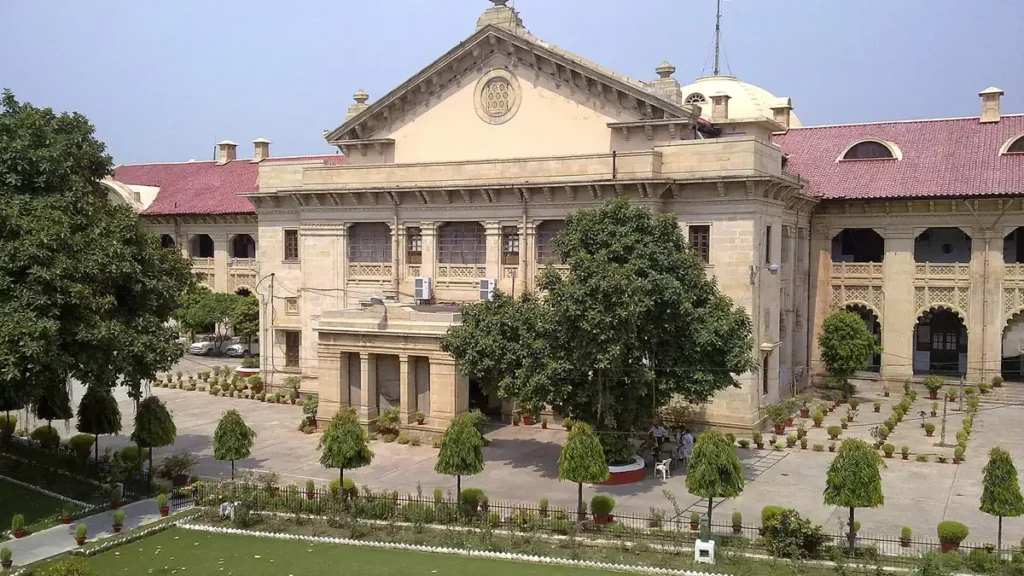
Image: Main building of the Allahabad High Court, Prayagraj. Vroomtrapit at English Wikipedia, Wikimedia Commons, CC0
Read all of October 2026 in the monthly UP current affairs compilation →
How to use this in Mains
If asked: Critically examine the provisions on disqualification of legislators after conviction. (UPPCS GS-V)
Quote: “Keeping in view the right to livelihood of a common man which is not less important than the right to contest election by a politician, conviction and sentence of appellant deserves to be stayed”
Use it: Use it to show how the court framed its reasoning; then discuss whether stays should be rare.
If asked: Criminalisation of politics is a threat to democracy. Discuss with recent examples. (UPPCS GS-V)
Quote: “There is no gainsaying that in order to suspend the conviction of an individual, the primary factors that are to be looked into, would be the peculiar facts and circumstances of that specific case, where the failure to stay such a conviction would lead to injustice or irreversible consequences.”
Use it: Quote the Supreme Court line (cited by the HC) to explain the test; then argue for fast-track appeals.
Exam angle
UPPCS GS-V: elections, RPA disqualification and judicial review; Prelims: Section 8, Lily Thomas, Article 191.
Practice MCQs
Original practice questions (not PYQs).
Under Section 8(3) of the Representation of the People Act, 1951, a person is disqualified if convicted and sentenced to imprisonment for at least
Answer (c) & explanation
A sentence of two years or more triggers disqualification from conviction until six years after release.
Consider the following statements:
1. Lily Thomas v Union of India (2013) struck down Section 8(4) of the RPA.
2. A stay of sentence alone removes disqualification.
3. Section 389 CrPC has been replaced by Section 430 of the BNSS.
How many of the statements given above are correct?
Answer (b) & explanation
Statements 1 and 3 are correct. Only a stay of the conviction, not just the sentence, lifts the bar.
Disqualification of members of a State Legislative Assembly is dealt with in
Answer (b) & explanation
Article 191 covers State legislators; Article 102 covers MPs.
Questions students ask about this
What did the High Court do?
It stayed the murder conviction and life sentence of Nandlal Rai pending his appeal and granted bail.
Why does a stay matter for elections?
A stay of conviction lifts the disqualification under the RPA while it lasts.
Which precedent did the court cite?
The Supreme Court’s 2023 ruling in Afjal Ansari v State of UP.
Is the case over?
No. The appeal is still pending; the stay lasts only until it is decided.
Keep studying
Go deeper
facts from cited sources only; cross-checked; faculty review pending