
DRDO’s indigenous AIP for Kalvari-class submarines reaches the Setting to Work Phase-2 stage
A submarine’s best weapon is staying hidden. India just moved closer to keeping its subs hidden longer. Diesel-electric submarines must surface often to recharge batteries, which can reveal them. Air Independent Propulsion (AIP) lets them stay under far longer. DRDO’s own AIP began its Setting to Work Phase-2 at L&T’s Hazira yard on 24 October. For you, it links fuel cells, the Kalvari class and defence self-reliance.
- Built by
- DRDO’s NMRL
- Where
- L&T, Hazira, Gujarat
- Technology
- Phosphoric acid fuel cell
- First boat
- Kalvari class, early 2027
AIP milestone: what happened?
- 24 Oct 2026: Setting to Work Phase-2 (switching on and testing the system in stages) of the AIP Energy Module began at L&T’s AM Naik Heavy Engineering Complex, Hazira, Gujarat.
- It was built in India by DRDO’s Naval Materials Research Laboratory (NMRL).
- Defence Secretary and DRDO Chairman Rajesh Kumar Singh (online) and Vice Admiral B. Sivakumar attended. The Chairman stressed Navy timelines and the strict safety that hydrogen and fuel-cell systems need.
- Next: the module will be powered up and tested to Navy rules, then go to Mazagon Dock Shipbuilders for fitting on a Kalvari-class submarine in early 2027.
What is Air Independent Propulsion?
A normal submarine is like a person holding their breath: it must come up for air. AIP is like carrying an oxygen tank.
- AIP lets a non-nuclear submarine make power underwater without outside air.
- It boosts underwater endurance by cutting dependence on oxygen from the air.
- India’s design uses phosphoric acid fuel cells, with hydrogen made on board.
- The Navy tested and approved the system at every stage of trials.
Diesel-electric vs AIP vs nuclear submarines
| Point | Diesel-electric | Diesel-electric + AIP | Nuclear-powered |
|---|---|---|---|
| Power underwater | Batteries | Batteries + fuel cells | Nuclear reactor |
| Surfacing / snorkelling | Every few days | Much less often | Rarely |
| Detection risk | Higher | Lower | Low (but larger size) |
| Indian example | Kalvari class | Kalvari class after refit | Arihant class |
Three kinds of AIP in the world
- Fuel cell (silent, no burning): Germany’s Type 212/214, and now India.
- Stirling engine (burns fuel with stored oxygen): Sweden’s Gotland class, Japan, China.
- MESMA steam turbine: France.
What is the policy framework?
- Project-75: six Scorpene-design Kalvari-class submarines built by Mazagon Dock with France’s Naval Group.
- Project-75(I): six more submarines with AIP.
- Positive indigenisation lists ban imports of listed defence items after set dates.
- Defence Acquisition Procedure 2020 puts Indian-designed and made equipment first.
How does a fuel-cell AIP work?
From hydrogen to silent power
- Hydrogen is made on board.
- In the fuel cell, hydrogen joins with stored oxygen.
- This gives direct-current (DC) electricity without burning anything.
- The only by-products are heat and water.
- The power charges batteries and drives the submarine silently.
What should you note for the exam?
| Angle | What to note |
|---|---|
| Science | Fuel cells: DC power; by-products heat and water |
| Defence | Kalvari (Scorpene) class; Project-75 and 75(I) |
| Institutions | DRDO, NMRL, Mazagon Dock, L&T |
| Policy | Atmanirbhar Bharat in defence |
What are the challenges?
- Long delays: Indian AIP took years to mature.
- Safety: hydrogen systems need strict care in a cramped submarine.
- Refits may keep boats away from duty.
- Fuel-cell and hydrogen-storage parts are still imported.
What should be done?
- Fit the first Kalvari-class boat on time in early 2027.
- Add AIP to the other boats during refits.
- Build Indian makers of fuel cells and hydrogen storage.
- Use the lessons for Project-75(I).
What can Prelims ask on AIP?
- AIP is for non-nuclear (diesel-electric) submarines.
- Fuel cells give DC power; by-products heat and water.
- Kalvari class = Scorpene design, Project-75, Mazagon Dock.
- INS Vagir commissioned January 2023; INS Vagsheer January 2025.
- Su-30MKI and T-90 are made in India under licence.
Probability in Prelims: Expect a statement question on Air Independent Propulsion: it lets diesel-electric (non-nuclear) submarines stay submerged longer; India’s system is built by the Defence Research and Development Organisation for the Kalvari (Scorpene) class.
How to write about defence indigenisation in Mains
Practice question (10 marks, 150 words): Discuss the significance of indigenous undersea technology for India’s maritime security. (GS-III)
- Intro: the AIP Setting to Work Phase-2 milestone.
- Body 1: what AIP does and why stealth matters in the Indian Ocean.
- Body 2: India’s submarine plans: Project-75, 75(I), nuclear boats.
- Body 3: challenges: delays, safety, supply chain.
- Way forward: timely refits, domestic fuel-cell industry, private sector role.
Ready lines for your answer
If asked: FDI in defence is set to be liberalised. What influence is this expected to have on Indian defence and economy? (GS-III, 2014)
Quote: “The AIP system boosts the underwater endurance of the diesel-electric submarines by reducing its dependence on atmospheric oxygen.”
Use it: Use it as an example of home-grown technology complementing foreign partnerships.
If asked: Examine the role of DRDO in achieving self-reliance in defence. (GS-III)
Quote: “Meeting the Navy's induction timelines while keeping the strict safety culture that hydrogen and fuel cell systems need.”
Use it: Quote it to show both the urgency and the technical care needed.
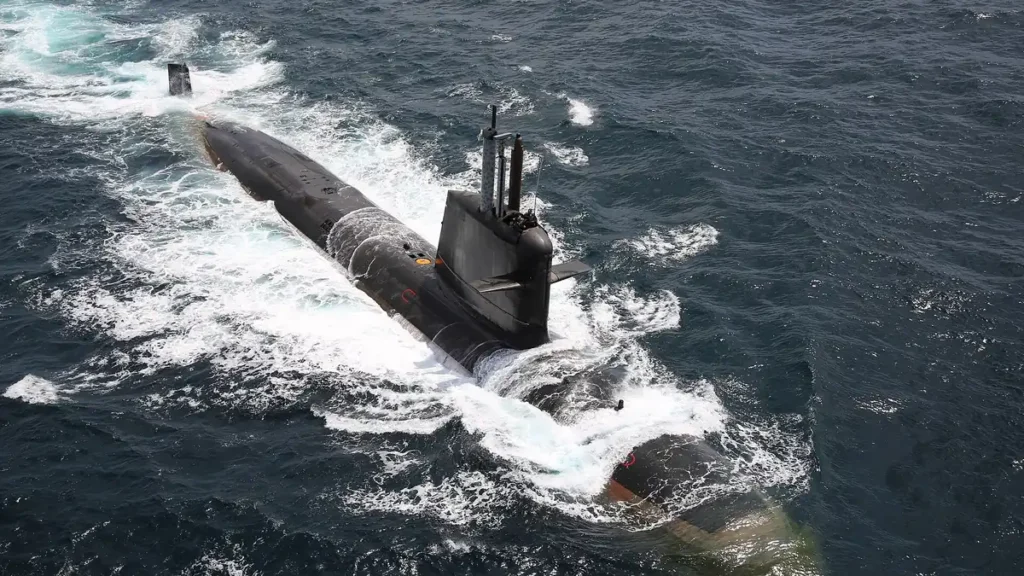
Image: INS Kalvari, the first Scorpene-class submarine built at Mazagon Dock, at sea. Indian Navy, via Wikimedia Commons, CC BY 2.5 IN
Exam angle
Prelims: AIP, fuel cells, Kalvari class, Project-75. · Mains GS-III: defence indigenisation; maritime security.
Practice MCQs
Original practice questions (not PYQs).
Consider the following statements:
1. Air Independent Propulsion is used mainly in nuclear-powered submarines.
2. A hydrogen fuel cell gives water as a by-product.
3. Kalvari-class submarines are based on the Scorpene design.
Which of the statements given above are correct?
Answer (b) & explanation
AIP is for non-nuclear, diesel-electric submarines.
With reference to fuel cells using pure hydrogen, which of the following statements is correct?
Answer (b) & explanation
Fuel cells produce direct current electrochemically, without combustion; by-products are heat and water.
Which Scorpene-class submarine was commissioned into the Indian Navy in January 2023?
Answer (b) & explanation
INS Vagir was commissioned in January 2023; INS Vagsheer in January 2025.
Questions students ask about this
What is AIP in a submarine?
Air Independent Propulsion: it lets a non-nuclear submarine make power underwater without outside air.
Who developed India’s AIP?
The Naval Materials Research Laboratory of DRDO.
Which submarine will get it first?
A Kalvari-class submarine, at Mazagon Dock, in early 2027.
Is an AIP submarine the same as a nuclear one?
No. It still uses diesel and batteries; AIP only adds time underwater. Arihant-class boats use a reactor.
Why does AIP matter?
Fewer trips to the surface make the submarine much harder to detect.
Official source: PIB, Ministry of Defence, 24 Oct 2026: Indigenous AIP system for Indian Navy’s diesel-electric submarines achieves key milestone