
India’s shipbuilding: deliveries set to double, but only 0.5% of global orders
Most ships carrying India’s trade are built abroad: Indian yards hold just 1 of every 200 units of world shipbuilding work. That is 0.5%, rank 12; China holds 64%. Yet Indian deliveries due in 2026–30 are nearly double those of 2021–25, and a ₹69,725-crore package aims for the top 10 by 2030 and top five by 2047. For you, it links Sagarmala, Vizhinjam and India’s manufacturing push.
- India’s order book
- 1.1 million CGT
- Global share
- 0.5%; rank 12
- China’s share
- 64%
- Package
- ₹69,725 crore
Shipbuilding numbers: what happened?
- 1 Sep 2026: Indian shipyards held orders of 1.1 million compensated gross tonnage (CGT), just 0.5% of the world total.
- India ranks 12th, behind China, South Korea, Japan, Italy, Russia, France, Vietnam, Germany, the Philippines, the United States and the Netherlands (BIMCO’s Niels Rasmussen).
- Deliveries due in 2026–2030 are nearly double those of 2021–2025, and could rise with new orders.
- The world order book hit a record 203.2 million CGT, up 13%; the earlier peak was 195.4 million in 2008.
What is compensated gross tonnage?
Weighing ships alone is unfair: a small, gadget-packed ferry takes more work than a big, plain cargo box.
- CGT measures shipbuilding work by adjusting a ship’s size for how hard it is to build.
- So a small but complex vessel can count for more CGT than a larger, simple bulk carrier.
- This lets analysts compare shipyard workloads across countries fairly.
- BIMCO (Baltic and International Maritime Council) is the world’s largest international shipping association, based in Denmark.
India vs the leaders
| Country | Share of global order book |
|---|---|
| China | 64% (won 74% of tonnage ordered in the past year) |
| South Korea | 19% |
| Japan | 6% |
| India | 0.5% (12th) |
What policies support shipbuilding?
- ₹69,725-crore shipbuilding package: aims for the top 10 by 2030 and the top five by 2047.
- Sagarmala Programme (2015, Ports Ministry): port-led growth. Sagarmala 2.0 adds shipbuilding, ship repair and maritime innovation.
- Vizhinjam (Kerala): India’s first deep-water transhipment port (where cargo switches between big and small ships), natural depth about 20 m, commissioned May 2025 under a PPP (public–private partnership).
- Maritime India Vision 2030 and Amrit Kaal Vision 2047 set long-term goals.
India’s main shipyards on one map
West coast: Mazagon Dock (Mumbai), Goa Shipyard (Goa), Cochin Shipyard (Kochi). East coast: Hindustan Shipyard (Visakhapatnam), Garden Reach Shipbuilders (Kolkata), L&T Kattupalli (near Chennai). Prelims loves matching a yard to its city.
How big is the global market?
| Measure | Figure |
|---|---|
| Global order book (1 Sep 2026) | 203.2 million CGT, up 13% |
| Earlier record (2008) | 195.4 million CGT |
| China’s share in each of six main cargo types | Over 72% |
| Container ships’ share of tonnage on order | 30% |
| China’s deliveries due in 2028 | 44 million CGT (22.7 million in 2025) |
What should you note for the exam?
| Angle | What to note |
|---|---|
| Economy | Manufacturing, MSMEs, employment, import substitution |
| Infrastructure | Sagarmala, Vizhinjam, shipbuilding clusters |
| Security | Own yards for naval and merchant fleets |
| Data | 0.5% share, rank 12, ₹69,725 crore, 2030/2047 targets |
What are the challenges?
- Tiny share: India relies on foreign yards for most ships its trade needs.
- Scale gap: China leads every cargo segment, with bigger yards and lower costs.
- Imported parts and special steel raise costs.
- Long build times and few dry docks deter buyers.
What should be done?
- Use the window: crowded Chinese yards give India a chance, backed by the ₹69,725-crore package.
- Build clusters linking ports, steel and parts makers.
- Train welders, naval architects and marine engineers at scale.
- Cheap, long-term loans for Indian shipowners who order at home.
What can Prelims ask on shipbuilding and ports?
- CGT measures shipbuilding work adjusted for complexity.
- Sagarmala: launched 2015; port-led development.
- Vizhinjam: Kerala; first deep-water transhipment port.
- BIMCO: shipping association based in Denmark.
- China, South Korea and Japan lead global shipbuilding.
Probability in Prelims: Expect a question on ports and shipbuilding: the Sagarmala Programme (port-led development, 2015), Vizhinjam (India’s first deep-water transhipment port, Kerala) and the ₹69,725-crore shipbuilding package.
How to write about shipbuilding in Mains
Practice question (15 marks, 250 words): Faster economic growth requires a larger share of manufacturing in GDP. Examine India’s shipbuilding push in this context. (GS-III)
- Intro: 0.5% share and rank 12, but deliveries to double.
- Body 1: why shipbuilding matters: jobs, steel demand, trade and security.
- Body 2: policies: ₹69,725-crore package, Sagarmala 2.0, Vizhinjam.
- Body 3: constraints: scale, costs, components, skills.
- Way forward: clusters, finance, skilling, assured domestic demand.
Ready lines for your answer
If asked: Why is maritime security vital to protect India’s sea trade? (GS-III, 2025)
Quote: “Just 0.5% of the global total, highlighting the scale of the challenge facing the country's ambition to emerge as a major shipbuilding hub.”
Use it: Use it to argue for domestic shipbuilding capacity.
If asked: Faster economic growth requires an increased share of manufacturing in GDP. Comment on present policies. (GS-III, 2023)
Quote: “The Centre's ₹69,725-crore shipbuilding package aims to propel India into the world's top 10 shipbuilding nations by 2030 and the top five by 2047.”
Use it: Quote it as a sector-specific manufacturing push.
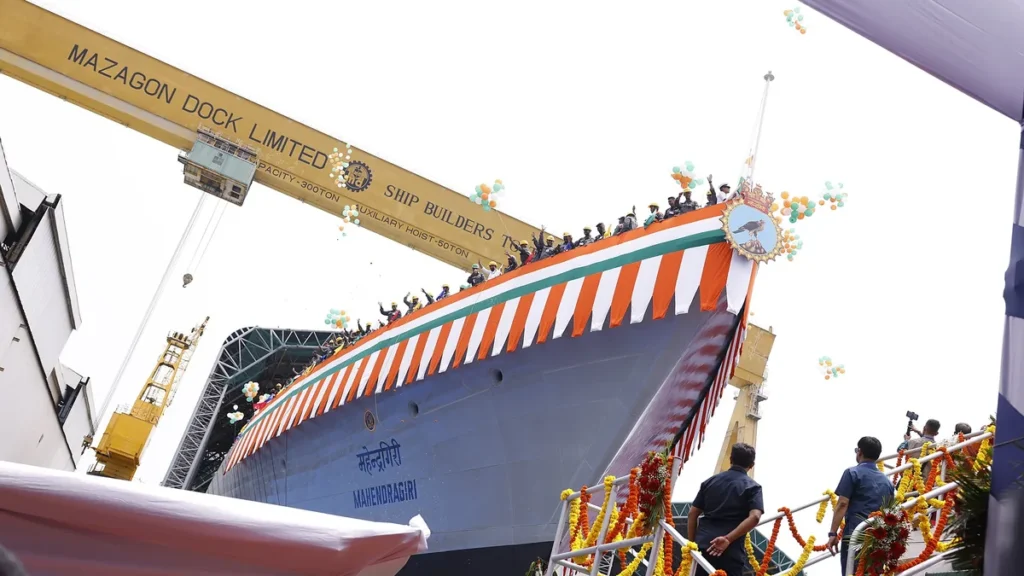
Image: A frigate being launched at Mazagon Dock Shipbuilders in Mumbai. Ministry of Defence, Government of India, via Wikimedia Commons, GODL-India
Exam angle
Prelims: CGT, Sagarmala, Vizhinjam, BIMCO. · Mains GS-III: manufacturing, infrastructure, maritime security.
Practice MCQs
Original practice questions (not PYQs).
Consider the following statements:
1. India holds about 5% of the global shipbuilding order book.
2. China holds the largest share of the global order book.
3. Vizhinjam port is in Kerala.
Which of the statements given above are correct?
Answer (b) & explanation
India’s share is only 0.5%.
‘Compensated gross tonnage’, seen in the news, is a measure of:
Answer (b) & explanation
CGT adjusts a ship’s gross tonnage for the complexity of building it.
The Sagarmala Programme of the Government of India primarily aims at:
Answer (b) & explanation
Launched in 2015, Sagarmala promotes port-led development; Sagarmala 2.0 adds shipbuilding and repair.
Questions students ask about this
What is India’s rank in global shipbuilding?
12th, with about 0.5% of the world order book (1.1 million CGT) on 1 September 2026.
Which country builds the most ships?
China, with 64% of orders, followed by South Korea (19%) and Japan (6%).
What is India’s target?
Top 10 by 2030 and top five by 2047, backed by a ₹69,725-crore package.
Why does shipbuilding matter for India?
Jobs, demand for Indian steel, less money spent abroad, and a stronger Navy.
What is CGT?
Compensated gross tonnage: a measure of shipbuilding work that adjusts for how complex a ship is.