
Bid to restrain CEC is against law, ECI tells SC
The Election Commission of India (ECI) is the umpire of our elections, the body that runs voting for Parliament, State Assemblies, the President and the Vice-President. Now the umpire itself is in court. Opposition leaders want the Supreme Court to stop Chief Election Commissioner (CEC) Gyanesh Kumar from acting alone, and all three members of the Commission have replied together that the plea is against the law. Read it to revise Article 324, how a CEC is removed and how the Commission takes decisions.
- Who replied
- CEC plus ECs Sukhbir Singh Sandhu and Vivek Joshi
- Reply
- Joint affidavit of nearly 250 pages
- Removal of CEC
- Only like a Supreme Court judge
- Decisions
- Majority rule, Section 18 of the 2023 Act
The ECI case in the Supreme Court: what happened?
Imagine a cricket match where one team says the umpire is biased and asks a higher authority to bench him. That is roughly what is happening. Opposition leaders, including the Leader of the Opposition in the Lok Sabha, have asked the Supreme Court to restrain (stop) the CEC, pointing to media reports of a ‘unilateral’ style, meaning decisions taken by one person without the others.
- All three members signed one reply: the CEC and both Election Commissioners (ECs), Sukhbir Singh Sandhu and Vivek Joshi.
- The Commission said a media report is “hardly evidence”, so petitions built on such reports should not even be maintainable (fit to be heard by a court).
- It explained the file trail: a decision goes from one EC to the other EC and then to the CEC. If a member is away, approval is taken electronically and recorded in the file later. Differences are settled by majority under Section 18 of the 2023 Act.
- On the July 28 order, which changed IT oversight (computer supervision) of electoral rolls without the two ECs’ knowledge, the ECs wrote to the Cabinet Secretary on July 29, and the order was “never implemented”.
- Outside court, Congress president Mallikarjun Kharge has sought the CEC’s resignation and called an INDIA bloc ‘Chalo Dilli’ rally on November 1. He says the ECI refused RTI (Right to Information) replies on the software used for the SIR (Special Intensive Revision, a door-to-door re-check of voter lists), calling it a “trade secret”.
What is the Election Commission of India?
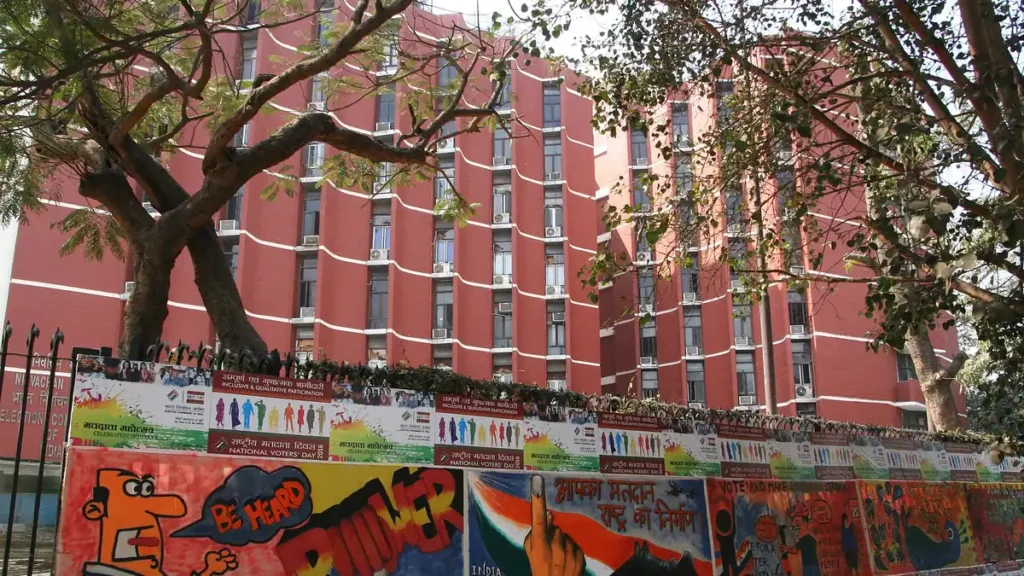
The ECI is a constitutional body, which means the Constitution itself creates it. Article 324 gives it ‘superintendence, direction and control’ of elections, in simple words, full charge of running them. It was set up on 25 January 1950, which is why that day is now National Voters’ Day.
Today it has three members: one CEC and two ECs. It has had more than one member since 1993. The President appoints them, now on the advice of a selection committee under the 2023 law on the CEC and ECs: the Prime Minister, the Leader of the Opposition in the Lok Sabha and a Union Cabinet Minister chosen by the Prime Minister.
What it does not run: elections to panchayats and municipalities. Those are conducted by State Election Commissions (Articles 243K and 243ZA). Disputes about an election result go to the High Court through an election petition, not to the ECI.
Who is protected, and how?
| Member | How can they be removed? | What it means |
|---|---|---|
| Chief Election Commissioner | Only like a Supreme Court judge: proved misbehaviour or incapacity, through Parliament | Very hard to remove, so the CEC can act without fear |
| Election Commissioners | On the recommendation of the CEC (Article 324(5)) | Weaker shield; the CEC has more weight inside the body |
| Decisions | Majority vote (Section 18, 2023 Act) | No single member is meant to decide alone |
Which laws and Articles apply?
- Article 324: the ECI’s control over elections to Parliament, State Legislatures, the President and the Vice-President.
- Article 324(5): the CEC can be removed only like a Supreme Court judge; ECs only on the CEC’s recommendation.
- Article 326: adult suffrage, meaning every citizen aged 18 or above can vote.
- 2023 Act on the appointment and service of the CEC and ECs: selection committee, and majority rule (Section 18).
Why does the ECI case matter?
| Angle | What to note |
|---|---|
| Trust | The ECI has no army and no money of its own; its power works only while every party trusts it. |
| Collegial working | Three members are meant to act together; an order passed without two of them shows a process gap. |
| Uneven shield | Only the CEC has judge-like protection, which tilts power inside the body. |
| Transparency | Refusing RTI replies on SIR software as a trade secret invites suspicion. |
What are the problems with the ECI case?
- Trust deficit: open charges of bias hurt the umpire, whatever the court finally decides.
- Friction inside: two ECs writing to the Cabinet Secretary shows the members were not on the same page.
- Closed technology: voters cannot check the software used to clean voter lists.
- Unequal protection: ECs can be removed on the CEC’s word, so they may hesitate to disagree.
What should be done next on the ECI case?
- Record every decision in writing, with dissent (disagreement) noted openly.
- Allow independent technical audits of the software used for electoral rolls.
- Give ECs the same removal protection as the CEC, as the Dinesh Goswami Committee and the Law Commission’s 255th Report suggested.
- Let the Supreme Court settle the matter; street pressure should not decide who runs the Commission.
What can Prelims ask on the ECI case?
- Article 324 = Election Commission of India (not 315, which is Public Service Commissions, or 280, the Finance Commission).
- CEC removed like a Supreme Court judge; ECs on the CEC’s recommendation.
- 2023 selection committee: Prime Minister, Leader of the Opposition, one Union Cabinet Minister.
- Panchayat and municipal polls: State Election Commissions, not the ECI.
- National Voters’ Day, 25 January: the ECI’s foundation day (1950). First CEC: Sukumar Sen.
How to write about the ECI case in Mains
Practice question (15 marks, 250 words): The removal shield given to the Chief Election Commissioner protects the Commission’s independence, but independence alone does not guarantee trust. Examine the reforms needed to strengthen the credibility of the Election Commission of India.
- Intro: the plea to restrain the CEC and the joint affidavit of all three members.
- Why trust is the ECI’s real power: no force or purse of its own.
- Structural fixes: equal removal protection for ECs, a broad selection panel, no post-retirement posts.
- Process fixes: recorded dissent, audited software, open data during roll revisions.
- Conclusion: a trusted umpire is the base of free and fair elections.
Ready lines for your answer
- “Decisions are first sent to one Election Commissioner and then to the other Election Commissioner and then finally to the CEC” (ECI affidavit in the Supreme Court).
- Independence protects the umpire; recorded dissent, audited software and equal protection for ECs build the trust that makes the umpire effective.
Quotable data pointThe CEC and both ECs filed a joint affidavit of nearly 250 pages; decisions go by majority under Section 18 of the 2023 Act.
Exam angle
Prelims: Article 324, removal of CEC and ECs, 2023 selection committee, State Election Commissions. · Mains GS-II: independence and credibility of constitutional bodies, electoral reforms.
Practice MCQs
Original practice questions (not PYQs).
Under Article 324 of the Constitution, the Election Commission of India does NOT conduct elections to:
Answer (c) & explanation
Panchayat and municipal elections are conducted by State Election Commissions (Articles 243K and 243ZA), not the ECI.
National Voters' Day is observed on 25 January because on that day:
Answer (b) & explanation
The ECI was established on 25 January 1950; National Voters' Day has been observed since 2011. The voting age was lowered by the 61st Amendment (1988).
Questions students ask about this
Why are opposition leaders in the Supreme Court against the CEC?
They want the court to restrain the CEC, citing media reports that he takes decisions alone. The ECI says such reports are not evidence.
How can a Chief Election Commissioner be removed?
Only in the same way and on the same grounds as a Supreme Court judge, which needs a special majority in both Houses of Parliament.
How does the Election Commission take decisions?
As a three-member body, by majority under Section 18 of the 2023 Act; files pass from one EC to the other and then to the CEC.
Does the ECI conduct panchayat elections?
No. Panchayat and municipal elections are run by State Election Commissions under Articles 243K and 243ZA.