
Double fortified salt: a ready answer to anaemia
Anaemia means the blood does not have enough healthy red cells or haemoglobin to carry oxygen, so a person feels tired and weak. Most of it in India comes from too little iron. Double Fortified Salt (DFS), ordinary salt that carries both iodine and iron, is a cheap fix already tested in India. A former Tata Trusts adviser argues it is being used unevenly. Read it for food fortification, Anaemia Mukt Bharat and ICDS.
- What
- Salt with iodine and iron
- Cost
- ₹14–20 per person a year
- Return
- ₹4.2 for every ₹1 spent
- Reach
- About 76 million people in four States
Double fortified salt: what is the news?
Getting people to take an iron tablet every day is hard; many stop after a few days. But almost everyone eats salt every day, in about the same amount. So what if the salt itself carried the iron? That is the simple idea behind Double Fortified Salt.
- About 95% of households already use iodised salt, so the delivery route exists.
- About 76 million people in four States get DFS through government safety-net schemes.
- A global review shows anaemia falling by up to 21%; India has trials in Bengaluru, Darjeeling and Punjab, and large-scale use in Uttar Pradesh.
- FSSAI (the Food Safety and Standards Authority of India) has a standard for DFS, and DFS is mandated in PM POSHAN (school meals) and ICDS (anganwadi services).
- It costs ₹14–20 per person a year, with a benefit-cost ratio of 4.2:1. But the Public Distribution System (PDS, ration shops), reaching about 800 million people, uses it unevenly because each State decides.
What is food fortification and double fortified salt?
Food fortification means adding small amounts of vitamins and minerals to everyday foods like rice, wheat flour, oil, milk and salt. It needs no change in what people eat. FSSAI regulates it under the Food Safety and Standards Act, 2006, and fortified packs carry a ‘+F’ logo.
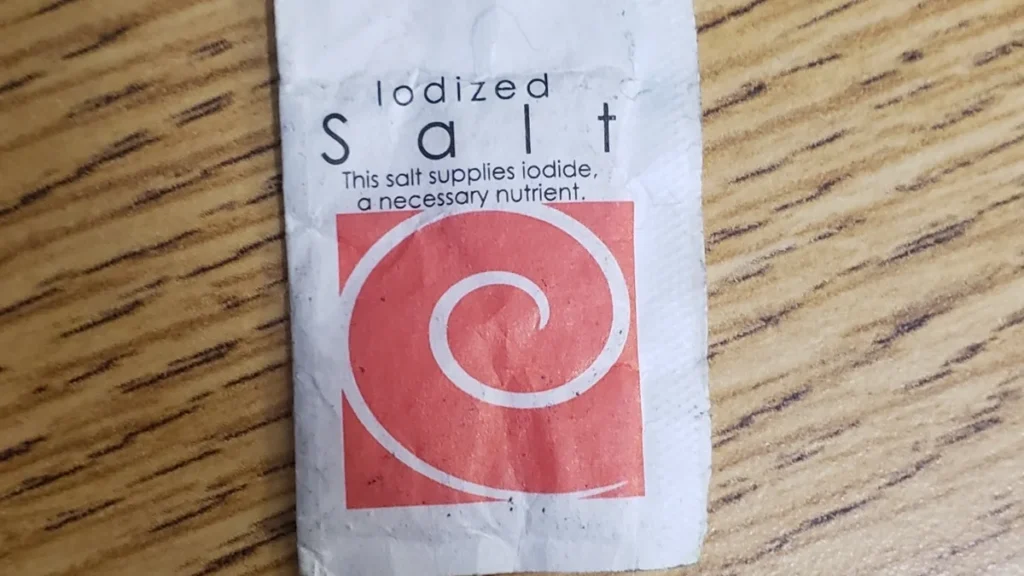
Iodised salt is ‘single fortified’: it has iodine, which protects against goitre. Double Fortified Salt adds iron as well. The hard part is keeping the iron stable so the salt does not change colour or taste.
India’s anaemia levels are high. NFHS-5 (2019–21) found about 57% of women aged 15–49 and about 67% of children aged 6–59 months anaemic. The Anaemia Mukt Bharat strategy, now revised as ‘7X7X7’, uses iron-folic acid supplements, deworming, testing and fortified foods.
DFS at a glance
| Point | Figure |
|---|---|
| Households using iodised salt | About 95% |
| People getting DFS now | About 76 million, in four States |
| Fall in anaemia (global review) | Up to 21% |
| Cost | ₹14–20 per person a year |
| Benefit-cost ratio | 4.2:1 |
| People reached by PDS | About 800 million |
Which laws and Articles apply?
- Food Safety and Standards Act, 2006: FSSAI sets fortification standards, including for DFS.
- National Food Security Act, 2013: the legal base of the PDS, PM POSHAN and ICDS.
- Article 47 (Directive Principle): the State shall raise nutrition and public health.
- Anaemia Mukt Bharat (2018): the national anaemia strategy.
Why does double fortified salt matter?
| Angle | What to note |
|---|---|
| No habit change | Iron rides on salt that everyone already eats. |
| Value for money | A 4.2:1 return makes it one of the cheapest nutrition tools. |
| Next generation | Less anaemia in mothers means fewer low-birth-weight babies. |
| Federal gap | The biggest safety net, the PDS, depends on 36 separate State and UT choices. |
What are the problems with double fortified salt?
- Uneven use in the PDS because the choice is left to States.
- Little demand in the open market, so private brands stay away.
- Iron must stay stable without changing colour or taste.
- Salt intake should fall for heart health, so fortification must work with less salt; thalassaemia and sickle cell screening must continue.
What should be done next on double fortified salt?
- A central push to use DFS in the PDS, with lab testing for quality.
- Awareness drives so families ask for DFS in shops.
- Keep supplements, deworming and testing going alongside DFS.
- Track anaemia data State by State to see results.
What can Prelims ask on double fortified salt?
- Anaemia Mukt Bharat: iron-folic acid, deworming, delayed cord clamping (UPSC 2023).
- Food fortification and the ‘+F’ logo; FSSAI.
- National Nutrition Mission (POSHAN Abhiyaan), 2018 (UPSC 2017).
How to write about double fortified salt in Mains
Practice question (15 marks, 250 words): Malnutrition in India is not only a health problem but also a problem of welfare delivery. Discuss with reference to Double Fortified Salt.
- Intro: anaemia levels (NFHS-5) and its cost.
- Why DFS: daily habit, cheap, proven, 4.2:1 return.
- Bottlenecks: uneven PDS use, weak market demand, quality.
- Way forward: central push in PDS, testing, awareness, other interventions.
- Conclusion: the barrier is institutional, not technical.
Ready lines for your answer
- “The barriers are now primarily institutional rather than technical”; these are “implementation challenges, not technological ones”.
- DFS needs no change in diet, costs ₹14–20 a person a year and returns ₹4.2 for every rupee.
Quotable data pointDFS cuts anaemia by up to 21% and costs ₹14–20 per person a year, with a benefit-cost ratio of 4.2:1.
Exam angle
Prelims: Anaemia Mukt Bharat, food fortification, +F logo, ICDS, PM POSHAN. · Mains GS-II: malnutrition and welfare delivery.
Practice MCQs
Original practice questions (not PYQs).
Double Fortified Salt (DFS) is fortified with:
Answer (a) & explanation
DFS carries both iodine and iron; FSSAI has a standard for it.
Consider the following statements:
1. The Anaemia Mukt Bharat strategy provides prophylactic calcium supplementation.
2. Fortified foods in India carry the '+F' logo.
3. Double Fortified Salt is mandated in PM POSHAN and ICDS.
How many of the above statements are correct?
Answer (b) & explanation
Statements 2 and 3 are correct. Anaemia Mukt Bharat provides iron-folic acid, not calcium.
Questions students ask about this
What is double fortified salt?
Salt fortified with both iodine and iron, so it fights goitre and iron-deficiency anaemia together.
How much does double fortified salt cost?
About ₹14–20 per person a year, with a benefit-cost ratio of 4.2:1.
Is DFS used in government schemes?
Yes. It is mandated in PM POSHAN and ICDS, but its use in the PDS depends on each State.
What is the '+F' logo?
The FSSAI mark that tells you a food is fortified with added vitamins or minerals.