
Sri Lankan Navy arrests seven Rameswaram fishermen
Sri Lanka’s Navy arrested seven fishermen from Rameswaram and Thangachimadam, saying they were poaching in its waters near Katchatheevu. Local fishers blame big trawlers from other ports. Read it to revise the Palk Bay fishing dispute, the 1974 agreement and sea zones.
- Arrested
- 7 fishermen
- Area
- Between Katchatheevu and Mannar North
- Tokens issued
- 398
- Agreement
- 1974 India–Sri Lanka
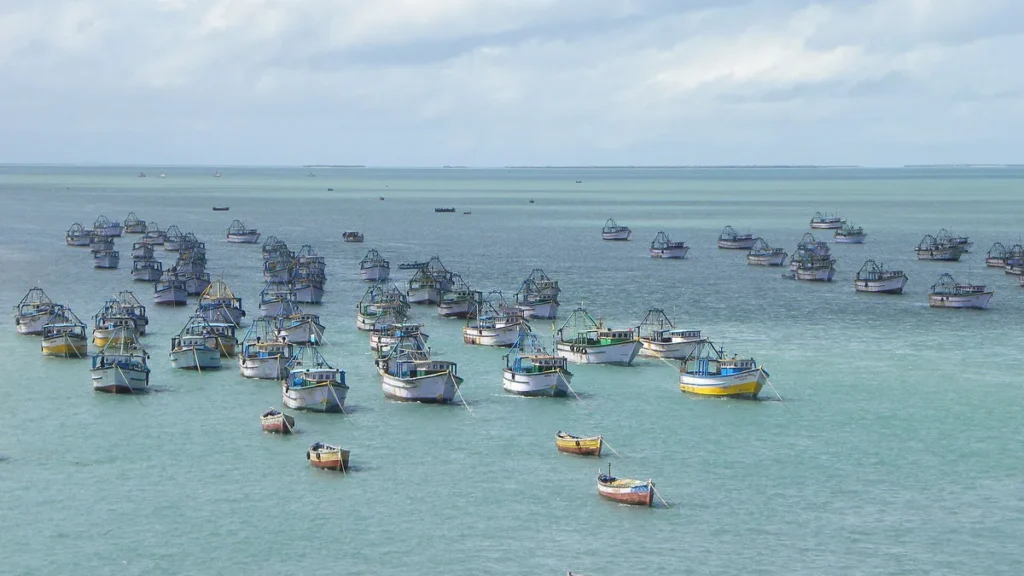
The arrests: what happened?
For fishers of Rameswaram, the sea has no clear line. For Sri Lanka, a line was drawn in 1974. Every arrest reopens that gap.
- Sri Lanka’s Navy arrested seven fishermen from Rameswaram and Thangachimadam around 1 a.m. on Sunday.
- They were fishing between Katchatheevu islet and Mannar North; the trawler was seized.
- Sri Lanka says they were poaching in its waters.
- Officials had issued 398 fishing tokens on Saturday.
- Ramanathapuram fishers blame big trawlers from Karaikal and Nagapattinam that went 100 nautical miles and damaged Sri Lankan nets.
- They asked Chief Minister C. Joseph Vijay to stop these trawlers; fishermen groups want the Centre to get those arrested released.
Why is Palk Bay fishing a dispute?
The Palk Strait separates Tamil Nadu from northern Sri Lanka. It is narrow, so the sea boundary is close to both coasts.
Under the 1974 agreement, India recognised Katchatheevu as part of Sri Lanka. A 1976 agreement set the boundary in the Gulf of Mannar and the Bay of Bengal.
Indian trawlers often use bottom trawling, which drags nets on the sea floor and harms fish stocks. Sri Lankan Tamil fishers say it destroys their livelihood.
Both countries have a Joint Working Group on fisheries, but arrests continue.
How far do a country’s rights go?
| Zone | Distance from coast | Rights |
|---|---|---|
| Territorial sea | 12 nautical miles | Full sovereignty |
| Contiguous zone | 24 nautical miles | Customs, immigration control |
| Exclusive Economic Zone | 200 nautical miles | Fishing and resources |
Which laws and Articles apply?
- India–Sri Lanka maritime boundary agreements, 1974 and 1976.
- UN Convention on the Law of the Sea (UNCLOS), 1982.
- Territorial Waters, Continental Shelf, EEZ and Other Maritime Zones Act, 1976.
- Article 51: respect for international law.
Why does the fishermen issue matter?
| Angle | What to note |
|---|---|
| Livelihood | Thousands of fishers depend on Palk Bay. |
| Diplomacy | Arrests strain India–Sri Lanka ties. |
| Ecology | Bottom trawling harms the sea bed. |
| Federal angle | Tamil Nadu and the Centre both involved. |
What are the problems with the fishermen issue?
- Bottom trawling continues despite harm.
- Few alternative jobs for fishers.
- Boats seized are rarely returned in good condition.
- Katchatheevu remains a political issue.
What should be done next on the fishermen issue?
- Shift fishers to deep-sea fishing with support.
- Phase out bottom trawling.
- Hold regular fishermen-level talks.
- Use the Joint Working Group for quick release.
What can Prelims ask on the fishermen issue?
Prelims probability: Expect a map question on the Palk Strait, Gulf of Mannar and Katchatheevu, or on sea zones under the Law of the Sea.
- Katchatheevu: recognised as Sri Lankan in the 1974 agreement.
- Palk Strait: between Tamil Nadu and Sri Lanka.
- Gulf of Mannar: south of Rameswaram; marine biosphere reserve.
- Territorial sea 12 nm, contiguous zone 24 nm, EEZ 200 nm (UNCLOS).
- Bottom trawling: nets dragged on the sea floor.
How to write about the fishermen issue in Mains
Practice question (15 marks, 250 words): The Palk Bay fisheries dispute is as much about livelihood as about boundaries. Discuss and suggest a way forward.
- Intro: arrest of seven fishers.
- Background: 1974 and 1976 agreements.
- Issues: bottom trawling, livelihood, diplomacy.
- Way forward: deep-sea fishing, talks, JWG.
- Conclusion: humane and lasting solution.
Ready lines for your answer
- Fish do not respect boundaries; fishers must.
- Livelihood needs a lasting fix, not repeated releases.
Quotable data point398 fishing tokens were issued on the day before the arrests.
Photo: BOMBMAN, CC BY 2.0, via Wikimedia Commons
Exam angle
Prelims: Palk Strait, Katchatheevu, sea zones. · Mains GS-II: India–Sri Lanka relations.
Practice MCQs
Original practice questions (not PYQs).
Katchatheevu, in the news, was recognised as part of Sri Lanka by an India–Sri Lanka agreement signed in:
Answer (a) & explanation
Under the 1974 maritime boundary agreement, India recognised Sri Lanka's claim over Katchatheevu. Tamil Nadu fishermen still treat it as a traditional fishing ground.
Consider the following statements:
1. Under the United Nations Convention on the Law of the Sea, the territorial sea extends up to 12 nautical miles from the baseline.
2. The Exclusive Economic Zone extends up to 200 nautical miles from the baseline.
3. The Palk Strait separates Tamil Nadu from the northern part of Sri Lanka.
How many of the above statements are correct?
Answer (c) & explanation
All three are correct. Ram Setu (Adam's Bridge), a chain of shoals between Rameswaram and Mannar, separates the Palk Bay from the Gulf of Mannar.
Questions students ask about this
Where were the fishermen arrested?
Between Katchatheevu islet and Mannar North.
Which agreement recognised Katchatheevu as Sri Lankan?
The 1974 India–Sri Lanka agreement.
What is bottom trawling?
A method where nets are dragged along the sea floor, harming fish stocks and the sea bed.
How far does the territorial sea extend?
12 nautical miles from the coast.