
Bangladesh garment strike opens a window for India
Garment workers in Bangladesh have protested for a week for higher wages, and close to 700 factories stopped work. Bangladesh is the world’s second-largest clothes exporter, and garments are about 80% of its exports. As it loses special trade benefits, India’s textile sector may gain. Read it to revise LDC graduation and India’s FTAs.
- Factories hit
- Close to 700
- Wage demand
- 12,500 → 30,000 taka a month
- Sector size
- About $40 billion; 80% of exports
- Rank
- Bangladesh 2nd, India 6th in apparel exports
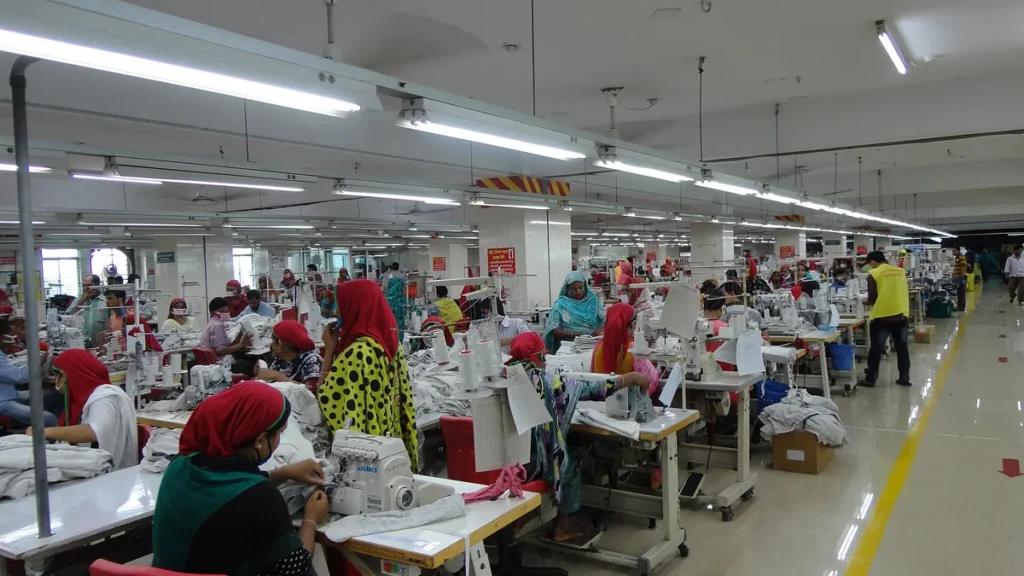
The garment strike: what happened?
The shirt you are wearing may well say ‘Made in Bangladesh’. Now that supply line is shaking.
- For a week, garment workers in Gazipur, Ashulia and Dhaka have protested, and close to 700 factories stopped work.
- They want the minimum monthly wage raised from 12,500 taka (about $100) to 30,000 taka ($242).
- They point to inflation (rising prices) of 8.34% in September 2026.
- The readymade garment sector employs over four million workers and earns about $40 billion a year — roughly 80% of Bangladesh’s exports.
- Strikes during peak order months can push foreign buyers to look elsewhere.
Why did Bangladesh grow so big in garments?
Bangladesh became the world’s second-largest apparel exporter after China, thanks to cheap labour and a special status.
As a Least Developed Country (LDC) — a UN tag for the poorest countries — it got duty-free, quota-free entry into Western markets.
That status is ending. Its garments will face tariffs (import taxes) of 9.6% to 12% in Europe. Meanwhile India’s new Free Trade Agreements (FTAs) with the EU and the UK give Indian textiles zero-duty access.
India vs Bangladesh in garments
| Factor | Position |
|---|---|
| Export rank | Bangladesh 2nd, India 6th |
| Raw material | India grows its own cotton and yarn |
| EU/UK market access | India: zero duty under new FTAs; Bangladesh: tariffs after LDC exit |
| Labour cost | Bangladesh lower, but now under pressure |
Which rules and schemes apply?
- LDC graduation: decided by the UN based on income, human assets and economic vulnerability.
- India’s FTAs with the United Kingdom and the European Union cut duties on Indian textiles.
- PM MITRA parks: large integrated textile parks to cut costs.
- Production Linked Incentive (PLI) scheme for textiles: rewards extra production of man-made fibre clothes and technical textiles.
Why does the Bangladesh garment strike matter?
| Angle | What to note |
|---|---|
| Economy | Chance to grab export orders and jobs. |
| Neighbourhood | Instability next door affects India. |
| Labour | Shows the cost of low-wage growth. |
| Prelims | LDC status, apparel rankings, PM MITRA. |
What are the problems with the Bangladesh garment strike?
- Vietnam is a fast, efficient competitor too.
- Indian factories are often small and less efficient.
- Man-made fibre supply in India is limited and costly.
- Gains from a neighbour’s trouble may not last.
What should be done next on the Bangladesh garment strike?
- Scale up factories through PM MITRA parks.
- Improve man-made fibre supply and logistics.
- Use FTA access with quality and compliance standards.
- Keep friendly, stable trade ties with Bangladesh.
What can Prelims ask on the Bangladesh garment strike?
Prelims probability: Medium. Past-question trend: textile certification (2026) and India–Bangladesh links such as Maitri Setu (2026). Freshness: live strike during peak order months. Static link: Least Developed Country graduation, Multi-Fibre Arrangement. Testable fact: Bangladesh is the second-largest apparel exporter; India is sixth.
- Bangladesh: 2nd-largest apparel exporter; India: 6th.
- Garments: about 80% of Bangladesh’s exports.
- LDC status gives duty-free, quota-free access to many markets.
- The Multi-Fibre Arrangement, which set textile quotas, ended in 2005.
- PM MITRA: mega textile parks scheme.
How to write about the Bangladesh garment strike in Mains
Practice question (15 marks, 250 words): Bangladesh’s garment crisis is an opportunity for India’s textile sector. Examine.
- Intro: strike, 700 factories shut.
- Why Bangladesh led: cheap labour, LDC status.
- India’s edge: cotton, FTAs.
- Limits: scale, Vietnam, man-made fibre.
- Conclusion: build capacity, not just wait.
Ready lines for your answer
- Low wages can build an industry but cannot sustain it forever.
- India's textile chance lies in scale, speed and its own cotton.
Quotable data pointBangladesh garments: about $40 billion, 80% of exports; close to 700 factories shut in the strike.
Photo: Fahad Faisal, CC BY-SA 4.0, via Wikimedia Commons
Exam angle
Prelims: LDC status, apparel rankings. · Mains GS-II/III: India–Bangladesh, textile exports.
Practice MCQs
Original practice questions (not PYQs).
Readymade garments account for roughly what share of Bangladesh's merchandise exports?
Answer (c) & explanation
Readymade garments make up about 80% of Bangladesh's exports, which is why a strike in its garment belts matters for global buyers and for India.
Consider the following statements:
1. Bangladesh is among the world's largest exporters of readymade garments, second only to China.
2. Bangladesh shares its longest land border with India.
3. The Ganga enters Bangladesh as the Meghna.
How many of the above statements are correct?
Answer (b) & explanation
Statements 1 and 2 are correct. The Ganga enters Bangladesh as the Padma; the Meghna is formed later and carries the combined waters to the Bay of Bengal.
Questions students ask about this
Why are Bangladesh garment workers striking?
For a higher minimum wage — from 12,500 to 30,000 taka a month — as prices rise.
How important are garments for Bangladesh?
Very. They earn about $40 billion a year, roughly 80% of its exports.
What is LDC status?
A UN tag for the poorest countries that brings trade benefits like duty-free access.
How can India gain?
Buyers may shift orders to India, which now has zero-duty access to the EU and UK.
Where does India rank in apparel exports?
Sixth in the world.