
Home Minister orders tighter coastal watch, hunt for drug kingpins
Union Home Minister Amit Shah reviewed Gujarat’s security in Ahmedabad. He asked for a tighter watch on the coast and the Pakistan border, action against drug kingpins (not just small sellers), and a stronger cybercrime helpline. Read it to revise India’s coastal security set-up and the new criminal laws.
- Gujarat coastline
- About 2,340 km, India’s longest
- Chargesheets in 60 days
- 92%
- Pending forensic cases
- Over 25,000
- Cyber helpline
- 1930
The Gujarat review: what happened?
India’s longest coastline is also a favourite route for drug smugglers. The Home Minister wants it sealed tighter.
- The Home Minister reviewed law and order and internal security in Ahmedabad on 7 November.
- With a coastline of nearly 2,340 km and a land border with Pakistan, he asked for better coordination among the Border Security Force (BSF), State Police, Coast Guard and central agencies.
- Under the new criminal laws, 92% of Gujarat’s chargesheets (the police’s formal list of charges) were filed within 60 days and 86% within 90 days.
- He ordered a special drive to clear over 25,000 pending forensic cases.
- On drugs, he said whole networks and kingpins must be targeted, with financial probes to seize illegal assets.
- He asked for more capacity for the 1930 cybercrime helpline and faster deportation of illegal foreigners; 2,412 have been deported.
How does India guard its coast?
After the 2008 Mumbai attacks, when terrorists came by sea, India built a three-layer coastal security system.
The Navy guards the deep sea, the Coast Guard the territorial waters (up to 12 nautical miles, about 22 km), and the State marine police the shallow waters near the shore.
Gujarat’s coast has seen big drug seizures, often of drugs coming by sea from the Makran coast region.
The three layers of coastal security
| Layer | Who |
|---|---|
| Deep sea | Indian Navy |
| Territorial waters (up to 12 nautical miles) | Indian Coast Guard |
| Near shore | State marine police |
Which laws and Articles apply?
- Narcotic Drugs and Psychotropic Substances (NDPS) Act, 1985: the main anti-drug law.
- Coast Guard Act, 1978: set up the Indian Coast Guard under the Ministry of Defence.
- New criminal laws from 1 July 2024: Bharatiya Nyaya Sanhita, Bharatiya Nagarik Suraksha Sanhita and Bharatiya Sakshya Adhiniyam, with time limits and forensic use.
- Police and public order are State subjects (List II); the Centre supports through central forces and agencies.
Why does Gujarat’s security review matter?
| Angle | What to note |
|---|---|
| Security | Sea routes for drugs, arms and infiltration. |
| Youth | Drugs destroy health and families. |
| Justice | Faster chargesheets and forensics mean faster trials. |
| Prelims | Coastal layers, 1930 helpline, NDPS Act. |
What are the problems with Gujarat’s security review?
- A long coast with many small landing points is hard to watch.
- Forensic labs are short of staff, so cases pile up.
- Small peddlers are caught while kingpins escape.
- Cyber frauds grow faster than police skills.
What should be done next on Gujarat’s security review?
- Use radars, drones and fishing-boat tracking along the coast.
- Hire more forensic experts and build labs.
- Follow the money to catch drug networks.
- Train police in cyber investigation and expand 1930.
What can Prelims ask on Gujarat’s security review?
Prelims probability: Medium. Past-question trend: Zero First Information Report (2026), the Law of the Sea (2022) and cyber-incident reporting (2017). Freshness: new criminal-law results. Static link: coastal security set-up after 2008. Testable fact: Gujarat has India’s longest coastline, about 2,340 km.
- Gujarat has India’s longest coastline, about 2,340 km.
- Three-layer coastal security: Navy, Coast Guard, marine police.
- Cybercrime helpline: 1930.
- NDPS Act: 1985.
- New criminal laws in force since 1 July 2024.
How to write about Gujarat’s security review in Mains
Practice question (15 marks, 250 words): Coastal security and narcotics are closely linked threats. Discuss with reference to Gujarat.
- Intro: Home Minister’s review.
- Coastal set-up after 2008.
- Drug routes and kingpins.
- Gaps: forensics, coordination, cyber.
- Conclusion: tech, money trail, coordination.
Ready lines for your answer
- Drugs that enter by sea fund crime on land.
- Catching the kingpin's money hurts more than catching the courier.
Quotable data pointGujarat coast about 2,340 km; 92% chargesheets in 60 days; 25,000+ pending forensic cases.
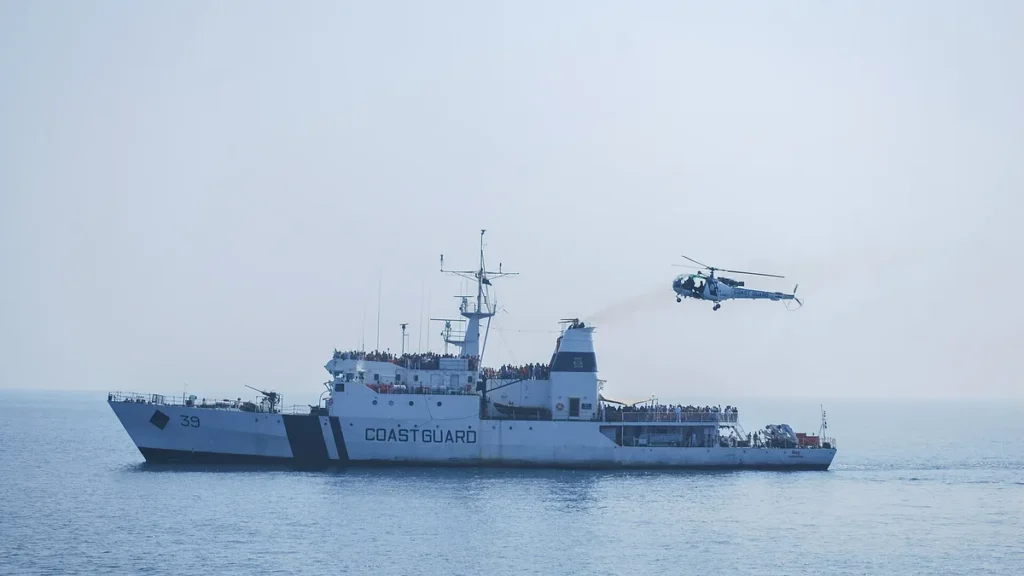
Photo: Drashokk, CC BY-SA 4.0, via Wikimedia Commons
Exam angle
Prelims: coastal security layers, 1930, NDPS. · Mains GS-III: border and coastal security, narcotics.
Practice MCQs
Original practice questions (not PYQs).
Consider the following statements:
1. The Indian Coast Guard functions under the Ministry of Home Affairs.
2. India's territorial sea extends up to 12 nautical miles from the baseline.
3. The Narcotics Control Bureau functions under the Ministry of Home Affairs.
How many of the above statements are correct?
Answer (b) & explanation
Statements 2 and 3 are correct. The Indian Coast Guard functions under the Ministry of Defence.
Which number is the national helpline for reporting cyber fraud and cybercrime?
Answer (d) & explanation
1930 is the national cybercrime helpline; 112 is the emergency number, 1098 is Childline and 1091 is the women's helpline.
Questions students ask about this
Which State has India's longest coastline?
Gujarat, about 2,340 km.
Who guards India's coast?
The Navy (deep sea), Coast Guard (territorial waters) and State marine police (near shore).
What is the 1930 helpline?
The national number to report cyber financial fraud quickly.
Why target drug kingpins?
Catching small sellers does not stop supply; seizing the network's money does.
What are the new criminal laws?
BNS, BNSS and BSA, in force from 1 July 2024, replacing the IPC, CrPC and Evidence Act.