
Panchayati Raj in India: Committees, 73rd Amendment, PESA and the Three Fs Problem (UPSC Notes + PYQs)
UPSC has already asked about this. Read the story with these questions in mind.
- Prelims 2011The Constitution (Seventy-Third Amendment) Act, 1992, which aims at promoting the Panchayati Raj Institutions in the country, provides for which of the following ?Solve it below ↓
- Prelims 2016Consider the following statements: The minimum age prescribed for any person to be a member of Panchayat is 25 years. …Solve it below ↓
See all 4 PYQs
- Prelims 2013The Government enacted the Panchayat Extension to Scheduled Areas (PESA) Act in 1996. Which one of the following is *not* identified as its objective?Solve it below ↓
- Prelims 2026Which of the following statements with respect to the Revamped Rashtriya Gram Swaraj Abhiyan (RGSA) is/are correct ?Solve it below ↓
Background: Gandhi’s village republics and Article 40
Gandhi imagined India as a federation of self-reliant village republics. The Constituent Assembly was divided: Ambedkar saw villages as sinks of localism and caste, so panchayats went into the Directive Principles as Article 40, asking the State to organise them as units of self-government. For forty years they existed only where States chose. The Balwant Rai Mehta Committee (1957) recommended a three-tier system after the Community Development Programme failed to win people’s participation, and Rajasthan began it at Nagaur on 2 October 1959. The Ashok Mehta Committee (1977) preferred two tiers, while the G.V.K. Rao (1985) and L.M. Singhvi (1986) committees argued for constitutional status. The 64th Amendment Bill failed in 1989; the 73rd Amendment (1992) finally came into force on 24 April 1993, now marked as National Panchayati Raj Day.
How we got here
| Committee | Year | Key idea |
|---|---|---|
| Balwant Rai Mehta | 1957 | Three-tier “democratic decentralisation”; Rajasthan (Nagaur, 2 Oct 1959) first |
| Ashok Mehta | 1978 | Two-tier system; party participation |
| G.V.K. Rao | 1985 | District as the key unit of planning |
| L.M. Singhvi | 1986 | Constitutional status for panchayats |
- 1957Balwant Rai Mehta Committee
- 1959Rajasthan starts PRIs at Nagaur
- 1977Ashok Mehta Committee
- 1986L.M. Singhvi Committee
- 199273rd Amendment passed
- 1993In force on 24 April
- 1996PESA Act
Compulsory and voluntary provisions
Compulsory: gram sabha; three tiers (intermediate tier optional for States under 20 lakh population); direct elections to all seats; minimum age 21; reservation for SCs/STs in proportion to population; at least one-third for women; five-year term with elections within six months of dissolution; State Election Commission (Art. 243K); State Finance Commission every five years (Art. 243-I).
Voluntary: reservation for backward classes; powers over the 29 Eleventh Schedule subjects; taxation powers; representation of MPs and MLAs.
PESA, 1996
The Panchayats (Extension to Scheduled Areas) Act gives gram sabhas in Fifth Schedule areas powers over minor forest produce, minor minerals, land acquisition consultation, money-lending and village markets. Several States notified rules late; consent provisions are often bypassed.
- Zila ParishadDistrict level
- Panchayat SamitiBlock level
- Gram PanchayatVillage level
- Gram SabhaAll adult voters
The three Fs problem
Panchayats lack funds (own revenue is tiny), functions (few States devolved all 29 subjects) and functionaries (staff answer to line departments). The Devolution Index of the Ministry of Panchayati Raj ranks States on this. “Sarpanch-pati” proxy rule by husbands of elected women is another persistent problem.
Key Articles of Part IX
| Article | Provision |
|---|---|
| 243A | Gram Sabha: powers given by State law |
| 243B | Three tiers; intermediate tier optional where population is under 20 lakh |
| 243D | Reservation for SCs, STs and at least one-third for women |
| 243E | Five-year term; fresh election within six months of dissolution |
| 243G | Powers and functions; 29 subjects in the Eleventh Schedule |
| 243H | Power to impose taxes as State law allows |
| 243-I | State Finance Commission every five years |
| 243K | State Election Commission |
| 243M | Exemptions: Nagaland, Meghalaya, Mizoram, Scheduled and tribal areas |
Several States, including Bihar, Rajasthan and Maharashtra, have raised women’s reservation in panchayats to 50%, well above the constitutional floor.
What has worked
Over 31 lakh elected representatives, about 46% women; Kerala’s People’s Plan Campaign (1996); e-Gram Swaraj and SVAMITVA property cards; Gram Panchayat Development Plans; Finance Commission grants now flow directly to panchayats.
The Gram Sabha: heart of the system
The Gram Sabha is the body of all adults on the electoral roll of a village. It is the only form of direct democracy in the Constitution. Its functions, set by State laws, usually include approving the village plan and budget, choosing beneficiaries for schemes, and conducting social audits, which are mandatory under the rural employment guarantee. Under PESA, the Gram Sabha has stronger powers: consent for land acquisition, control over minor forest produce, and protection of customs. In practice many Gram Sabhas meet rarely, attendance is thin, and decisions are made by the sarpanch and officials. Where they work, as in Kerala’s People’s Plan Campaign or in villages that used social audits to catch fraud, the results have been striking.
Problems: why panchayats remain weak
- Funds: most money comes as tied scheme grants; own revenue from property tax and fees is tiny.
- Functions: States have devolved few of the 29 subjects in a real sense; line departments keep control.
- Functionaries: panchayats lack their own staff; secretaries and engineers report to the State.
- Sarpanch-pati: husbands or relatives act for elected women, though many women leaders have grown in confidence over successive terms.
- Elections delayed in some States, and State Finance Commissions constituted late or their reports ignored.
- Capacity: weak planning, accounting and digital skills.
Way forward for Mains
The 2nd Administrative Reforms Commission and successive Finance Commissions have pointed in the same direction: activity mapping that clearly assigns each function to a tier, untied grants tied to performance, a separate cadre for panchayats, empowered Gram Sabhas and timely elections. Digital tools such as e-Gram Swaraj for planning and accounting, and property cards under the SVAMITVA scheme that can widen the property tax base, help. The goal is not just more money but genuine local choice, so that a village can decide its own priorities and be held accountable for them.
Panchayati Raj: UPSC angle
For UPSC CSE
Prelims: article numbers, compulsory vs voluntary, Eleventh Schedule, PESA powers, committees. Mains GS-II: devolution, three Fs, women’s leadership.
Panchayati Raj UPSC PYQs (Prelims)
Questions UPSC has actually asked, from the official papers. Pick an option to check yourself.
The Constitution (Seventy-Third Amendment) Act, 1992, which aims at promoting the Panchayati Raj Institutions in the country, provides for which of the following ?
– 1. Constitution of District Planning Committees.
– 2. State Election Commissions to conduct all panchayat elections.
– 3. Establishment of State Finance Commissions.
Select the correct answer using the codes given below :
The 73rd Amendment provides State Election Commissions (Article 243K) and State Finance Commissions (Article 243I) for panchayats. District Planning Committees come from the 74th Amendment (Article 243ZD, in the municipalities part). So 2 and 3 only. Answer as per the official UPSC key · Battle IAS PYQ bankAnswer (c) & why
Consider the following statements :
– 1. The minimum age prescribed for any person to be a member of Panchayat is 25 years.
– 2. A Panchayat reconstituted after premature dissolution continues only for the remainder period.
Which of the statements given above is/are correct?
Article 243F sets the minimum age for Panchayat membership at 21. Under Article 243E, a Panchayat elected after early dissolution serves only the rest of the five-year term. Answer as per the official UPSC key · Battle IAS PYQ bankAnswer (b) & why
The Government enacted the Panchayat Extension to Scheduled Areas (PESA) Act in 1996. Which one of the following is *not* identified as its objective?
PESA extends panchayats to Fifth Schedule areas to give tribal communities self-governance, respect customary rights and protect them from exploitation (land alienation, money-lending). Autonomous district councils are a Sixth Schedule feature, not part of PESA. Answer as per the official UPSC key · Battle IAS PYQ bankAnswer (c) & why
Which of the following statements with respect to the Revamped Rashtriya Gram Swaraj Abhiyan (RGSA) is/are correct ?
– 1. The period of its implementation is 1st April, 2021 to 31st March, 2026.
– 2. The key objective of the Revamped RGSA is to develop the governance capabilities of the Panchayati Raj Institutions to deliver on the Sustainable Development Goals.
– 3. The share of the Central funding for the Revamped RGSA is 100% for all States and Union Territories.
Select the answer using the code given below :
The Revamped RGSA was approved in 2022 to run from 2022-23 to 2025-26, so statement 1 has the wrong start. Its aim is to build the governance capacity of Panchayats for the SDGs. Funding is shared 60:40 with States (90:10 for north-eastern and hill States). Only Union Territories get 100%. Answer as per the official UPSC key · Battle IAS PYQ bankAnswer (b) & why
Mains PYQs on this topic
Questions from the official UPSC Mains papers (2023-2026 in the Battle IAS Mains bank), newest first. Each links to a model answer.
- UPSC Mains 2024 · GS Paper II · Q5 · 10 marks
Analyse the role of local bodies in providing good governance at local level and bring out the pros and cons merging the rural local bodies with the urban local bodies.
Quick quiz
The minimum age to contest panchayat elections is
Article 243F.Answer (b)
Which committee first recommended constitutional status for panchayats?
L.M. Singhvi, 1986.Answer (c)
How many subjects are listed in the Eleventh Schedule?
29 subjects.Answer (b)
FAQs
When did the 73rd Amendment come into force?
On 24 April 1993, now observed as National Panchayati Raj Day.
Is reservation for OBCs in panchayats compulsory?
No. It is left to the States.
Who conducts panchayat elections?
The State Election Commission (Article 243K).
Which State first introduced Panchayati Raj?
Rajasthan, at Nagaur on 2 October 1959.
What is the Gram Sabha?
The body of all persons on the electoral roll of a village panchayat area; its powers are set by State law under Article 243A.
Which States are exempt from Part IX?
Nagaland, Meghalaya and Mizoram, and certain hill and tribal areas, under Article 243M.
Who conducts panchayat elections?
The State Election Commission under Article 243K, not the Election Commission of India.
Spotted an error? Tell us. We correct within 48 hours.
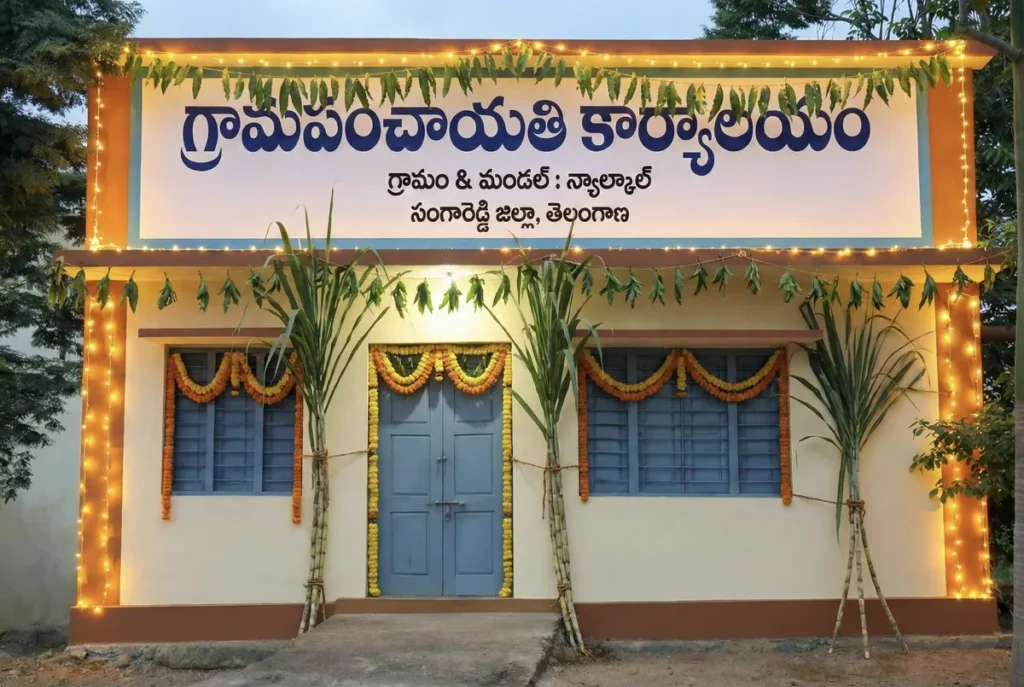
Image: NyalkalEditor, Wikimedia Commons, CC BY-SA 4.0
How to use this in Mains
If asked: UPSC Mains 2024, GS-II: Analyse the role of local bodies in providing good governance at local level and bring out the pros and cons merging the rural local bodies with the urban local bodies.
Quote: “Panchayats lack funds (own revenue is tiny), functions (few States devolved all 29 subjects) and functionaries (staff answer to line departments).”
Use it: Use as the central problem of local bodies.
In the news

Supreme Court: no prior approval under Section 17A needed to probe a bribe demand
In a judgment of 16 October 2026, a Supreme Court Bench of Justices S.V.N. Bhatti and N.V. Anjaria held that investigating a bribe demand by a public servant does not need prior approval under Section 17A of the Prevention of Corruption Act. Asking for a bribe, the court said, is not part of discharging official duties.
19 Oct 2026
CCPA acts against online sale of explosives: 3,940 sellers delisted from seven platforms
The Central Consumer Protection Authority (CCPA) said on 19 October 2026 that 3,940 sellers of regulated explosives such as ammonium nitrate, picric acid and PETN have been delisted from seven online platforms after its action. It has fined Dial4Trade and ExportersIndia ₹10 lakh per order, and other cases are under hearing or investigation.
19 Oct 2026
India to host 61st CIML meeting on legal metrology in New Delhi, 26–28 October
India will host the 61st meeting of the International Committee of Legal Metrology (CIML) for the first time, in New Delhi from 26 to 28 October 2026. The Department of Consumer Affairs is organising it with the International Organization of Legal Metrology (OIML), and more than 100 delegates are expected, PIB said on 19 October.
19 Oct 2026
NMC withdraws MSMER-2023: medical colleges lose the fixed penalty rulebook, annual disclosure stays
The National Medical Commission (NMC) has de-notified the Maintenance of Standards of Medical Education Regulations, 2023 (MSMER-2023) by a notification dated 14 October 2026, published in the Gazette on 16 October. Its fixed penalties, including seat cuts and fines of up to ₹5 lakh for false records, go with it. The Annual Disclosure Report stays.
19 Oct 2026