
Finance Commission of India (Article 280): Composition, Functions, Devolution Criteria and the 16th Finance Commission (UPSC Notes + PYQs)
UPSC has already asked about this. Read the story with these questions in mind.
Background: fiscal federalism in one paragraph
Every federation faces a mismatch between who raises money and who spends it. In India the Union holds the most productive taxes, such as income tax, corporation tax and customs, while States run police, health, schools, agriculture and most public services. Economists call this vertical imbalance. There is also horizontal imbalance: richer States raise far more per person than poorer ones. The framers borrowed from the Government of India Act, 1935 and the Niemeyer Award to create a periodic, expert, constitutional body that would correct both imbalances by formula. Article 280 requires the President to constitute a Finance Commission every five years or earlier. Since 1951 sixteen commissions have been set up, and their awards now decide the flow of a large share of central taxes to the States.
Why it exists
The Union collects the more buoyant taxes, while States carry most spending on health, police, schools and farms. This “vertical fiscal imbalance” needs a neutral body to share money by formula, not by political favour. The Finance Commission is that body; its recommendations are advisory but almost always accepted.
Composition and functions
- A chairman and four members; qualifications set by the Finance Commission (Miscellaneous Provisions) Act, 1951.
- Recommends the distribution of the divisible pool of taxes, principles of grants-in-aid (Art. 275), and measures to augment State Consolidated Funds to support panchayats and municipalities (added by the 73rd/74th Amendments).
- Its report and an explanatory memorandum are laid before Parliament (Art. 281).
- 1Union collects gross tax revenue
- 2Cesses, surcharges and collection cost removed
- 3Divisible pool: net proceeds
- 441% to States (vertical)
- 5Shared by formula among 28 States (horizontal)
The 15th Finance Commission formula (2021-26)
| Criterion | Weight |
|---|---|
| Income distance | 45% |
| Population (2011) | 15% |
| Area | 15% |
| Forest and ecology | 10% |
| Demographic performance | 12.5% |
| Tax effort | 2.5% |
Chaired by N.K. Singh, it gave States 41% of the divisible pool, down from 42% because Jammu and Kashmir became a Union Territory. It also recommended revenue deficit grants, local body grants and disaster management funds.
The 16th Finance Commission
Constituted on 31 December 2023 under Arvind Panagariya, it covers 2026-27 to 2030-31. It submitted its report to the President in November 2025; the report was tabled with the Union Budget for 2026-27.
Vertical and horizontal devolution explained
Vertical devolution is the share of the divisible pool that goes to all States together. The divisible pool is the net proceeds of Union taxes, that is gross tax revenue minus cesses, surcharges and the cost of collection (Article 270). Horizontal devolution is how the States’ share is divided among them, using a formula with weights for need, equity and efficiency. Need is captured by population and area, equity by income distance (poorer States get more), and efficiency by indicators such as demographic performance and tax effort. Besides tax shares, the Commission recommends grants-in-aid under Article 275: revenue deficit grants, grants for rural and urban local bodies, and disaster management grants.
| Commission | Chair | States’ share |
|---|---|---|
| 13th (2010-15) | Vijay Kelkar | 32% |
| 14th (2015-20) | Y.V. Reddy | 42% |
| 15th (2020-26) | N.K. Singh | 41% |
| 16th (2026-31) | Arvind Panagariya | 41% |
Issues for Mains
- Growing cesses and surcharges, which are outside the divisible pool, shrink what States actually get.
- Southern States argue that population-based criteria penalise good demographic performance.
- Conditional grants vs fiscal autonomy.
- Overlap with the GST Council and centrally sponsored schemes.
- Tax sharingVertical and horizontal
- Grants-in-aidArticle 275
- Local bodiesAugment State funds
- Other mattersReferred by President
What the 16th Finance Commission recommended
The 16th Finance Commission submitted its report to the President on 17 November 2025, and it was laid in Parliament on 1 February 2026 with an explanatory memorandum on action taken, as Article 281 requires. The government accepted its recommendation to keep the States’ vertical share at 41% of the divisible pool for 2026-27 to 2030-31. For horizontal devolution the Commission used population, demographic performance, area, forest, per capita income distance and, for the first time, each State’s contribution to national GDP, which rewards economic performance. It also asked the Union to disclose the net proceeds of taxes as certified by the CAG every year, so that the size of the divisible pool is transparent. Grants for rural and urban local bodies and for disaster management continue.
Finance Commission vs other fiscal bodies
| Body | Basis | Role |
|---|---|---|
| Finance Commission | Article 280; every five years | Shares Union taxes; grants-in-aid |
| GST Council | Article 279A | Rates and rules of GST; Union and States vote together |
| State Finance Commission | Articles 243-I and 243Y | Shares State funds with panchayats and municipalities |
| NITI Aayog | Executive resolution, 2015 | Policy think tank; no grant-giving role |
Debates for Mains
- Cesses and surcharges: they are kept outside the divisible pool, so the effective transfer to States is lower than the headline share.
- Equity vs efficiency: heavy weight on income distance helps poorer States but can seem to penalise those that grew and controlled population.
- Terms of reference: States object when the Union adds terms such as defence funding or performance conditions without consulting them.
- Third tier: local body grants depend on States constituting State Finance Commissions on time and publishing accounts.
- Way forward: a permanent FC secretariat, wider consultation on terms, and limits on the share of cesses in gross tax revenue.
Finance Commission: UPSC angle
For UPSC CSE
Prelims: Article 280, who appoints, chairmen, devolution share, criteria. Mains GS-II/III: fiscal federalism, cesses, horizontal equity vs efficiency.
Finance Commission UPSC PYQs (Prelims)
Questions UPSC has actually asked, from the official papers. Pick an option to check yourself.
With reference to the Finance Commission of India, which of the following statements is correct ?
The Finance Commission (Article 280) recommends how central taxes are shared between the Union and the States, the principles of grants-in-aid, and measures for local bodies’ finances. None of the three options describes its work. Answer as per the official UPSC key · Battle IAS PYQ bankAnswer (d) & why
With reference to the Fourteenth Finance Commission, which of the following statements is/are correct?
– 1. It has increased the share of States in the central divisible pool from 32 percent to 42 percent.
– 2. It has made recommendations concerning sector-specific grants.
Select the correct answer using the code given below.
The 14th Finance Commission (Y. V. Reddy, 2015–20) raised the States’ share of the divisible pool from 32% to 42%, the biggest jump ever. It gave grants only for local bodies, disaster relief and revenue deficits, and deliberately made no sector-specific grants, preferring untied money. The 15th FC later fixed the share at 41%. Answer as per the official UPSC key · Battle IAS PYQ bankAnswer (a) & why
Which of the following statements with regard to recommendations of the 15th Finance Commission of India are correct?
– I. It has recommended grants of ₹4,800 crores from the year 2022-23 to the year 2025-26 for incentivizing States to enhance educational outcomes.
– II. 45% of the net proceeds of Union taxes are to be shared with States.
– III. ₹45,000 crores are to be kept as performance-based incentive for all States for carrying out agricultural reforms.
– IV. It reintroduced tax effort criteria to reward fiscal performance.
Select the correct answer using the code given below.
The 15th Finance Commission (N.K. Singh) fixed the States’ share at 41% for 2021-26, not 45%; the 14th FC had given 42%. Its report did include ₹4,800 crore of grants for better educational outcomes, ₹45,000 crore as incentive for agricultural reforms, and it brought back tax effort (2.5% weight) in the devolution formula. Answer as per the official UPSC key · Battle IAS PYQ bankAnswer (c) & why
Mains PYQs on this topic
Questions from the official UPSC Mains papers (2023-2026 in the Battle IAS Mains bank), newest first. Each links to a model answer.
- UPSC Mains 2025 · GS Paper II · Q14 · 15 marks
Examine the evolving pattern of Centre-State financial relations in the context of planned development in India. How far have the recent reforms impacted the fiscal federalism in India?
Quick quiz
The Finance Commission is constituted under
Every five years or earlier.Answer (b)
Which criterion had the highest weight in the 15th FC formula?
45%.Answer (c)
The chairman of the 16th Finance Commission is
Constituted on 31 December 2023.Answer (c)
FAQs
Are Finance Commission recommendations binding?
No, they are advisory, but by convention they are largely accepted.
What is vertical devolution?
The share of the divisible pool of central taxes that goes to States as a whole.
What is horizontal devolution?
How the States’ share is divided among individual States, using criteria such as income distance and population.
Do cesses go to States?
No. Cesses and surcharges are outside the divisible pool.
Are Finance Commission recommendations binding?
No, they are advisory, but by convention the Union has accepted the main tax-sharing recommendations of every Commission.
What is the divisible pool?
The net proceeds of Union taxes after excluding cesses, surcharges and the cost of collection; only this pool is shared with States.
How is the Finance Commission different from NITI Aayog?
The Finance Commission is a constitutional body that decides tax shares and grants; NITI Aayog is an executive think tank with no power to transfer funds.
Spotted an error? Tell us. We correct within 48 hours.
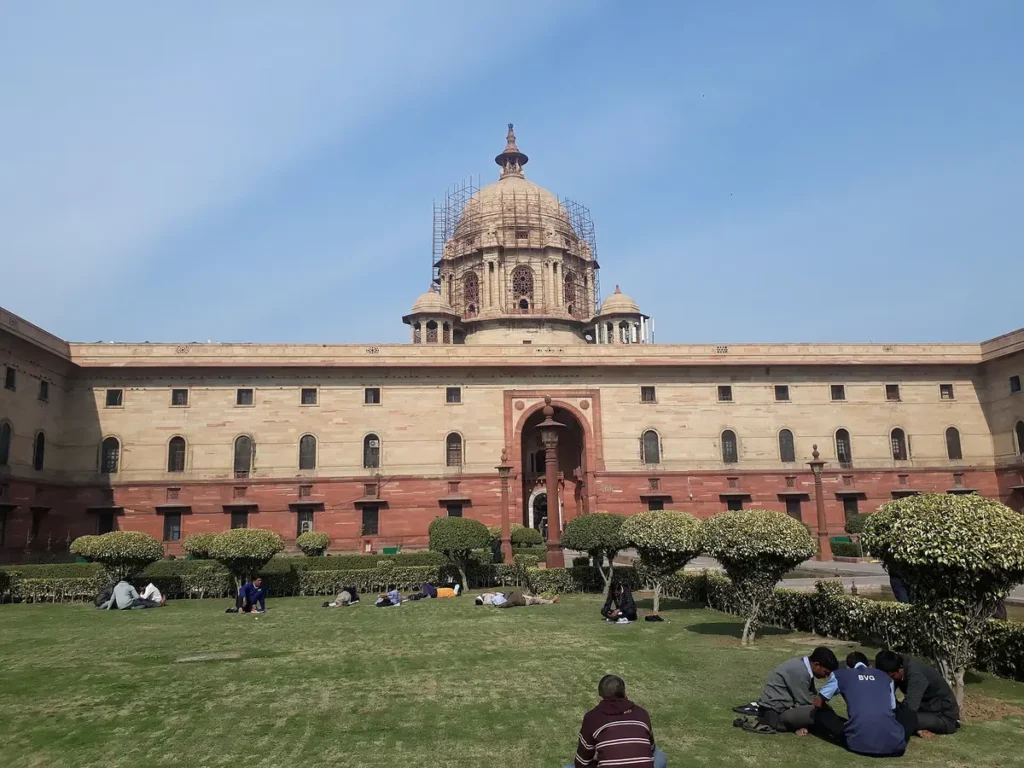
Image: Pinakpani, Wikimedia Commons, CC BY-SA 4.0
How to use this in Mains
If asked: UPSC Mains 2025, GS-II: Examine the evolving pattern of Centre-State financial relations in the context of planned development in India. How far have the recent reforms impacted the fiscal federalism in India?
Quote: “Growing cesses and surcharges, which are outside the divisible pool, shrink what States actually get.”
Use it: Use as the key issue in Centre-State financial relations.
In the news

Supreme Court: no prior approval under Section 17A needed to probe a bribe demand
In a judgment of 16 October 2026, a Supreme Court Bench of Justices S.V.N. Bhatti and N.V. Anjaria held that investigating a bribe demand by a public servant does not need prior approval under Section 17A of the Prevention of Corruption Act. Asking for a bribe, the court said, is not part of discharging official duties.
19 Oct 2026
CCPA acts against online sale of explosives: 3,940 sellers delisted from seven platforms
The Central Consumer Protection Authority (CCPA) said on 19 October 2026 that 3,940 sellers of regulated explosives such as ammonium nitrate, picric acid and PETN have been delisted from seven online platforms after its action. It has fined Dial4Trade and ExportersIndia ₹10 lakh per order, and other cases are under hearing or investigation.
19 Oct 2026
India to host 61st CIML meeting on legal metrology in New Delhi, 26–28 October
India will host the 61st meeting of the International Committee of Legal Metrology (CIML) for the first time, in New Delhi from 26 to 28 October 2026. The Department of Consumer Affairs is organising it with the International Organization of Legal Metrology (OIML), and more than 100 delegates are expected, PIB said on 19 October.
19 Oct 2026
NMC withdraws MSMER-2023: medical colleges lose the fixed penalty rulebook, annual disclosure stays
The National Medical Commission (NMC) has de-notified the Maintenance of Standards of Medical Education Regulations, 2023 (MSMER-2023) by a notification dated 14 October 2026, published in the Gazette on 16 October. Its fixed penalties, including seat cuts and fines of up to ₹5 lakh for false records, go with it. The Annual Disclosure Report stays.
19 Oct 2026