
SCO Heads of Government meet in Dushanbe: Rajnath calls for dismantling the terror ecosystem
Next story · 21 OctRubio at Jamnagar: US pitches oil and Venezuelan crude to India’s ‘refining superpower’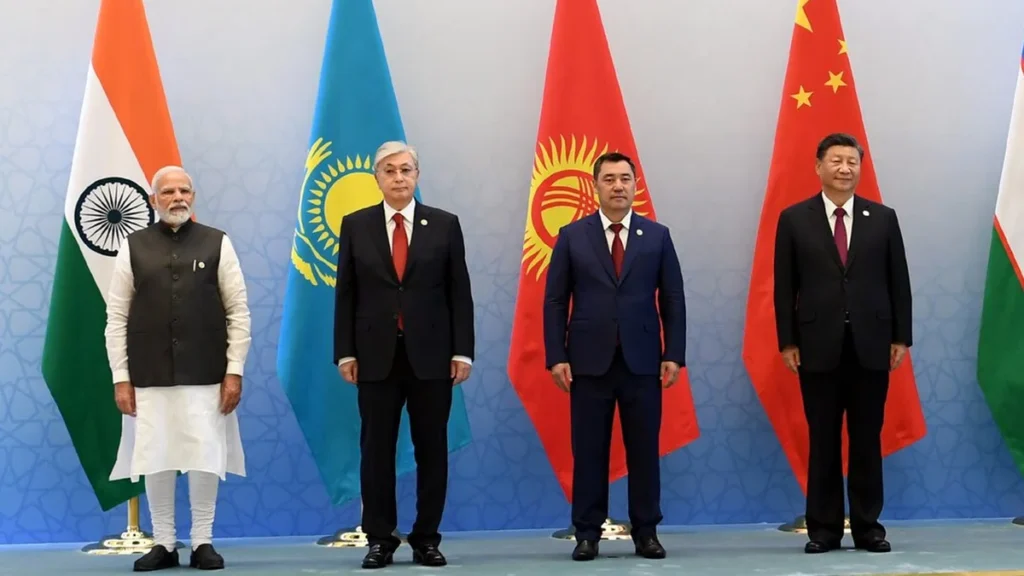
UPSC has already asked about this. Read the story with these questions in mind.
- Prelims 2025India is one of the founding members of the International North-South Transport Corridor (INSTC), a multimodal transportation corridor, which will connectSolve with answer →
- Mains 2023 · GS2‘Virus of Conflict is affecting the functioning of the SCO’ In the light of the above statement point out the role of India in…See model answer →
Defence Minister Rajnath Singh represented India at the 25th meeting of the SCO Council of Heads of Government in Dushanbe, Tajikistan, on 20 October 2026. With Pakistan’s Deputy Prime Minister in the room, he said there can be no justification and no double standards on terrorism. The meeting adopted the SCO budget for 2027 and a 2026–30 action plan for trade and economic cooperation.
- Meeting
- 25th SCO CHG
- Venue, date
- Dushanbe, 20 Oct 2026
- India represented by
- Rajnath Singh
- Adopted
- PMTEC Action Plan 2026–30
SCO Heads of Government meeting: what happened?
The SCO is one of the few forums where India sits at the same table as both China and Pakistan. So every line India speaks there is chosen with care, and this one was blunt: no place for those who finance or shelter terrorists.
- Rajnath Singh called on members to dismantle ‘the entire ecosystem of terrorism’ (PIB, 20 Oct 2026).
- He said new SCO bodies must meet real needs: ‘A greater number of institutions does not necessarily translate into greater achievements.’
- India backed the Action Plan for the Multilateral Trade and Economic Cooperation Programme (PMTEC) for 2026–30.
- He invited members to the first SCO Civilisational Dialogue Forum, to be hosted by India later this year.
What is the SCO and its Heads of Government council?
- Founded in 2001 in Shanghai; India and Pakistan became full members in 2017.
- Permanent bodies: the Secretariat in Beijing and the Regional Anti-Terrorist Structure (RATS) in Tashkent.
- The Council of Heads of State is the top body; the Council of Heads of Government (CHG) handles economic and practical cooperation and the budget.
- The Bishkek summit (Aug–Sep 2026) decided on a Universal Centre in Tashkent and an Anti-Drug Centre in Dushanbe as permanent bodies.
What did India push, and what did it guard against?
| India pushed | India guarded against |
|---|---|
| Joint action on terror finance and safe havens | Double standards on terrorism |
| INSTC and Chabahar for Central Asian links | Projects that ignore sovereignty (read: CPEC through PoK) |
| Simpler customs, digital documents, DPI | New bodies that duplicate old ones |
| ISA, CDRI, Mission LiFE, Global Biofuel Alliance | — |
Which legal and treaty frameworks apply?
- SCO Charter (2002) and the Shanghai Convention on combating terrorism, separatism and extremism (2001).
- UNSC Resolution 1373 (2001) obliges states to deny safe haven and financing to terrorists.
- UNSC 1267 Committee runs the sanctions list on ISIL and Al-Qaida-linked individuals.
- In India, the UAPA, 1967 is the main counter-terror law; Article 51(c) asks the State to respect international law.
What are the challenges for India in the SCO?
- Consensus rule lets China and Pakistan dilute language on cross-border terror.
- China’s Belt and Road and CPEC clash with India’s sovereignty concerns.
- Western partners see the SCO as China–Russia led; India must balance that with the Quad.
- Connectivity to Central Asia still depends on Iran, where war and the Hormuz blockade add risk.
What should India do next?
- Use RATS for intelligence sharing on terror finance and drones.
- Push Chabahar and INSTC as the sovereignty-respecting route to Central Asia.
- Offer DPI and digital customs tools as practical public goods.
- Use the Civilisational Dialogue Forum to build soft power.
What can Prelims ask on the SCO?
- SCO Secretariat: Beijing; RATS: Tashkent.
- India: observer 2005, full member 2017.
- 25th CHG: Dushanbe, 20 Oct 2026; 2026 summit: Bishkek.
- New permanent bodies: Universal Centre (Tashkent), Anti-Drug Centre (Dushanbe).
- INSTC links India, Iran, Russia via sea, rail and road.
How to write about the SCO in Mains
Practice question (10 marks, 150 words): Is the SCO useful for India’s security and connectivity goals? Critically examine. (GS-II)
- Intro: 25th CHG, Dushanbe, 20 Oct 2026.
- Gains: RATS, Central Asia access, a seat with China and Russia.
- Limits: consensus, Pakistan, BRI/CPEC.
- India’s approach: no double standards, sovereignty-based connectivity.
- Conclusion: engage, but set the agenda.
Image: Prime Minister Narendra Modi with the leaders of Kazakhstan, Kyrgyzstan and China at the SCO summit in Samarkand, 16 September 2022. Prime Minister’s Office, Government of India, Wikimedia Commons, GODL-India
How to use this in Mains
If asked: Discuss the role of regional organisations in countering terrorism. (GS-III)
Quote: “There can be no justification for terrorism, no double standards in addressing it, and no place for those who finance, support, or provide safe havens to terrorists.”
Use it: Use it as India’s stated position, then add RATS and UNSC 1373.
If asked: Examine India’s approach to connectivity projects in Eurasia. (GS-II)
Quote: “Connectivity must be based on consultation and respect for the sovereignty and territorial integrity of all countries.”
Use it: Quote it while contrasting INSTC and Chabahar with CPEC.
Exam angle
Prelims: SCO bodies and locations, new centres, INSTC. · Mains GS-II: SCO’s value for India; GS-III: terror financing.
Practice MCQs
Original practice questions (not PYQs).
Consider the following statements about the SCO:
1. Its Secretariat is in Beijing.
2. Its Regional Anti-Terrorist Structure is in Tashkent.
3. India became a full member in 2005.
How many of the statements given above are correct?
Answer (b) & explanation
Statements 1 and 2 are correct. India was an observer from 2005 and a full member from 2017.
The 25th meeting of the SCO Council of Heads of Government in October 2026 was held in
Answer (c) & explanation
It was held in Dushanbe, Tajikistan, on 20 October 2026; the 2026 summit was in Bishkek.
Which of the following are among the founding members of the SCO (2001)?
1. Uzbekistan
2. India
3. Kazakhstan
4. Pakistan
Select the correct answer using the code given below.
Answer (a) & explanation
Founding members: China, Russia, Kazakhstan, Kyrgyzstan, Tajikistan and Uzbekistan. India and Pakistan joined in 2017.
Questions students ask about this
Who represented India at the SCO CHG?
Defence Minister Rajnath Singh.
What did the meeting adopt?
A joint communique, the SCO budget for 2027 and the PMTEC Action Plan 2026–30.
Which new SCO bodies were welcomed?
A Universal Centre in Tashkent and an Anti-Drug Centre in Dushanbe.
What will India host?
The first SCO Civilisational Dialogue Forum, later this year.
Keep studying
Go deeper
Official source: PIB, 20 Oct 2026: 25th SCO Council of Heads of Government Meeting: Raksha Mantri calls for unified action to dismantle the entire ecosystem of terrorism
facts from cited sources only; faculty review pending