
Cooperative federalism and law reform: Law Commission proposes a ‘citizen friction test’
Next story · 22 OctBadr pact: Pakistan, Türkiye, Qatar and Indonesia sign a defence-industry MoU in Doha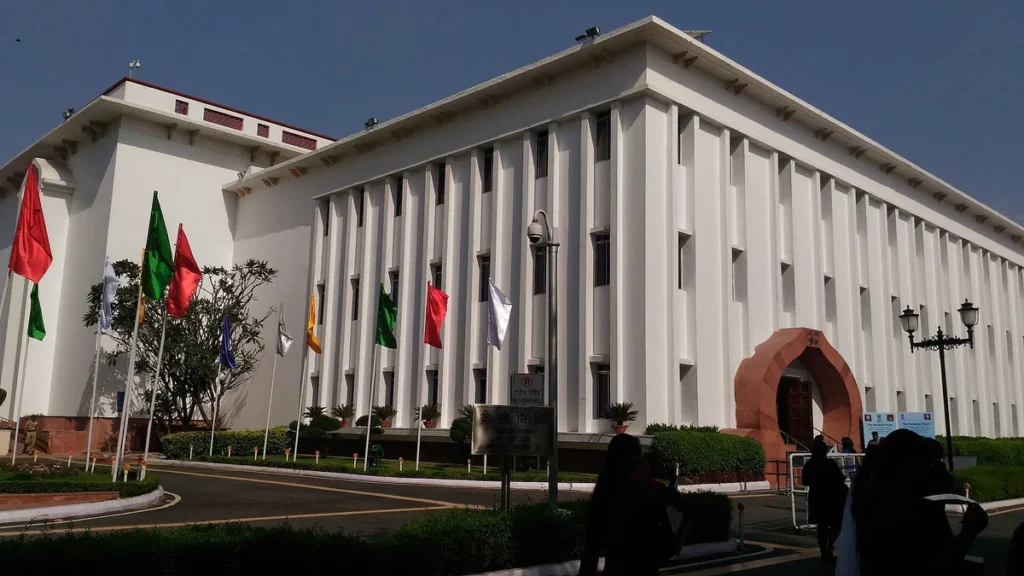
UPSC has already asked about this. Read the story with these questions in mind.
On 22 October 2026, the 23rd Law Commission of India held a national conference on ‘Co-operative Federalism and Law Reforms’ at Vigyan Bhawan, inaugurated by Vice-President C. P. Radhakrishnan. He urged State Law Commissions to find and repeal outdated laws. Law Commission Chairperson Justice (retd.) Dinesh Maheshwari proposed a ‘citizen friction test’ to check whether a law reduces the time, cost and paperwork it imposes on citizens.
- Date
- 22 Oct 2026
- Organiser
- 23rd Law Commission
- Obsolete laws repealed
- 1,700+ in 12 years
- New idea
- Citizen friction test
Law Commission conference: what happened?
Laws are made in Delhi and in 28 State capitals, but the citizen meets them as one system. This conference asked how the Centre and States can reform laws together, without making everything uniform.
- The Vice-President cited the replacement of three colonial criminal laws and the repeal of over 1,700 obsolete laws in 12 years (PIB).
- He said cooperative federalism in law reform ‘does not imply uniformity in every matter’.
- Law Minister Arjun Ram Meghwal listed four priorities: continuous dialogue, evidence-based and participatory reform, technology with human oversight, and citizen-centric design.
- Justice Maheshwari proposed a common law-reform docket, joint studies, post-enactment review and first joint issue papers within about six months.
What is the Law Commission?
- A non-constitutional, non-statutory body set up by executive order for a fixed term, usually three years.
- First Law Commission of independent India: 1955, chaired by M. C. Setalvad.
- It studies laws and recommends reform, on reference from the government or on its own.
- Its reports are advisory; governments may accept or reject them.
How do Union and State law-making interact?
| Tool | What it does |
|---|---|
| Seventh Schedule | Divides subjects into Union, State and Concurrent Lists |
| Article 252 | Parliament can legislate for States that consent on a State subject |
| Article 254 | Resolves conflicts on Concurrent subjects |
| Article 263 | Inter-State Council for Centre–State coordination |
Which constitutional provisions apply?
- Article 1: India, that is Bharat, shall be a Union of States.
- Article 245–246: territorial extent and subject-wise division of legislative power.
- Article 254(2): a State law on a Concurrent subject can prevail in that State with the President’s assent.
- Article 39A: equal justice and free legal aid.
What are the challenges?
- Many States have no active State Law Commission.
- Old State laws stay on the books because no one reviews them.
- Post-enactment review of laws is rare in India.
- Political differences between Centre and States slow joint work.
What should be done next?
- Set up or revive State Law Commissions with a shared reform docket.
- Apply the citizen friction test before and after laws are passed.
- Use the Inter-State Council and zonal councils for legal coordination.
- Publish plain-language guides to new laws.
What can Prelims ask on the Law Commission?
- Law Commission: executive body, not constitutional or statutory.
- First (pre-independence) Law Commission: 1834, chaired by Lord Macaulay.
- First after independence: 1955, M. C. Setalvad.
- 23rd Law Commission chair: Justice (retd.) Dinesh Maheshwari.
- Inter-State Council: Article 263; set up in 1990 on the Sarkaria Commission’s advice.
How to write about cooperative federalism in Mains
Practice question (10 marks, 150 words): Cooperative federalism in law reform does not mean uniformity. Discuss. (GS-II)
- Intro: Law Commission conference, 22 Oct 2026.
- Constitution: Lists, Articles 252, 254, 263.
- Practice: repeal of obsolete laws, new criminal laws.
- Ideas: joint docket, citizen friction test, post-enactment review.
- Conclusion: one citizen, one justice system, many law-makers.
Image: Vigyan Bhawan, New Delhi. Sumita Roy Dutta, Wikimedia Commons, CC BY-SA 4.0
How to use this in Mains
If asked: Discuss the role of the Law Commission in legal reform in India. (GS-II)
Quote: “For the citizen, justice is not divided between the Lists of the Seventh Schedule.”
Use it: Use Justice Maheshwari’s line to argue for Centre–State cooperation.
If asked: ‘Cooperative federalism is essential for good governance.’ Comment. (GS-II)
Quote: “The task is not to make every State think alike. It is to ensure that no State has to think alone.”
Use it: Quote it to show cooperation without uniformity.
Exam angle
Prelims: Law Commission, Articles 1, 252, 254, 263. · Mains GS-II: cooperative federalism; law reform.
Practice MCQs
Original practice questions (not PYQs).
The Law Commission of India is
Answer (c) & explanation
The Law Commission is constituted by an executive order for a fixed term.
Which Article of the Constitution provides for an Inter-State Council?
Answer (c) & explanation
Article 263 empowers the President to set up an Inter-State Council.
Under Article 252 of the Constitution, Parliament may legislate on a State subject for two or more States when
Answer (b) & explanation
Article 252 needs resolutions by the legislatures of two or more States.
Questions students ask about this
What is the ‘citizen friction test’?
A check on whether a law reduces the time, cost and procedural burden on citizens.
Who organised the conference?
The 23rd Law Commission of India.
What did the Vice-President ask States to do?
Identify and repeal or amend outdated laws through State Law Commissions.
Is the Law Commission a statutory body?
No. It is set up by an executive order.
Keep studying
Go deeper
Official source: PIB, 22 Oct 2026: Vice-President inaugurates Conference on Cooperative Federalism and Law Reforms
facts from cited sources only; faculty review pending