
Bleached corals revived in the lab: two studies on algae transfer and heat-tolerant symbionts
A bleached coral looks dead, but it is often just starving, and scientists have found two ways to feed it back to life. In 2023–25, about 80% of the world’s reefs, including Lakshadweep’s, faced extreme heat in the fourth global mass bleaching. Two lab studies show recovery is possible: a base for future work, not a cure. Time to revise coral biology and India’s reefs.
- Heat stress
- ~80% of reefs, 2023–25
- Event
- 4th global mass bleaching
- Lab algae
- Strain SS8
- India hit
- Lakshadweep reefs
Coral recovery studies: what happened?
- Study one: brief contact between bleached and healthy corals passed on algae and led to full recovery, often within days. It worked only between corals of the same genetic background (close relatives).
- Study two (Environmental Microbiology Reports): a lab-made heat-tolerant algae strain, SS8, was put into two Great Barrier Reef corals, Galaxea fascicularis and Psammocora columna.
- Donor and receiving corals fused (grew together) within three and nine days; SS8 could also spread through the water.
- Rohan Arthur of the Nature Conservation Foundation: “Both these papers show, with eloquent simplicity, a mechanism that has been suspected was possible for a long time.”
What is coral bleaching?
Think of a coral as a house and the algae as tenants paying rent in food. Heat makes the house evict them.
- Corals are colonies of tiny animals called polyps (phylum Cnidaria, the jellyfish family) that build calcium carbonate (limestone) skeletons.
- Algae called zooxanthellae live inside them and make most of their food by photosynthesis (using sunlight). They also give corals colour.
- When water gets too warm, corals push the algae out and turn white: this is bleaching.
- Bleaching is not instant death. Corals can recover if the water cools soon, but long heat kills them.
Study one vs study two
| Point | Contact with healthy coral | Heat-tolerant algae SS8 |
|---|---|---|
| Method | Brief contact between bleached and healthy corals | Lab-made algae strain introduced |
| Result | Full recovery, often within days | Fusion in 3 and 9 days; spread through water |
| Limit | Only within the same genetic background | Tested in tanks on two species |
| Use | Basis for recovery interventions | Possible heat-hardy reefs in future |
What exactly is SS8?
A strain of the alga Cladocopium proliferum, grown for years in warmer water until it got used to heat. Corals also picked it up from the water, so fusion alone is not proven to pass it on.
What protects India’s reefs?
- India’s reefs: Gulf of Mannar, Gulf of Kachchh, Andaman and Nicobar Islands and Lakshadweep (not the Sundarbans).
- All reef-building corals are in Schedule I (highest protection) of the Wild Life (Protection) Act, 1972.
- Coastal Regulation Zone rules restrict building near sensitive coasts.
- Gulf of Mannar and Gulf of Kachchh have Marine National Parks.
How serious is the threat?
| Measure | Figure |
|---|---|
| Reefs under extreme heat stress, 2023–25 | About 80% |
| Global mass bleaching events | 1998, 2010, 2014–17, 2023–25 |
| Annual mass bleaching expected by | 2080 |
| Warming beyond which widespread coral death is expected | 3°C |
What should you note for the exam?
| Angle | What to note |
|---|---|
| Biology | Polyps, Cnidaria, zooxanthellae, calcium carbonate |
| Map | Indian reef sites; one-third of world reefs in Australia, Indonesia, Philippines |
| Threats | Warming, acidification, pollution, overfishing |
| Restoration | Biorock technology; coral nurseries; heat-tolerant symbionts |
What are the challenges?
- Heat is the root cause: lab fixes cannot replace cutting emissions.
- Hard to scale: recovery worked only between related corals in tanks.
- Ocean acidification (seas turning more acidic) weakens skeletons even without bleaching.
- Pollution, overfishing and coastal building slow recovery.
What should be done?
- Test heat-tolerant algae and coral nurseries in Lakshadweep and the Gulf of Mannar.
- Control local pollution, overfishing and construction so reefs recover between heatwaves.
- Expand reef monitoring and early bleaching alerts.
- Cut emissions: the only long-term fix.
What can Prelims ask on corals?
- Zooxanthellae: symbiotic algae; bleaching = their expulsion.
- Corals belong to the phylum Cnidaria.
- Indian reefs: Gulf of Mannar, Gulf of Kachchh, Andaman and Nicobar, Lakshadweep.
- Coral reefs host more animal phyla than tropical rainforests.
- Biorock technology: restoring damaged reefs.
Probability in Prelims: Expect a statement question on coral bleaching: heat makes corals expel their symbiotic algae (zooxanthellae); India’s reefs lie in the Gulf of Mannar, Gulf of Kachchh, Andaman and Nicobar Islands and Lakshadweep.
How to write about coral reefs in Mains
Practice question (15 marks, 250 words): Assess the impact of global warming on the coral life system with examples. (GS-I, 2019)
- Intro: 80% of reefs under heat stress in 2023–25; fourth global bleaching.
- Body 1: how bleaching works; zooxanthellae.
- Body 2: examples: Great Barrier Reef, Lakshadweep, Andaman.
- Body 3: new science: algae transfer and SS8; limits of scale.
- Way forward: emission cuts, local protection, restoration research.
Ready lines for your answer
If asked: Assess the impact of global warming on the coral life system with examples. (GS-I, 2019)
Quote: “Because bleaching resistance was only transferred between individuals of the same genet, it is difficult to conceive of how this can translate into reef-wide interventions.”
Use it: Use it to show the limits of lab solutions.
If asked: Discuss the measures needed to conserve India’s marine biodiversity. (GS-III)
Quote: “Both these papers show, with eloquent simplicity, a mechanism that has been suspected was possible for a long time.”
Use it: Quote it while discussing research-led restoration.
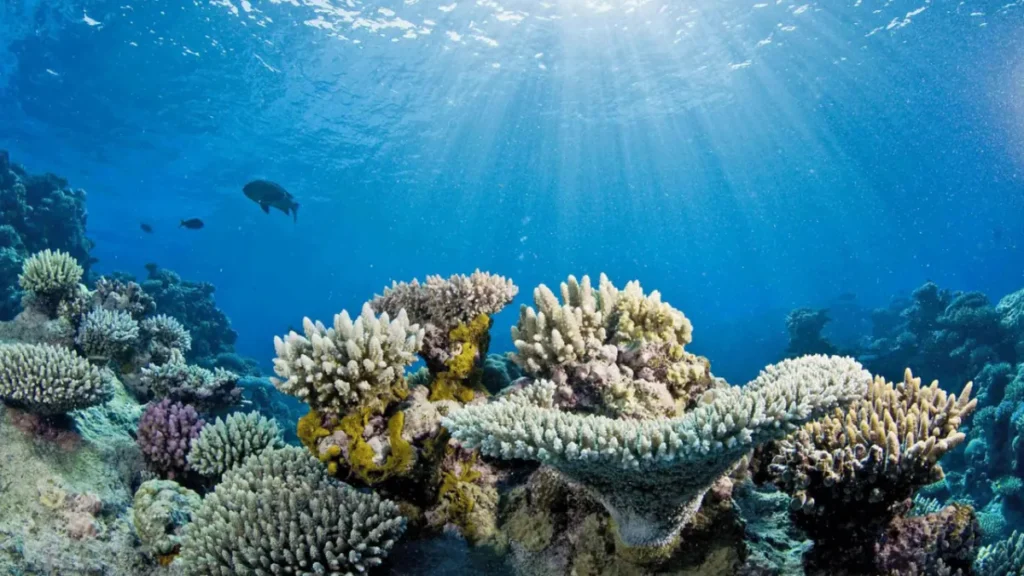
Image: A coral reef with healthy corals and some showing signs of bleaching. NOAA, via Wikimedia Commons, Public domain
Exam angle
Prelims: zooxanthellae, Cnidaria, Indian reef sites, Biorock. · Mains GS-I/III: global warming and coral ecosystems.
Practice MCQs
Original practice questions (not PYQs).
Consider the following statements:
1. Corals get most of their food from algae living in their tissues.
2. A bleached coral is always dead.
3. The Sundarbans has large coral reefs.
Which of the statements given above is/are correct?
Answer (a) & explanation
Bleached corals can recover if the water cools; the Sundarbans is a mangrove area.
Which of the following have coral reefs?
1. Andaman and Nicobar Islands
2. Gulf of Kachchh
3. Gulf of Mannar
4. Sundarbans
Select the correct answer using the code given below.
Answer (a) & explanation
The Sundarbans has no coral reefs.
‘Biorock technology’ is associated with:
Answer (a) & explanation
Biorock uses a mild electric current on steel frames to help corals regrow.
Questions students ask about this
Can bleached corals recover?
Yes, if the water cools in time. The new studies show recovery can be faster with help from healthy corals or heat-tolerant algae.
Why do corals bleach?
Heat makes them push out their algae (zooxanthellae), which give them food and colour.
Is a bleached coral dead?
Not yet. It is alive but starving; long heat kills it.
Where are India’s coral reefs?
Gulf of Mannar, Gulf of Kachchh, Andaman and Nicobar Islands and Lakshadweep.
Can lab methods save reefs?
Not alone. Scientists call them a base for research; cutting ocean warming is still essential.