
Iran warns of an ‘apocalyptic war’ if attacked again: what it means for India, the Strait of Hormuz and BRICS
One narrow sea lane carries a fifth of the world’s oil, and Iran has just threatened war around it. Iran says any new attack by the United States (US) and Israel will become an “apocalyptic war” hitting the Gulf kingdoms around it, and US warships will not enter the Persian Gulf. Its Speaker will also skip a BRICS meeting in Delhi. For you, it links the Strait of Hormuz, the Gulf Cooperation Council and India’s energy security.
- Who warned
- IRGC spokesperson Hossein Mohebbi
- Flashpoint
- Persian Gulf and Strait of Hormuz
- India link
- Speaker skips BRICS forum, Delhi
- Indians in Gulf
- About 90 lakh
Iran’s warning: what happened?
Iran has fought two rounds of war with the US and Israel. With talk of fresh US strikes, it has given its sharpest warning yet.
- 24 Oct 2026: Brigadier General Hossein Mohebbi, spokesperson of the Islamic Revolutionary Guard Corps (IRGC, Iran’s most powerful military force), said that if attacked, Iran “will achieve absolute victory in this apocalyptic war”, which would “decide the fate” of other nations in the region.
- He meant the Gulf monarchies (countries ruled by kings), where Iran hit US bases and energy sites earlier in the war.
- Major General Ali Abdollahi, Chief of the General Staff of Iran’s Armed Forces, said US naval forces are “no longer capable of approaching the Persian Gulf waters”.
- India angle: Speaker Mohammad Bagher Ghalibaf will skip the BRICS Parliamentary Forum in New Delhi (26–27 Oct); a delegation will go instead.
What is the medicine-flight row with India?
- Reports said India did not let Iran Air fly medicines to Tehran, fearing US sanctions (penalties for dealing with Iran) on Indian airports and operators.
- India’s position: Iran “is free to take delivery of such medical consignments through a third country like Armenia”.
- Iran’s position: humanitarian aid is “not under any international sanction”; some temperature-sensitive drugs were spoiled.
- Indian officials say the Speaker’s decision is not linked to medicines, which Indian firms keep sending through Oman and Armenia.
Gulf Cooperation Council vs BRICS: where does Iran stand?
| Point | Gulf Cooperation Council | BRICS |
|---|---|---|
| Founded | 1981, headquarters Riyadh | First summit 2009, Yekaterinburg |
| Members | Saudi Arabia, UAE, Qatar, Kuwait, Bahrain, Oman | Brazil, Russia, India, China, South Africa + new members |
| Iran | Not a member | Member since 2024 |
| India’s role | Top trade partner; home to most Indians abroad | Chair in 2026; hosts the Parliamentary Forum |
What is the geography and legal angle?
Picture the Persian Gulf as a room with one narrow door: the Strait of Hormuz.
- Strait of Hormuz: between Iran and Oman’s Musandam peninsula; links the Persian Gulf with the Gulf of Oman and the Arabian Sea; about 39 km (21 nautical miles) wide at its narrowest.
- Ships from Bahrain, Qatar, Kuwait and Iraq must cross it to reach the Indian Ocean; about one-fifth of world oil trade passes through it.
- India’s stake: nearly half its crude oil and over half its LNG (liquefied natural gas) imports pass here (Indian Express).
- UN Convention on the Law of the Sea: ships have a right of “transit passage” through international straits.
- Chabahar Port: on Iran’s Gulf of Oman coast, outside the Strait; India Ports Global Limited runs its Shahid Beheshti terminal under a 10-year deal (2024).
Map in words (remember it forever)
Sail out of the Gulf towards India: Iran is on your left, Oman’s Musandam on your right. Past the “door”, Chabahar sits on Iran’s coast to your left, outside the chokepoint. That is why India chose it.
How does a Gulf war reach India?
From a strike in the Gulf to an Indian household
- A strike on Iran → Iran attacks Gulf oil sites or ships.
- Tankers avoid Hormuz; shipping and insurance costs jump.
- Crude oil and LPG (cooking gas) get costlier; India, which imports most of its oil, pays more.
- Jobs and money sent home by about 90 lakh Indians in the Gulf are at risk.
- India must plan evacuations, as before.
What should you note for the exam?
| Angle | What to note |
|---|---|
| Map | Hormuz, Musandam, Gulf of Oman, Chabahar, Bandar Abbas |
| Groupings | GCC members vs non-members; BRICS expansion (2024, 2025) |
| Connectivity | Chabahar and the International North–South Transport Corridor (INSTC) |
| Energy | Hormuz chokepoint; Sumed pipeline as another route to Europe |
| Diaspora | About 90 lakh Indians in Gulf countries |
What are the challenges for India?
- Energy at risk: a wider war threatens the oil and gas India buys through Hormuz.
- People at risk: Iran has already hit energy sites in Gulf countries where lakhs of Indians work.
- Sanctions squeeze: fear of US sanctions blocks even medicine trade with Iran, a BRICS partner.
- Projects like Chabahar and the North–South corridor slow down in wartime.
What should India do?
- Create a sanction-proof channel for medicines.
- Keep talking to all sides: Iran, the Gulf states and the US.
- Keep evacuation plans and naval escorts ready.
- Buy oil from more countries and fill strategic petroleum reserves (emergency oil stocks) while prices allow.
What can Prelims ask on Iran and the Gulf?
- Strait of Hormuz: between Iran and Oman (Musandam); links the Persian Gulf and the Gulf of Oman.
- GCC: six members; Iran and Iraq are not members.
- BRICS: Egypt, Ethiopia, Iran and the UAE joined in 2024; Indonesia in January 2025; India chairs in 2026.
- New Development Bank (the BRICS bank): headquarters Shanghai.
- Chabahar: on the Gulf of Oman, outside Hormuz; part of the INSTC route.
Probability in Prelims: Expect a map-based question on the Strait of Hormuz: it links the Persian Gulf to the Gulf of Oman, and ships from Bahrain, Qatar, Kuwait and Iraq must cross it to reach the Indian Ocean.
How to write about the Iran crisis in Mains
Practice question (15 marks, 250 words): “Energy security is the kingpin of India’s West Asia policy.” In light of the renewed Iran–United States tensions, discuss India’s options. (GS-II)
- Intro: Iran’s ‘apocalyptic war’ warning of 24 Oct 2026 in one line.
- Body 1: stakes: Hormuz oil route, 90 lakh Indians, remittances.
- Body 2: the sanctions dilemma: the medicine-flight row and the Armenia route.
- Body 3: strategic links: Chabahar, INSTC, BRICS chair year.
- Way forward: multi-alignment, diversified crude, evacuation readiness, humanitarian channels.
Ready lines for your answer
If asked: In what ways would the US–Iran confrontation affect India’s national interest? How should India respond? (GS-II, 2018)
Quote: “Preserving the country's [territorial] integrity and safeguarding its national and religious identity are among the most important responsibilities of the Iranian nation today.”
Use it: Quote it to show how Tehran frames the war as existential, which makes escalation likely.
If asked: How would you integrate energy security with India’s foreign policy in the coming years? (GS-II, 2025)
Quote: “India is free to take delivery of such medical consignments through a third country like Armenia.”
Use it: Use it to show how sanctions shape even humanitarian ties, and why India needs alternate channels.
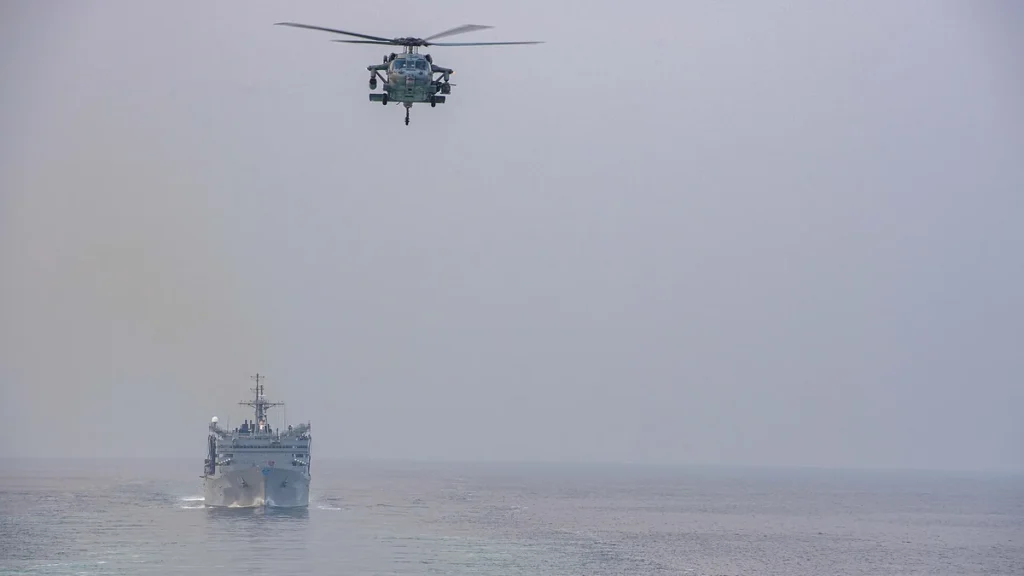
Image: A U.S. Navy ship and helicopter of the Dwight D. Eisenhower Carrier Strike Group transiting the Strait of Hormuz. U.S. Navy, via Wikimedia Commons, Public domain
Exam angle
Prelims: Strait of Hormuz, GCC members, BRICS expansion, Chabahar, INSTC. · Mains GS-II: India’s West Asia policy and energy security.
Practice MCQs
Original practice questions (not PYQs).
Consider the following statements:
1. Iran is a member of the Gulf Cooperation Council.
2. The Strait of Hormuz lies between Iran and Oman.
3. Iran is a member of BRICS.
Which of the statements given above are correct?
Answer (b) & explanation
Iran is not a GCC member; the GCC has six Arab members. The Strait lies between Iran and Oman’s Musandam peninsula, and Iran joined BRICS in 2024.
Ships from which of the following countries must cross the Strait of Hormuz to reach the Indian Ocean?
1. Kuwait
2. Oman
3. Qatar
4. Iraq
Select the correct answer using the code given below.
Answer (a) & explanation
Kuwait, Qatar and Iraq lie inside the Persian Gulf. Oman has a long coast on the Gulf of Oman and the Arabian Sea outside the Strait.
Chabahar Port, developed with India’s help, is located on the coast of:
Answer (b) & explanation
Chabahar is on Iran’s Gulf of Oman coast, outside the Strait of Hormuz, which is why it matters for India’s access to Afghanistan and Central Asia.
Questions students ask about this
Can Iran really close the Strait of Hormuz?
It can threaten ships, but closing it would also block Iran’s own oil exports, so it is mostly used as a threat.
Why is the Strait of Hormuz so important for India?
About one-fifth of world oil trade, and nearly half of India’s crude imports, pass through it.
Is Iran a member of the Gulf Cooperation Council?
No. The GCC has six Arab members: Saudi Arabia, UAE, Qatar, Kuwait, Bahrain, Oman. Iran is in BRICS instead.
Why is Iran’s Speaker skipping the BRICS meet in Delhi?
It came amid a row over a blocked Iran Air medicine flight; India says the two are not linked.
How would a Gulf war affect common Indians?
Fuel and cooking gas could cost more, and about 90 lakh Indians working in the Gulf could lose income.