
Nearly all coral reefs critically endangered: global study
The first global check of coral reefs on the IUCN Red List of Ecosystems is out. It finds almost all of the world’s reefs Critically Endangered because of future ocean warming. All four of India’s reef regions are on the list. Read it to revise coral bleaching, ocean acidification and India’s reef areas.
- Reef units at risk
- 96%
- Reef area covered
- 99.8%
- Released at
- COP17, Yerevan, Armenia
- India’s sites
- 162 of 350
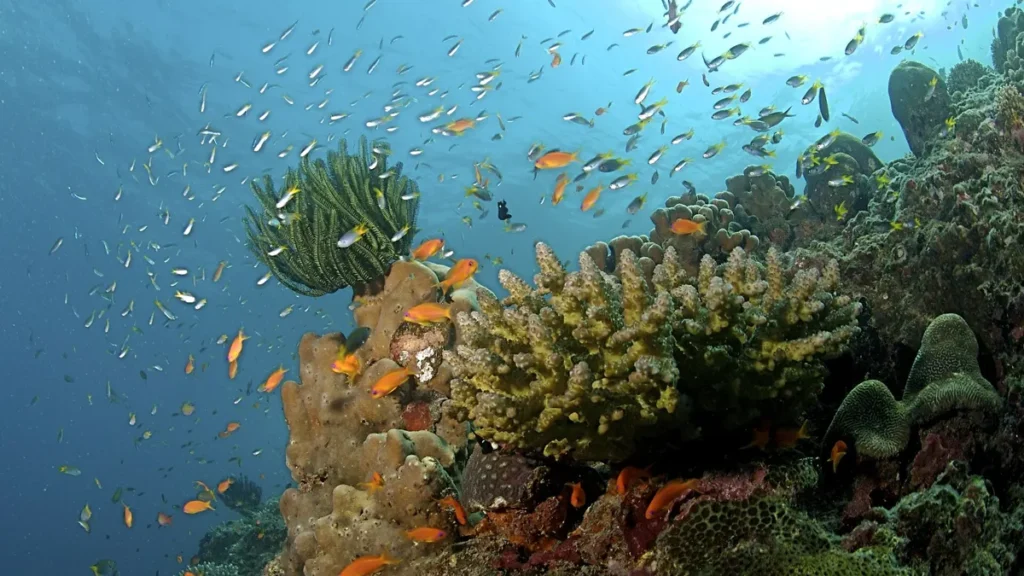
The coral reef study: what happened?
Coral reefs cover a tiny part of the ocean but feed and shelter a huge share of sea life. Now almost all of them are in danger.
- The study is the first global check of coral reefs on the IUCN Red List of Ecosystems.
- 96% of reef units, covering 99.8% of reef area, are Critically Endangered due to future ocean warming.
- It was released at the COP17 biodiversity conference in Yerevan, Armenia.
- Zoological Survey of India scientists co-wrote the South Asia report; 162 of 350 monitoring sites came from India.
What are coral reefs?
Corals are tiny animals that live with algae called zooxanthellae. The algae give them food and colour.
When the sea gets too warm, corals throw out the algae and turn white. This is coral bleaching.
More carbon dioxide in the sea makes it acidic, which weakens coral skeletons. This is ocean acidification.
India’s reef regions
| Region | Status today | Projected |
|---|---|---|
| Gulf of Mannar and Palk Bay | Endangered | Critically Endangered |
| Andaman and Nicobar | Vulnerable | Critically Endangered |
| Lakshadweep | Vulnerable | Critically Endangered |
| Gulf of Kachchh | Vulnerable | Critically Endangered |
Which laws and Articles apply?
- IUCN Red List of Ecosystems: rates risk to whole ecosystems.
- Wildlife (Protection) Act, 1972: corals are in Schedule I.
- Coastal Regulation Zone rules protect reef areas.
- Convention on Biological Diversity: COP17 held in Yerevan.
Why does coral reefs matter?
| Angle | What to note |
|---|---|
| Biodiversity | Reefs shelter a huge share of marine life. |
| Livelihood | Fishers depend on reefs. |
| Coastal safety | Reefs break waves and storms. |
| Climate | Warming is the main threat. |
What are the problems with coral reefs?
- Ocean warming is a global problem.
- Pollution and silt from land.
- Overfishing and tourism damage.
- Weak local monitoring.
What should be done next on coral reefs?
- Cut global emissions fast.
- Protect reefs from local pollution.
- Restore reefs with coral gardening.
- Expand monitoring sites.
What can Prelims ask on coral reefs?
Prelims probability: Expect a question on coral reef regions of India or the causes of coral bleaching and ocean acidification.
- India’s reef regions: Andaman-Nicobar, Lakshadweep, Gulf of Mannar-Palk Bay, Gulf of Kachchh.
- Coral bleaching: loss of zooxanthellae.
- Ocean acidification: more CO2 in sea water.
- Corals are in Schedule I of the Wildlife (Protection) Act.
- IUCN Red List of Ecosystems rates whole ecosystems.
How to write about coral reefs in Mains
Practice question (15 marks, 250 words): Coral reefs are among the most threatened ecosystems. Discuss the causes and suggest steps to protect India’s reefs.
- Intro: Red List finding.
- Causes: warming, acidification, pollution.
- Impact on India.
- Steps.
- Conclusion: save the rainforests of the sea.
Ready lines for your answer
- When reefs die, coasts lose their shield.
- The ocean's rainforests are running out of time.
Quotable data point96% of reef units, covering 99.8% of reef area, projected Critically Endangered.
Photo: Ritiks, CC BY-SA 3.0, via Wikimedia Commons
Exam angle
Prelims: coral regions, bleaching, IUCN. · Mains GS-III: biodiversity conservation.
Practice MCQs
Original practice questions (not PYQs).
Which one of the following is NOT one of India's major coral reef regions?
Answer (d) & explanation
India's four major reef regions are the Andaman and Nicobar Islands, Lakshadweep, the Gulf of Mannar and Palk Bay, and the Gulf of Kachchh. The Gulf of Khambhat has heavy silt and no major reefs.
Consider the following statements:
1. Coral bleaching happens when heat-stressed corals expel the algae living in their tissues.
2. Ocean acidification increases as seawater absorbs more carbon dioxide.
3. Most of the world's coral reefs are found in polar waters.
How many of the above statements are correct?
Answer (b) & explanation
Statements 1 and 2 are correct. Reef-building corals grow mainly in warm, shallow tropical waters.
Questions students ask about this
What share of reef units are Critically Endangered?
96%, covering 99.8% of reef area.
What are India's four reef regions?
Andaman and Nicobar, Lakshadweep, Gulf of Mannar and Palk Bay, and Gulf of Kachchh.
What causes coral bleaching?
Warm water makes corals throw out their algae, so they turn white.
Where was the study released?
At COP17 of the biodiversity convention in Yerevan, Armenia.