
Cess on sales tax is within a State’s power: Supreme Court
A seven-judge Bench of the Supreme Court has held that a cess or surcharge calculated on sales tax is within a State’s taxing power. The Court reaffirmed its 1975 ruling in S. Kodar v. State of Kerala. Read it to revise the Seventh Schedule, Entry 54 and how GST changed taxes.
- Bench
- Seven judges
- Judgment by
- Chief Justice Surya Kant
- Entry
- Entry 54, List II (old)
- Ruling reaffirmed
- S. Kodar (1975)
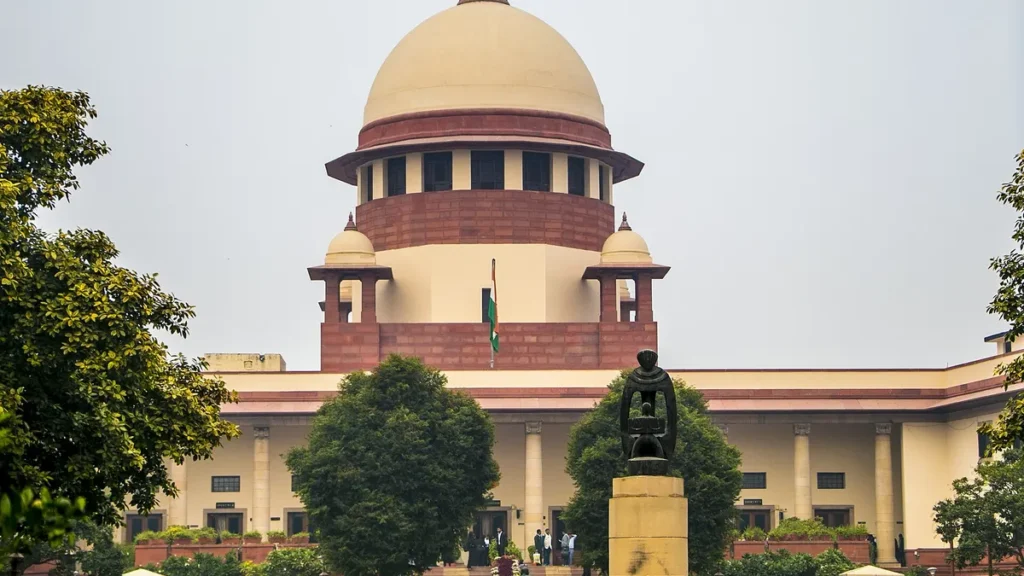
Sales-tax cess ruling: what happened?
Can a State add an extra charge on top of sales tax? A question pending since 1994 now has its answer.
- A seven-judge Constitution Bench held that a cess or surcharge on sales tax stays within State power.
- Chief Justice Surya Kant wrote the main judgment; Justice K.V. Viswanathan concurred.
- The Court said such a levy is an enhancement of sales tax under Entry 54 of the old State List, not a tax on income.
- It reaffirmed S. Kodar v. State of Kerala (1975).
- The India Cement case on cess on royalty does not bar this kind of surcharge.
How are taxes divided between Centre and States?
The Seventh Schedule has three lists: Union, State and Concurrent. Taxing powers are listed separately in the Union and State Lists.
Before GST, Entry 54 of the State List let States tax the sale or purchase of goods (sales tax or VAT).
GST in 2017 largely replaced this, but old cases on whether past levies were valid still needed an answer.
Which laws and Articles apply?
- Article 246 and Seventh Schedule: division of law-making powers.
- Entry 54, List II: tax on sale or purchase of goods (narrowed after the 101st Amendment, 2016).
- Article 246A: GST powers for Centre and States.
- Article 145(3): five or more judges hear major constitutional questions.
Why does the sales-tax cess ruling matter?
| Angle | What to note |
|---|---|
| Federalism | Clarifies State taxing power. |
| Legal certainty | Ends a decades-old dispute. |
| Tax design | Shows how courts read a tax’s nature versus its measure. |
| GST link | Historic levies are now settled. |
What are the problems with the sales-tax cess ruling?
- The issue is largely academic after GST.
- Long pendency since 1994 shows delays in big Benches.
- Cess and surcharge can add hidden costs.
- States still depend heavily on Centre for revenue.
What should be done next on the sales-tax cess ruling?
- Speed up hearing of pending constitutional references.
- Keep cesses transparent and limited.
- Strengthen the GST Council for fair sharing.
- Settle old tax refunds quickly.
What can Prelims ask on the sales-tax cess ruling?
Prelims probability: Medium: a fresh Supreme Court judgment that links to the Seventh Schedule and State taxing powers, though the pre-GST sales tax angle is narrow.
- Entry 54, List II: sales tax (pre-GST).
- S. Kodar v. State of Kerala: 1975.
- Article 246A: GST powers.
- 101st Amendment: GST (2016).
- Seven-judge Bench decision.
How to write about the sales-tax cess ruling in Mains
Practice question (15 marks, 250 words): Explain how the Seventh Schedule divides taxing powers between the Union and States, with reference to the recent judgment on cess on sales tax.
- Intro: the ruling.
- Seventh Schedule and Entry 54.
- Nature vs measure of a tax.
- Impact of GST.
- Conclusion: fiscal federalism clarity.
Ready lines for your answer
- A tax is judged by what it taxes, not just how it is counted.
- Clear tax powers make cooperative federalism work.
Quotable data pointPetitions on this question dated back to 1994.
Photo: Subhashish Panigrahi, CC BY-SA 4.0, via Wikimedia Commons
Exam angle
Prelims: Seventh Schedule, Entry 54, Article 246A. · Mains GS-II: fiscal federalism.
Practice MCQs
Original practice questions (not PYQs).
Before GST, the sales tax you paid on a toothpaste was typically:
Answer (d) & explanation
UPSC Prelims 2014: sales tax on toothpaste was imposed and collected by the State Government.
Consider the following statements: Which of the statements given above are correct?
Answer (a) & explanation
Statements 1 and 2 are correct. GST largely replaced the old sales-tax regime; the reference is largely academic going forward.
Questions students ask about this
What did the Supreme Court hold?
A cess or surcharge calculated on sales tax is within a State's taxing power under Entry 54 of List II.
Which earlier ruling was reaffirmed?
S. Kodar v. State of Kerala (1975).
How many judges were on the Bench?
Seven.
Does this matter after GST?
Mostly for old levies; GST has largely replaced Entry 54 for goods.