
Supreme Court of India (Articles 124-147): Composition, Appointment, Removal, Jurisdiction and Independence (UPSC Notes + PYQs)
UPSC has already asked about this. Read the story with these questions in mind.
- Prelims 2014The power of the Supreme Court of India to decide disputes between the Centre and the States falls under itsSolve it below ↓
- Prelims 2014The power to increase the number of judges in the Supreme Court of India is vested inSolve it below ↓
See all 5 PYQs
- Prelims 2012What is the provision to safeguard the autonomy of the Supreme Court of India?Solve it below ↓
- Prelims 2019Consider the following statements: The motion to impeach a Judge of the Supreme Court of India cannot be rejected by the Speaker of the…Solve it below ↓
- Prelims 2021With reference to Indian judiciary, consider the following statements: Any retired judge of the Supreme Court of India can be called back to sit…Solve it below ↓
Background: from the Federal Court to the Supreme Court
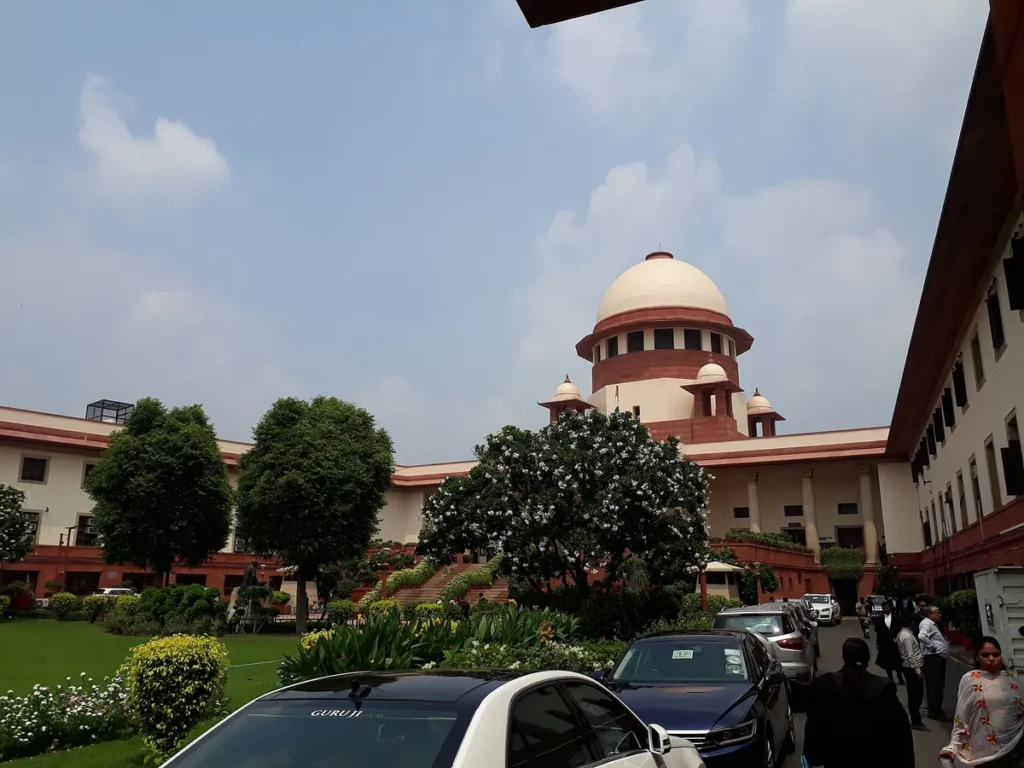
Before 1950 the highest court inside India was the Federal Court, set up in 1937 under the Government of India Act, 1935. It heard disputes between the Centre and the provinces and a limited set of appeals, but the last word in most cases lay with the Privy Council in London. The Abolition of Privy Council Jurisdiction Act, 1949 ended that link. On 28 January 1950 the Federal Court’s judges became the first judges of the Supreme Court, with H.J. Kania as the first Chief Justice. The Court sat in the Chamber of Princes in Parliament House until 1958, when it moved to its present building on Tilak Marg.
The Constituent Assembly argued over three questions that still drive today’s debates: who should appoint judges, how they can be removed, and how far the Court may test laws. It chose a middle path. Appointment went to the President “after consultation” with judges; removal was made deliberately hard; and the Court got wide writ powers. A “due process” clause was dropped in favour of “procedure established by law” in Article 21, a choice the Court itself softened in Maneka Gandhi (1978).
Composition and appointment
The Constitution began with a Chief Justice and seven judges. Parliament fixes the number by law; the 2019 amendment to the Supreme Court (Number of Judges) Act raised it to 33 plus the CJI. A judge must be an Indian citizen and either a High Court judge for five years, an advocate of a High Court for ten years, or a distinguished jurist in the President’s opinion. Appointments are made by the President, in practice on the recommendation of the collegium of the CJI and four senior-most judges. Judges retire at 65.
Removal and independence
A judge can be removed only on the ground of proved misbehaviour or incapacity, by an order of the President after each House passes an address with a majority of total membership and two-thirds of members present and voting (Article 124(4)). The procedure is in the Judges (Inquiry) Act, 1968. No judge of the Supreme Court has ever been removed this way. Other safeguards: salaries charged on the Consolidated Fund, no discussion of a judge’s conduct in Parliament except during removal, no practice in any Indian court after retirement, and the power to punish for contempt (Article 129).
Jurisdiction at a glance
| Type | Article | What it covers |
|---|---|---|
| Original | 131 | Disputes between the Centre and States, or between States |
| Writ | 32 | Enforcement of Fundamental Rights |
| Appellate | 132-134 | Constitutional, civil and criminal appeals from High Courts |
| Special leave | 136 | Discretionary appeal from any court or tribunal (except military) |
| Advisory | 143 | Opinion on a question referred by the President; not binding |
| Review | 137 | Review of its own judgments; curative petition since Rupa Ashok Hurra (2002) |
- OriginalArt. 131
- WritArt. 32
- AppellateArts. 132-134
- Special leaveArt. 136
- AdvisoryArt. 143
- Review and curativeArt. 137
Article 142 and the wider role
Article 142 lets the Court pass any order needed for “complete justice”. It was used to order the closure of liquor shops near highways, in the Bhopal gas settlement, and to dissolve marriages directly (Shilpa Sailesh, 2023). Critics say it lets the Court act like a legislature. Public interest litigation, which grew from Hussainara Khatoon (1979) and S.P. Gupta (1981), widened access but also crowded the docket.
Problems today
Pendency of over 80,000 cases, vacancies, long summer breaks, the opacity of the collegium, and the absence of regional benches (Article 130 allows the CJI, with the President’s approval, to sit elsewhere, but this has not been done). Reform ideas include a separate constitutional court, a national court of appeal, and fixed timelines for hearing constitutional cases.
Landmark judgments to know
| Case (year) | Why it matters |
|---|---|
| Kesavananda Bharati (1973) | Basic structure limits Parliament’s amending power |
| Minerva Mills (1980) | Judicial review and balance between FRs and DPSPs are basic features |
| S.R. Bommai (1994) | Limits on Article 356; floor test |
| Second and Third Judges cases (1993, 1998) | Collegium system |
| Supreme Court Advocates-on-Record Assn. (2015) | NJAC struck down |
| K.S. Puttaswamy (2017) | Privacy is a Fundamental Right |
Committees and reform proposals
The Law Commission’s 229th Report (2009) suggested regional cassation benches in Delhi, Chennai/Hyderabad, Kolkata and Mumbai, with a constitution bench in Delhi.
- 1Motion signed by 100 Lok Sabha or 50 Rajya Sabha members
- 2Speaker or Chairman admits or rejects it
- 3Three-member inquiry committee frames charges
- 4Committee report: guilty of misbehaviour or incapacity?
- 5Each House passes address by special majority in the same session
- 6President orders removal
Way forward
- Fill vacancies in time and publish reasons for collegium choices.
- Separate constitutional and appellate work, either through benches or a national court of appeal, so that five- and seven-judge benches are not delayed for years.
PYQ trend
Prelims asks the Supreme Court almost every year, usually through jurisdiction (Article 131 vs 136 vs 143), appointment and removal, and articles like 127 and 128. Mains GS-II keeps returning to judicial independence (2023), PIL and judicial power (2024), the collegium (2025) and “judicial legislation” (2026). Read the judgment summaries, not just the articles.
Supreme Court: UPSC angle
For UPSC CSE
Prelims: articles and types of jurisdiction, removal procedure, ad hoc judges (Article 127) and retired judges (Article 128). Mains GS-II: judicial independence, Article 142, PIL, pendency and judicial reforms.
Supreme Court UPSC PYQs (Prelims)
Questions UPSC has actually asked, from the official papers. Pick an option to check yourself.
The power of the Supreme Court of India to decide disputes between the Centre and the States falls under its
Article 131 gives the Supreme Court exclusive original jurisdiction over disputes between the Union and States, or between States. Advisory jurisdiction is Article 143. Answer as per the official UPSC key · Battle IAS PYQ bankAnswer (c) & why
The power to increase the number of judges in the Supreme Court of India is vested in
Article 124(1) fixed the Court’s strength and let Parliament change it by law. Under the Supreme Court (Number of Judges) Act, the sanctioned strength is now 34, including the Chief Justice (since 2019). Answer as per the official UPSC key · Battle IAS PYQ bankAnswer (b) & why
What is the provision to safeguard the autonomy of the Supreme Court of India?
– 1. While appointing the Supreme Court Judges, the President of India has to consult the Chief Justice of India.
– 2. The Supreme Court Judges can be removed by the Chief Justice of India only.
– 3. The salaries of the Judges are charged on the Consolidated Fund of India to which the legislature does not have to vote.
– 4. All appointments of officers and staffs of the Supreme Court of India are made by the Government only after consulting the Chief Justice of India.
Which of the statements given above is/are correct?
The CJI must be consulted in appointing judges, and judges’ salaries are charged on the Consolidated Fund, so they are not voted on. Judges are removed by the President after a parliamentary address, not by the CJI, and Supreme Court staff are appointed by the CJI (Art. 146), not the government. Answer as per the official UPSC key · Battle IAS PYQ bankAnswer (a) & why
Consider the following statements :
– 1. The motion to impeach a Judge of the Supreme Court of India cannot be rejected by the Speaker of the Lok Sabha as per the Judges (Inquiry) Act, 1968.
– 2. The Constitution of India defines and gives details of what constitutes 'incapacity and proved misbehaviour' of the Judges of the Supreme Court of India.
– 3. The details of the process of impeachment of the Judges of the Supreme Court of India are given in the Judges (Inquiry) Act, 1968.
– 4. If the motion for the impeachment of a Judge is taken up for voting, the law requires the motion to be backed by each House of the Parliament and supported by a majority of total membership of that House and by not less than two-thirds of total members of that House present and voting.
Which of the statements given above is/are correct?
Under Section 3 of the Judges (Inquiry) Act, the Speaker or Chairman may admit or refuse the motion. The Constitution uses “proved misbehaviour or incapacity” but does not define them. The procedure is in the Act. Article 124(4) sets the special majority in each House. Answer as per the official UPSC key · Battle IAS PYQ bankAnswer (c) & why
With reference to Indian judiciary, consider the following statements :
– 1. Any retired judge of the Supreme Court of India can be called back to sit and act as a Supreme Court judge by the Chief Justice of India with prior permission of the President of India.
– 2. A High Court in India has the power to review its own judgement as the Supreme Court does.
Which of the statements given above is/are correct?
Article 128 lets the Chief Justice, with the President’s previous consent, request a retired Supreme Court judge to sit again. Statement 2 turns on the words “as the Supreme Court does”. Article 137 gives the Supreme Court an express power of review. The Constitution has no matching article for High Courts. UPSC treated statement 2 as wrong. Answer as per the official UPSC key · Battle IAS PYQ bankAnswer (a) & why
Mains PYQs on this topic
Questions from the official UPSC Mains papers (2023-2026 in the Battle IAS Mains bank), newest first. Each links to a model answer.
- UPSC Mains 2026 · GS Paper II · Q12 · 15 marks
What is meant by judicial legislation? In this context, discuss the verdicts of the apex court allowing “passive euthanasia” and a “living will”.
- UPSC Mains 2025 · GS Paper II · Q11 · 15 marks
“Constitutional morality is the fulcrum which acts as an essential check upon the high functionaries and citizens alike… .” In view of the above observation of the Supreme Court, explain the concept of constitutional morality and its application to ensure balance between judicial independence and judicial accountability in India.
- UPSC Mains 2025 · GS Paper II · Q13 · 15 marks
Discuss the evolution of collegium system in India. Critically examine the advantages and disadvantages of the system of appointment of the Judges of the Supreme Court of India and that of the USA.
- UPSC Mains 2024 · GS Paper II · Q14 · 15 marks
Explain the reasons for the growth of public interest litigation in India. As a result of it, has the Indian Supreme Court emerged as the world’s most powerful judiciary?
- UPSC Mains 2023 · GS Paper II · Q1 · 10 marks
“Constitutionally guaranteed judicial independence is a prerequisite of democracy.” Comment.
Quick quiz
A dispute between two States goes to the Supreme Court under its
Article 131.Answer (b)
Who can increase the number of Supreme Court judges?
By law under Article 124(1).Answer (b)
Retired judges may be asked to sit in the Supreme Court under Article
Article 127 is about ad hoc judges.Answer (c)
FAQs
How many judges does the Supreme Court have?
34, including the Chief Justice, since the 2019 amendment.
Is an advisory opinion under Article 143 binding?
No. The President may or may not accept it, though it carries great weight.
What is a curative petition?
A last remedy after a review petition is dismissed, created by the Court in Rupa Ashok Hurra (2002) to prevent gross miscarriage of justice.
Where does the Supreme Court sit?
In Delhi, or elsewhere as the CJI decides with the President’s approval (Article 130).
Can a Supreme Court judge be removed by the CJI?
No. Only the President can remove a judge, after Parliament passes an address under Article 124(4).
What is special leave under Article 136?
A discretionary power to hear an appeal from any court or tribunal in India, except military tribunals.
Spotted an error? Tell us. We correct within 48 hours.
Image: Pinakpani, Wikimedia Commons, CC BY-SA 4.0
How to use this in Mains
If asked: Discuss the problems faced by the Supreme Court and suggest reforms. (GS-II)
Quote: “Pendency of over 80,000 cases, vacancies, long summer breaks, the opacity of the collegium, and the absence of regional benches (Article 130 allows the CJI, with the President’s approval, to sit elsewhere, but this has not been done).”
Use it: Use it as your problem statement in the body.
In the news

Supreme Court: no prior approval under Section 17A needed to probe a bribe demand
In a judgment of 16 October 2026, a Supreme Court Bench of Justices S.V.N. Bhatti and N.V. Anjaria held that investigating a bribe demand by a public servant does not need prior approval under Section 17A of the Prevention of Corruption Act. Asking for a bribe, the court said, is not part of discharging official duties.
19 Oct 2026
CCPA acts against online sale of explosives: 3,940 sellers delisted from seven platforms
The Central Consumer Protection Authority (CCPA) said on 19 October 2026 that 3,940 sellers of regulated explosives such as ammonium nitrate, picric acid and PETN have been delisted from seven online platforms after its action. It has fined Dial4Trade and ExportersIndia ₹10 lakh per order, and other cases are under hearing or investigation.
19 Oct 2026
India to host 61st CIML meeting on legal metrology in New Delhi, 26–28 October
India will host the 61st meeting of the International Committee of Legal Metrology (CIML) for the first time, in New Delhi from 26 to 28 October 2026. The Department of Consumer Affairs is organising it with the International Organization of Legal Metrology (OIML), and more than 100 delegates are expected, PIB said on 19 October.
19 Oct 2026
NMC withdraws MSMER-2023: medical colleges lose the fixed penalty rulebook, annual disclosure stays
The National Medical Commission (NMC) has de-notified the Maintenance of Standards of Medical Education Regulations, 2023 (MSMER-2023) by a notification dated 14 October 2026, published in the Gazette on 16 October. Its fixed penalties, including seat cuts and fines of up to ₹5 lakh for false records, go with it. The Annual Disclosure Report stays.
19 Oct 2026