
Tamil Nadu scraps Kurian panel on Union-State ties
Tamil Nadu’s new government led by C. Joseph Vijay has disbanded the Justice Kurian Joseph Committee on Union-State Relations and handed its work to the State Law Commission, reconstituted in August. The committee, set up by the earlier M.K. Stalin government, had already submitted Part I of its report in February, covering State autonomy, delimitation and the office of the Governor. The government called it a non-statutory body whose work overlaps with the Law Commission. Read it to revise Rajamannar, Sarkaria, Punchhi and the Inter-State Council.
- Committee
- Justice Kurian Joseph Committee on Union-State Relations
- Set up by
- Earlier M.K. Stalin government
- Part I report
- February 2026: autonomy, delimitation, Governor
- Now
- Disbanded; work sent to the State Law Commission
Kurian Committee: what happened?
A State that once set the tone on Centre–State reform has shut its latest panel before the report was finished.
- Tamil Nadu’s new government led by C. Joseph Vijay has disbanded the Justice Kurian Joseph Committee on Union-State Relations and handed its work to the State Law Commission, reconstituted in August.
- The committee, set up by the earlier M.K. Stalin government, had already submitted Part I of its report in February, covering State autonomy, delimitation and the office of the Governor.
- The government called it a “non-statutory body” whose work overlaps with the Law Commission; The Hindu’s editorial says this is unconvincing, as the Law Commission itself exists only by an executive order.
- Earlier Tamil Nadu committees on Concurrent List conflicts led to State laws, such as horizontal reservation in professional courses for disadvantaged students; the editorial asks the government to let the committee finish.
Which earlier panels shaped Centre–State debate?
The Rajamannar Committee was set up by the Tamil Nadu government in 1969 to study Centre–State relations and Concurrent List conflicts. It remains a standard Prelims fact.
The Sarkaria Commission (1983–88) recommended a permanent Inter-State Council, which was set up in 1990. The Punchhi Commission later reviewed the same ground, including the role of Governors.
Article 263 allows the President to establish an Inter-State Council. Article 262 deals with inter-State water disputes; Article 280 with the Finance Commission. Zonal Councils are statutory bodies under the States Reorganisation Act, 1956, not constitutional bodies.
The Seventh Schedule divides powers among Union, State and Concurrent Lists. States often argue that the Union has used the Concurrent List and centrally sponsored schemes to shrink their room.
Who set them up
| Body | Origin / idea |
|---|---|
| Rajamannar Committee, 1969 | Tamil Nadu government |
| Sarkaria Commission | Recommended a permanent Inter-State Council |
| Inter-State Council | Article 263; set up in 1990 |
| Zonal Councils | Statutory, States Reorganisation Act, 1956 |
Which laws and Articles apply?
- Article 263: Inter-State Council; set up in 1990 on Sarkaria’s advice.
- Seventh Schedule: Union, State and Concurrent Lists.
- Article 262 (water disputes) and Article 280 (Finance Commission) are often confused with Article 263.
- State Law Commissions are usually created by executive order, as are many expert committees.
Why does the Kurian Committee on Union-State ties matter?
| Angle | What to note |
|---|---|
| Federalism | State panels have long shaped the Union–State agenda. |
| Institutions | A “non-statutory” label also applies to many Law Commissions. |
| Governors | Part I already covered the Governor, a live GS-II theme. |
| Prelims | Rajamannar 1969, Article 263, Zonal Councils are statutory. |
What are the problems with the Kurian Committee on Union-State ties?
- The committee was wound up after Part I, so later work may be lost or delayed.
- Overlap with a Law Commission is not, by itself, a reason to scrap a specialised panel.
- Centre–State disputes over Governors, grants and delimitation remain unresolved.
- Frequent changes of panel weaken institutional memory.
What should be done next on the Kurian Committee on Union-State ties?
- Publish Part I and any unfinished terms of reference in full.
- Let the Law Commission take the work forward on a public timetable.
- Use the Inter-State Council for the national debate on autonomy and Governors.
- Keep Concurrent List conflicts under regular legislative review.
What can Prelims ask on the Kurian Committee on Union-State ties?
Prelims probability: Medium. Trend: Sarkaria on Governors (2019), constitutional status of councils (2025, 1995); Inter-State Council (the State 2021). Freshness: committee disbanded. Static link: Article 263, Seventh Schedule. Testable fact: Rajamannar Committee was set up by Tamil Nadu in 1969.
- Rajamannar Committee was set up by Tamil Nadu in 1969.
- Inter-State Council: Article 263; set up in 1990.
- Zonal Councils are statutory, not constitutional.
- Kurian Committee Part I: autonomy, delimitation, Governor.
- Sarkaria recommended a permanent Inter-State Council.
How to write about the Kurian Committee on Union-State ties in Mains
Practice question (15 marks, 250 words): Examine the role of State-level committees in the debate on Centre–State relations, with reference to the winding up of the Kurian Committee in Tamil Nadu.
- Intro: committee disbanded, work sent to the Law Commission.
- Rajamannar, Sarkaria and Punchhi in brief.
- Article 263 and the Inter-State Council.
- Governors, delimitation and the Concurrent List.
- Conclusion: finish the work, do not just rename it.
Ready lines for your answer
- A non-statutory body can still do constitutional work.
- Federalism is a report that States have to finish, not file away.
Quotable data pointKurian Committee Part I, February 2026; Rajamannar 1969; ISC under Article 263.
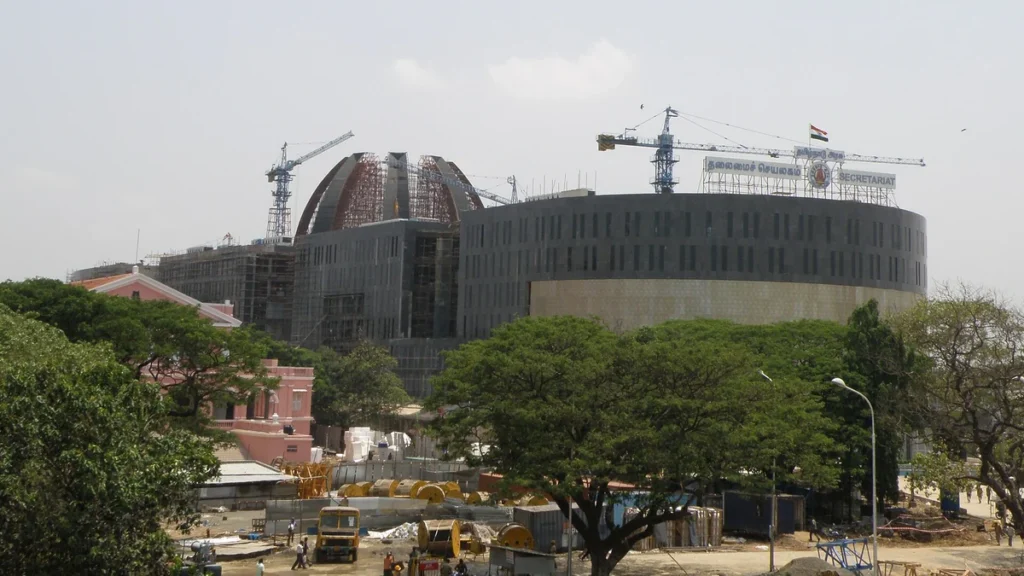
Photo: Prateek Karandikar, CC BY-SA 4.0, via Wikimedia Commons
Exam angle
Prelims: Rajamannar 1969, Article 263, Zonal Councils. · Mains GS-II: federalism and Governors.
Practice MCQs
Original practice questions (not PYQs).
The Inter-State Council is established under which Article of the Constitution?
Answer (c) & explanation
Article 263 allows the President to set up an Inter-State Council; it was set up in 1990 on the Sarkaria Commission's advice. Article 262 deals with inter-State water disputes and Article 280 with the Finance Commission.
Consider the following statements:
1. The Rajamannar Committee on Centre-State relations was set up by the Tamil Nadu government.
2. The Sarkaria Commission recommended a permanent Inter-State Council.
3. Zonal Councils are constitutional bodies.
How many of the above statements are correct?
Answer (b) & explanation
Statements 1 and 2 are correct. Zonal Councils are statutory bodies under the States Reorganisation Act, 1956.
Questions students ask about this
What has Tamil Nadu done?
It has disbanded the Justice Kurian Joseph Committee on Union-State Relations and sent the work to the State Law Commission.
Who had set up the committee?
The earlier M.K. Stalin government. Part I of the report was submitted in February.
What did Part I cover?
State autonomy, delimitation and the office of the Governor.
Under which Article is the Inter-State Council set up?
Article 263. It was set up in 1990 on the Sarkaria Commission’s advice.
Who set up the Rajamannar Committee?
The Tamil Nadu government, in 1969.