
Why some satellites now process data in orbit
Satellites photograph floods, crops, ships and weather. But the data must be sent down, received at ground stations when the satellite passes over, and then studied. In an emergency this delay can cost lives. One answer is to process data in space. An artificial intelligence model on the satellite can drop cloudy pictures, pick those that show changing flood waters and send only the useful part. The European Space Agency’s Phi-Sat-1 already showed this. Satellites could also talk to each other with laser links and share computing tasks. Computing in space is hard: power is limited, there is no air to cool chips, radiation harms electronics, repairs are impossible, and cost matters. The writer says orbit computing will not replace data centres on Earth. It makes sense where data is created in space and must be used fast or shrunk before it is sent. Read it to revise remote sensing, onboard processing and the Indian Space Policy 2023.
- The problem
- Satellite images must be sent to Earth and wait for a ground-station pass before they are studied; in a disaster that delay can cost lives
- The idea
- Process data on the satellite: drop cloudy pictures, pick useful flood images, and send only what is needed
- A working example
- The European Space Agency’s Phi-Sat-1 already showed onboard filtering of images
- The limits
- Power, heat, radiation, no repairs in orbit, and cost; orbit computing will not replace data centres on Earth
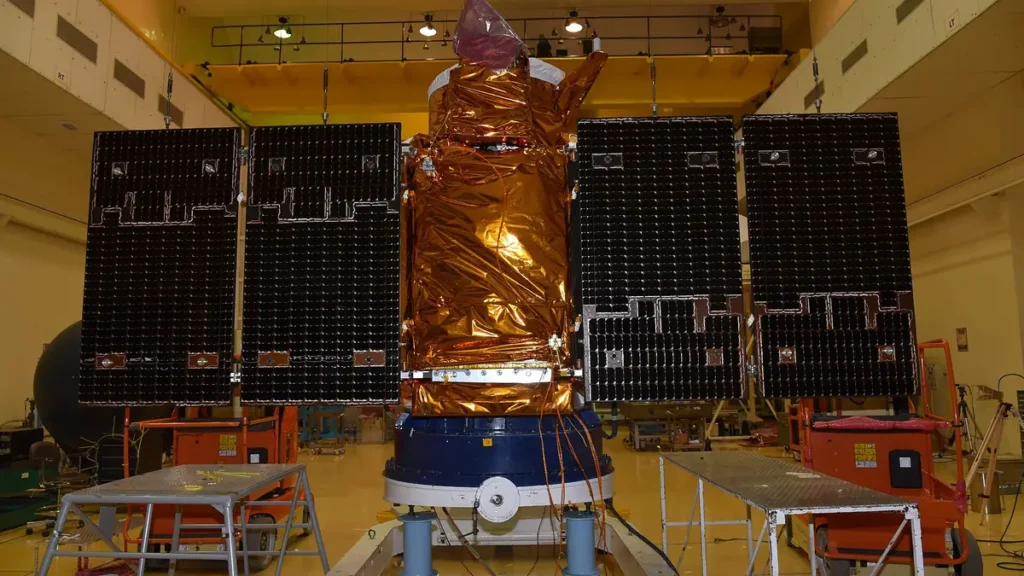
Why would a satellite process data in space rather than on Earth?
A flood image that sits on a satellite until the next ground-station pass is an image that arrives too late. That is the case for doing some of the computing in orbit, and also the case for not doing all of it there.
- Satellites photograph floods, crops, ships and weather. But the data must be sent down, received at ground stations when the satellite passes over, and then studied. In an emergency this delay can cost lives.
- One answer is to process data in space. An artificial intelligence model on the satellite can drop cloudy pictures, pick those that show changing flood waters and send only the useful part.
- The European Space Agency’s Phi-Sat-1 already showed this. Satellites could also talk to each other with laser links and share computing tasks.
- Computing in space is hard. Power is limited, there is no air to cool chips, radiation harms electronics, repairs are impossible, and cost matters. The writer says orbit computing will not replace data centres on Earth. It makes sense where data is created in space and must be used fast or shrunk before it is sent.
What is remote sensing, and where does India stand?
Remote sensing is the art of studying the Earth from a distance, usually with cameras and radars on satellites. India has flown a long line of Earth-observation satellites, and uses them for crops, weather, water, forests and disaster maps. The bottleneck is often not the picture, but the time it takes to get the picture to an analyst.
Onboard processing means the satellite does some of the analysis itself. A model can discard cloud-covered frames, detect a sudden change in flood water, or compress a scene so that a short radio pass is enough to send the alert. That is what Phi-Sat-1 demonstrated for the European Space Agency.
The Indian Space Policy 2023 opened a larger role for non-government firms in building and operating satellites, including Earth-observation services, under the oversight of IN-SPACe, with ISRO as the national agency and NSIL as the commercial arm. Faster, processed-in-orbit data is one of the services a private or government mission could sell to disaster and farm users.
The physics does not change with the policy. In orbit there is little power, no air to carry heat away, and a radiation environment that upsets ordinary chips. That is why the argument in this explainer is careful: use orbit computing where speed or bandwidth makes it necessary, and keep the heavy work in data centres on Earth.
When orbit processing helps, and when it does not
| Item | What to note |
|---|---|
| Classic flow | Photograph, wait for a ground-station pass, download, then analyse on Earth |
| Onboard processing | Filter clouds, pick useful frames, shrink the data, send an alert sooner |
| Phi-Sat-1 | European Space Agency mission that showed this approach in orbit |
| Limits | Power, cooling, radiation, no repairs, and cost |
| The practical rule | Use it where data is born in space and must be used fast or shrunk; do not try to replace Earth data centres |
Which policies and ideas apply?
- Indian Space Policy, 2023: the present policy frame for government and non-government activity in space, including Earth-observation services.
- IN-SPACe is the authorised agency for private participation; ISRO remains the national space agency; NSIL is the commercial arm.
- Remote sensing and disaster support are established civilian uses of Indian and foreign Earth-observation satellites.
- Phi-Sat-1, of the European Space Agency, is the working international example of onboard artificial-intelligence filtering cited in this explainer.
Why does onboard satellite processing matter?
| Angle | What to note |
|---|---|
| Science and technology | Onboard processing is a live example of putting computing where the data is born, not only where the data centre is. |
| Disaster management | A flood or cyclone alert that arrives after the next ground pass can be too late; this is the operational case for filtering in orbit. |
| Prelims | Remote sensing, Phi-Sat-1, onboard processing, laser links between satellites, and the Indian Space Policy 2023. |
| Limits of technology | Power, heat, radiation and cost are why orbit computing is a complement to, not a replacement for, Earth data centres. |
What are the problems with onboard satellite processing?
- A model that drops “cloudy” pictures can also drop a useful frame if it is poorly trained, which is a risk in a disaster.
- Onboard chips are hard to cool, hard to shield and impossible to repair; a failed computer in orbit is a failed mission, not a failed rack in a hall.
- Laser links and shared computing between satellites add complexity, and are still harder than sending a raw image when there is time.
- If agencies treat orbit computing as a slogan, they may under-invest in ground stations and in the last-mile systems that actually get an alert to a district official.
What should be done next on onboard satellite processing?
- Disaster and farm agencies should say which products they need in minutes rather than in hours, so that onboard processing is built for a real user, not only for a demonstration.
- India’s Earth-observation programme, including private missions under the 2023 policy, should treat onboard filtering as one tool alongside more ground stations and better download capacity.
- Any onboard model should be tested against missed detections, especially of floods and cyclones, before it is allowed to drop frames.
- Students should remember the simple rule from this explainer: process in orbit when the data must be used fast or shrunk; leave the heavy work on Earth.
What can Prelims ask on onboard satellite processing?
Prelims probability: Medium. Remote sensing was asked in 2015 and 2019 and private space entry in 2026. The topic is a fresh science explainer on a theme UPSC likes. Testable facts: onboard processing, Phi-Sat-1, the 2023 space policy.
- Onboard processing lets a satellite filter cloudy images and send only useful flood or disaster data.
- The European Space Agency’s Phi-Sat-1 already demonstrated this in orbit.
- Limits include power, cooling, radiation, the impossibility of repairs, and cost.
- Orbit computing will not replace data centres on Earth; it is for data that is created in space and must be used fast or shrunk.
- The Indian Space Policy 2023 is the present frame for government and private Earth-observation activity.
How to write about onboard satellite processing in Mains
Practice question (15 marks, 250 words): Some satellites now process data in orbit rather than sending every image to Earth first. Explain the idea, its uses in disaster management, and its limits.
- Open with the delay: a satellite must wait for a ground-station pass before a raw image can be studied.
- Explain onboard processing and the Phi-Sat-1 example, including the filtering of cloudy or unhelpful frames.
- Link the idea to flood and disaster alerts, and to laser links between satellites.
- State the hard limits: power, heat, radiation, no repairs, and cost.
- Close with the rule that orbit computing complements, and does not replace, data centres on Earth, and mention the Indian Space Policy 2023 as the domestic policy frame.
Ready lines for your answer
- The scarce resource is often not the picture, but the time it takes to get the picture to an analyst.
- Process in orbit when you must; keep the heavy computing on Earth.
Quotable data pointOnboard processing can filter cloudy frames and send useful flood data sooner; Phi-Sat-1 (ESA) demonstrated this. Limits: power, heat, radiation, no repairs, cost. Complements, does not replace, Earth data centres. Policy frame in India: Indian Space Policy 2023.
Photo: Indian Space Research Organisation, GODL-India, via Wikimedia Commons
Exam angle
Prelims: remote sensing, Phi-Sat-1, onboard processing, and the Indian Space Policy 2023. · Mains GS-III: space technology for disaster management and the limits of computing in orbit.
Practice MCQs
Original practice questions (not PYQs).
Consider the following statements:
1. Computing in orbit will fully replace data centres on Earth.
2. Space has air that helps cool electronics on satellites.
3. Electronics in space face no problem from radiation.
How many of the above statements are correct?
Answer (d) & explanation
None is correct. Data centres on Earth will still be needed; there is no air in space to cool chips; radiation and temperature extremes harm electronics.
Questions students ask about this
What problem does onboard processing try to solve?
A satellite’s images usually wait for a ground-station pass and then for analysis on Earth. In a disaster, that delay can cost lives.
How does processing in orbit help?
An onboard model can drop cloudy pictures, pick frames that show changing flood waters, and send only the useful part.
Which mission already showed this?
The European Space Agency’s Phi-Sat-1.
Why is computing in space difficult?
Power is limited, there is no air to cool chips, radiation harms electronics, repairs are impossible, and the cost is high.
Will this replace data centres on Earth?
The explainer says no. It makes sense where data is created in space and must be used fast or shrunk before it is sent.