
Gupta Empire (c. 319-550 CE): Rulers, Administration, Economy, Art and Science (UPSC Notes + PYQs)
UPSC has already asked about this. Read the story with these questions in mind.
Background: north India after the Kushanas
After the decline of the Kushanas in the north and the Satavahanas in the Deccan in the third century CE, north India broke into small kingdoms and republics. The Guptas rose from the middle Ganga valley, probably as feudatories of the Kushanas, with fertile land, iron deposits and the old trade routes of Magadha at their command. Their founder was Sri Gupta, followed by Ghatotkacha, but the real founder of the empire was Chandragupta I, who took the title Maharajadhiraja and began the Gupta era in 319-320 CE. His marriage to the Lichchhavi princess Kumaradevi brought prestige and resources, and gold coins show the couple together. Over the next 150 years the Guptas built the largest empire in north India since the Mauryas, though it was looser and more decentralised.
Rulers and expansion
| Ruler | Highlights |
|---|---|
| Chandragupta I (c. 319-335) | Gupta era begins 319-20 CE; married Lichchhavi princess Kumaradevi |
| Samudragupta (c. 335-375) | Conquests in the Prayag Prashasti by Harishena; “Indian Napoleon” (V.A. Smith); veena-playing coins |
| Chandragupta II (c. 375-415) | Defeated the Western Kshatrapas; silver coins; Faxian’s visit; Navaratnas tradition |
| Kumaragupta I (c. 415-455) | Nalanda founded (traditionally) |
| Skandagupta (c. 455-467) | Repulsed the Hunas; Junagadh inscription on Sudarshana lake repair |
- c. 319-335 CEChandragupta I; Gupta era begins
- c. 335-375 CESamudragupta: Allahabad inscription
- c. 375-415 CEChandragupta II: Shakas defeated
- c. 415-455 CEKumaragupta I: Nalanda
- c. 455-467 CESkandagupta resists Hunas
Administration and society
Kings took grand titles like Maharajadhiraja. Provinces (bhukti) were split into districts (vishaya). Unlike the Mauryas, the Guptas ran a looser, more feudal state with hereditary officials and growing land grants (agrahara) that gave fiscal and administrative rights to Brahmins and temples. Forced labour (vishti) existed. The caste order hardened, and the number of untouchables increased according to Faxian.
Art, literature and science
- Literature: Kalidasa (Abhijnanashakuntalam, Meghaduta), Vishakhadatta (Mudrarakshasa), Amarasimha’s Amarakosha.
- Science: Aryabhata (Aryabhatiya, 499 CE): rotation of the earth, place-value notation; Varahamihira (Brihat Samhita).
- Art: Sarnath Buddha images, Mathura school, Dashavatara temple at Deogarh (Lalitpur, UP), Bhitargaon brick temple (Kanpur), Ajanta murals (Vakataka patronage).
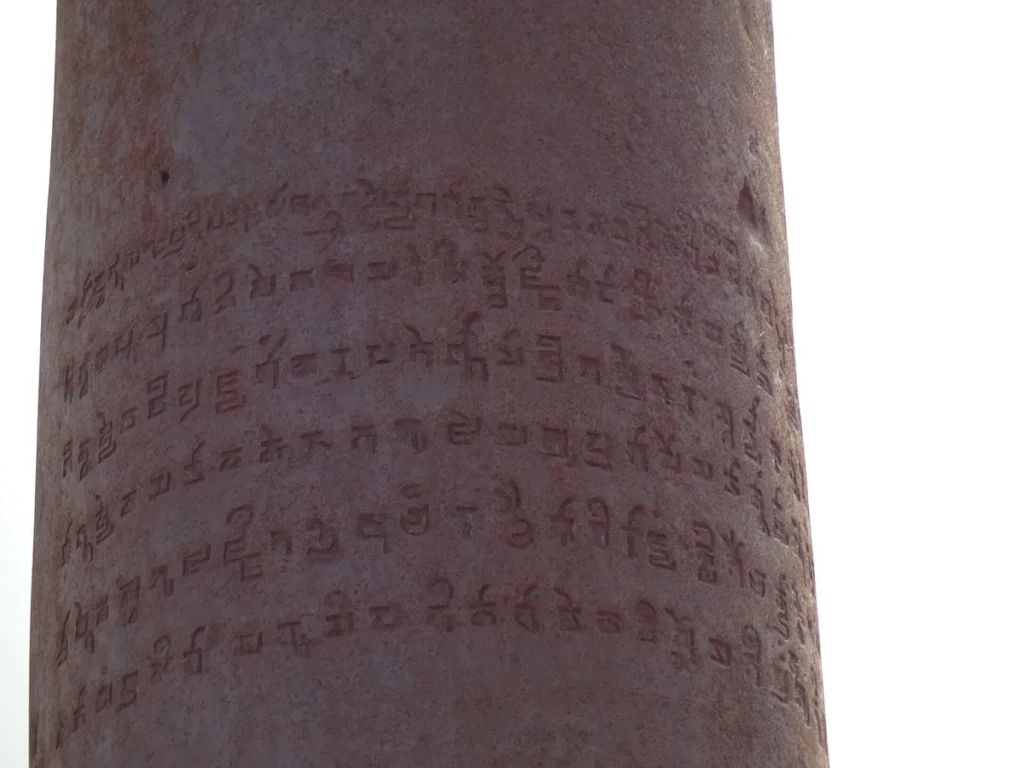
- Metallurgy: the Iron Pillar of Mehrauli.
Was it really a golden age?
The “golden age” label came from nationalist historians who saw cultural brilliance. Later historians note feudalisation, declining trade and urban decay in some regions, more caste rigidity, and the lower status of women. Use both views in Mains.
- AryabhataAryabhatiya; earth rotates
- VarahamihiraBrihat Samhita
- KalidasaAbhijnanashakuntalam
- VishakhadattaMudrarakshasa
- AmarasimhaAmarakosha
Sources for Gupta history
| Source | What it tells us |
|---|---|
| Allahabad (Prayag) Pillar inscription | Harisena’s praise of Samudragupta’s conquests |
| Mehrauli Iron Pillar | King Chandra, usually identified with Chandragupta II; rust-free iron |
| Bhitari pillar inscription | Skandagupta’s fight against the Hunas |
| Junagadh inscription | Skandagupta’s repair of the Sudarshana lake |
| Fa-Hien’s account | Life under Chandragupta II; mild punishments |
| Gold coins (dinaras) | Kings as warriors, musicians, horse sacrificers |
| Puranas and Kalidasa’s works | Religion, society and courtly culture |
The Allahabad inscription is engraved on an Ashokan pillar, which neatly contrasts Ashoka’s message of non-violence with Samudragupta’s celebration of conquest.
Gupta administration in Prelims
The empire was divided into bhuktis (provinces) under uparikas, and these into vishayas (districts) under vishayapatis. Officials called kumaramatyas formed a high cadre. Many offices became hereditary, and a single person could hold several posts. Far-off kings who accepted Gupta overlordship kept their thrones, which made the empire looser than the Mauryan one.
Decline
Huna invasions under Toramana and Mihirakula, rise of feudatories such as the Maukharis and Vardhanas, loss of western trade, and weak successors.
Economy: land grants and trade
Agriculture remained the base, and the State took a share of produce as revenue. A defining feature of the period was the growth of land grants to Brahmanas and temples (agrahara and devadana), often with fiscal and administrative rights. These grants spread agriculture into new areas but, many historians argue, began to shift power to local intermediaries, a process sometimes linked to feudal tendencies. The Guptas issued the largest number of gold coins in ancient India, though historians note that silver and copper coins were fewer than in Kushana times. Long-distance trade with the Roman world declined after the third century, while trade with south-east Asia grew. Guilds (shrenis) of merchants and artisans remained important and had their own seals.
Gupta art and temples
Gupta sculpture set the classical standard for Indian art: calm, graceful Buddha images from Sarnath and Mathura, the Varaha panel at Udayagiri caves near Vidisha, and the Dashavatara temple at Deogarh, one of the earliest north Indian stone temples with a shikhara-like tower. The Bhitargaon temple in Kanpur is an early brick temple. Some Ajanta paintings belong to this period under the patronage of the Vakatakas, who were allied with the Guptas through Prabhavatigupta, daughter of Chandragupta II. Nalanda was founded as a monastic university in the fifth century, traditionally linked to Kumaragupta I.
Was it a golden age? Using the debate in Mains
- Case for: political unity over a large area, classical Sanskrit literature (Kalidasa), science (Aryabhata, Varahamihira), mature temple art, gold coinage.
- Case against: it was golden mainly for elites; caste hierarchy hardened, untouchability (Fa-Hien notes chandalas living outside villages) and the subordination of women grew, with the first recorded sati inscription at Eran (510 CE); land grants weakened central power.
- Balanced view: call it a classical age of cultural achievement rather than a golden age for all.
Gupta Empire: UPSC angle
For UPSC CSE
Prelims: ruler-event matching, Faxian, inscriptions, ports, art sites. Mains GS-I: golden age debate; Gupta art and science.
Gupta Empire UPSC PYQs (Prelims)
Questions UPSC has actually asked, from the official papers. Pick an option to check yourself.
Fa-hien (Faxian), the Chinese pilgrim, travelled to India during the reign of
Faxian was in India from about 399 to 412, in the reign of Chandragupta II (Vikramaditya). He came to collect Vinaya texts. He wrote of a mild government, few harsh punishments, and the Chandalas living outside towns. He never names the king. Answer as per the official UPSC key · Battle IAS PYQ bankAnswer (b) & why
With reference to forced labour (Vishti) in India during the Gupta period, which one of the following statements is correct?
Vishti was unpaid labour the state or the holder of a land grant could demand. It was treated as a tax paid in labour. Gupta-period inscriptions from central India and Kathiawar (Valabhi grants) mention it, which rules out (b). No source speaks of weekly wages or of eldest sons. Answer as per the official UPSC key · Battle IAS PYQ bankAnswer (a) & why
With reference to the period of Gupta dynasty in ancient India, the towns Ghantasala, Kadura and Chaul were well known as
Ghantasala and Kadura on the Andhra coast, near the Krishna delta, and Chaul on the Konkan coast were ports that traded with South-east Asia and the West. Tamralipti in Bengal was another major port of the time. Ghantasala also had a Buddhist stupa, but it is remembered here as a port. Answer as per the official UPSC key · Battle IAS PYQ bankAnswer (a) & why
Mains PYQs on this topic
No UPSC Mains question from 2023-2026 is directly on this topic. Older papers (2013-2022) will be added as the Mains bank grows.
Quick quiz
The Prayag Prashasti of Samudragupta was composed by
Harishena, his court poet.Answer (b)
Faxian visited India during the reign of
He travelled c. 399-412 CE.Answer (b)
FAQs
Why is the Gupta period called a golden age?
For its achievements in literature, art, science and political unity, though historians debate the label.
Who was the greatest Gupta ruler?
Samudragupta is often called so for his conquests; Chandragupta II for prosperity and culture.
Which Gupta ruler fought the Hunas?
Skandagupta repulsed them; later rulers lost ground.
What is an agrahara?
A land grant to Brahmins, often tax-free, with rights over the villagers.
Who is called the Napoleon of India?
Samudragupta, a title given by V.A. Smith because of his military campaigns described in the Allahabad inscription.
Why did the Gupta empire decline?
Huna invasions, weak successors, rise of feudatories such as the Maukharis and Maitrakas, and loss of revenue from trade and land grants.
Which Chinese pilgrim visited during the Gupta period?
Fa-Hien (Faxian), during the reign of Chandragupta II.
Spotted an error? Tell us. We correct within 48 hours.
Image: SAMIR KUMAR BHUYAN, Wikimedia Commons, CC BY-SA 4.0
How to use this in Mains
If asked: Was the Gupta period a golden age? Critically examine. (GS-I)
Quote: “Balanced view: call it a classical age of cultural achievement rather than a golden age for all.”
Use it: Use as your balanced conclusion.
In the news
Pollen study links Harappan decline to weak monsoon (5100–4000 BP)
A pollen study by the Birbal Sahni Institute of Palaeosciences links the shrinking of the Harappan Civilization to a weak Indian Summer Monsoon between about 5100 and 4000 years before present, the Science Ministry said on 29 July 2026. Sediments from Deoria Tal in the Garhwal Himalaya show an abrupt dry spell, the "4.2 ka event".
29 Jul 2026
Sarnath inscribed as India’s 45th UNESCO World Heritage Site
On 25 July 2026 the 48th World Heritage Committee in Busan inscribed the "Ancient Buddhist Site of Sarnath" on the UNESCO World Heritage List. It is India's 45th property. The serial site in Varanasi covers Chaukhandi Stupa and the Archaeological Remains of Sarnath, where the Buddha gave his first sermon.
25 Jul 2026
Rakhigarhi skeletal remains handed to Anthropological Survey of India
ASI handed human skeletal remains from Rakhigarhi, Haryana, to the Anthropological Survey of India under a new MoU, the Culture Ministry said on 22 June 2026. The 2025-26 dig at Mound No. 7 found eight burials; three complete skeletons plus fragments went to AnSI's Kolkata repository. Planned work includes aDNA, isotopes and palaeopathology with partner labs.
22 Jun 2026
Relics of the Buddha’s chief disciples enshrined for exposition in Mongolia
The holy relics of Arhat Sariputra and Arhat Mahamoggallana, the Buddha's two chief disciples, were ceremonially enshrined at Gandantegchenling Monastery in Ulaanbaatar on Buddha Purnima (Vesak) 2026. Brought from India for a ten-day exposition from 31 May to 10 June 2026, they arrived on a special IAF IL-76 aircraft and had travelled abroad only once before, to Thailand in 2024.
31 May 2026