
UPSC Mains 2024 GS2 Q13: model answer
What changes has the Union Government recently introduced in the domain of Centre-State relations? Suggest measures to be adopted to build the trust between the Centre and the States and for strengthening federalism.
What the question wants
Recent changes in Centre-State relations, the friction they caused, and trust-building measures.
How to structure it
Intro: India's federation has a strong Centre by design. Body: (1) Recent changes (fiscal, legislative, administrative); (2) Frictions; (3) Measures to build trust. Conclusion: Federalism is a basic feature (S.R. Bommai, 1994).
- 1(1) Recent changes (fiscal, legislative, administrative)
- 2(2) Frictions
- 3(3) Measures to build trust
Model answer
India's federation has a strong Centre by design. Recent years have brought important changes that both integrated and strained relations.
Recent changes
- Fiscal: GST (2017) with the GST Council; end of GST compensation in 2022; NITI Aayog replacing the Planning Commission; higher tax devolution (41%) but growing cesses and surcharges outside the divisible pool.
- Legislative: J&K Reorganisation Act, 2019 converting a State into UTs; Government of NCT of Delhi (Amendment) Act, 2023 giving the Centre control over services after the Supreme Court's 2023 ruling.
- Administrative: BSF's jurisdiction raised to 50 km in Punjab, West Bengal and Assam (2021); proposals to change IAS deputation rules; central agencies' cases against State leaders.
- Cooperative steps: competitive rankings, Aspirational Districts, GST Council decisions by consensus.
Frictions
- Governors delaying assent to State Bills (Punjab and Tamil Nadu cases before the Supreme Court).
- States like Kerala and Karnataka complain about borrowing limits and devolution.
- Withdrawal of general consent to CBI by several States.
Measures to build trust
- Revive the Inter-State Council (Art. 263), which has met rarely, and regular Zonal Councils.
- Implement Sarkaria (1988) and Punchhi (2010) recommendations on Governors' appointment and conduct; time limits for assent.
- Cap cesses and surcharges, or share them with States.
- Consult States before laws on Concurrent List subjects.
- Strengthen local bodies as the third tier.
- Use the GST Council model of shared decision-making in other areas.
Federalism is a basic feature (S.R. Bommai, 1994). A confident Centre gains when it treats States as partners in Team India.
Keywords, cases and data to drop in
GST Council cesses GNCTD Act 2023 Governor's assent Inter-State Council Punchhi Commission
Where most answers lose marks
- Only listing Constitution articles.
Same theme in Prelims
Which of the following statements with respect to the Revamped Rashtriya Gram Swaraj Abhiyan (RGSA) is/are correct ?
- 1. The period of its implementation is 1st April, 2021 to 31st March, 2026.
- 2. The key objective of the Revamped RGSA is to develop the governance capabilities of the Panchayati Raj Institutions to deliver on the Sustainable Development Goals.
- 3. The share of the Central funding for the Revamped RGSA is 100% for all States and Union Territories.
Select the answer using the code given below :
Answer (b) & explanation
Only statement 2 is correct (b). Statement 2 is right: the Revamped RGSA aims to build the governance capacity of Panchayati Raj Institutions to deliver on the SDGs. Statement 1 is wrong: it was approved in 2022 to run from 2022-23 to 2025-26, not from April 2021. Statement 3 is wrong: funding is shared 60:40 with States (90:10 for north-eastern and hill States); only Union Territories get 100%. So options (a), (c) and (d) fail.
Notice the link: the RGSA uses the Localisation of SDGs approach through nine themes, such as poverty-free and healthy villages. The 73rd Amendment (1992) gave Panchayats constitutional status. 24 April is National Panchayati Raj Day.
"100% for all" is the giveaway. Centrally sponsored schemes almost always share costs with States.
Answer as per the official UPSC answer key.
Consider the following statements :
- I. Panchayats at the intermediate level exist in all States.
- II. To be eligible to be a Member of a Panchayat at the intermediate level, a person should attain the age of thirty years.
- III. The Chief Minister of a State constitutes a commission to review the financial position of Panchayats at the intermediate levels and to make recommendations regarding the distribution of net proceeds of taxes and duties, leviable by the State, between the State and Panchayats at the intermediate level.
Which of the statements given above are not correct?
Answer (d) & explanation
All three statements are not correct (d). Statement I is wrong: Article 243B lets States with a population under 20 lakh skip the intermediate level, so it does not exist in all States. Statement II is wrong: the minimum age is 21, not 30 (Article 243F). Statement III is wrong: the State Finance Commission is set up by the Governor under Article 243I, not the Chief Minister, and it reviews all panchayats. So all three are not correct.
Notice the trap: the question asks which are not correct. Other 73rd Amendment (1992) features: a State Election Commission (Article 243K), one-third seats for women (many States give 50%), and the Eleventh Schedule with 29 subjects.
the question asks for statements that are not correct. Circle "not" before you start.
Answer as per the official UPSC answer key.
With reference to India, consider the following :
- I. The Inter-State Council
- II. The National Security Council
- III. Zonal Councils
How many of the above were established as per the provisions of the Constitution of India?
Answer (a) & explanation
Only one was set up under the Constitution (a). Item I is right: the Inter-State Council rests on Article 263, which lets the President set it up; it was formed in 1990, after the Sarkaria Commission advised it. Item III is wrong: Zonal Councils come from the States Reorganisation Act, 1956, an ordinary law, so they are statutory. Item II is wrong: the National Security Council (1998) was set up by an executive decision. So options (b), (c) and (d) fail.
Notice the pattern UPSC tests: constitutional bodies (Finance Commission, Election Commission, CAG), statutory bodies (NHRC, Zonal Councils) and executive bodies (NITI Aayog, NSC). The Union Home Minister chairs all five Zonal Councils. The North Eastern Council is a separate statutory body.
"council" in all three names. Ask where each one's power comes from: Constitution, Act or government order.
Answer as per the official UPSC answer key.
Fresh examples from current affairs

21st Maritime State Development Council: first MSDC under the Indian Ports Act, 2025
The 21st Maritime State Development Council met in Mumbai on 13 October 2026. It was the first MSDC after the Indian Ports Act, 2025 (notified 15 May 2026) made the Council a statutory body. Members adopted Vision 2030 and 2047 targets and set March 2027 deadlines for One Nation One Port Process and Maritime Single Window integration.
UPSC angle: Prelims: Ports Act 2025 date, MSDC, ONOP, Sagar Setu, SbPCP/BCSPS. · Mains GS-III: ports and shipbuilding; GS-II: cooperative federalism.
13 Oct 2026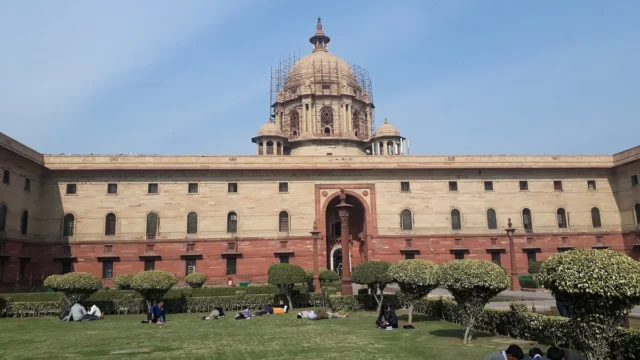
57th GST Council: arrest provisions to go, prosecution threshold raised to ₹5 crore
The 57th GST Council meeting on 8 October 2026 focused on process reform rather than rates. It recommended removing arrest powers under GST, raising the prosecution threshold from ₹1 crore to ₹5 crore, cutting the general penalty from ₹25,000 to ₹10,000, no notices below ₹10,000 tax, wider input tax credit and refunds, and limits on interception of goods in transit.
UPSC angle: Prelims: GST Council structure, Article 279A. · Mains GS-III: indirect tax reform; GS-II: fiscal federalism.
8 Oct 2026
Seven years since abrogation of Article 370
On 5 August 2026 the Prime Minister marked seven years since Articles 370 and 35(A) ceased to operate in 2019, calling 5 August 2019 a defining milestone. He said the full application of the Constitution has empowered women and marginalised communities in Jammu and Kashmir and Ladakh. The change rested on two Presidential Orders, C.O. 272 and C.O. 273.
UPSC angle: Prelims: J&K reorganisation.
5 Aug 2026
₹1,09,019 crore advance tax devolution released to States
The Union Government released an additional tax devolution instalment of ₹1,09,019 crore to the States on 1 August 2026, the Finance Ministry said. It comes on top of the normal monthly devolution due on 10 August. The aim is to help States speed up capital and development spending. Uttar Pradesh got the largest share, ₹19,208 crore.
UPSC angle: Prelims: divisible pool; FC share.
1 Aug 2026Learn the concept
Question text as printed in the official UPSC question paper: https://www.upsc.gov.in/sites/default/files/QP_CSM_2024_GenStud_II_03102024.pdf The model answer is original Battle IAS work; use it to learn structure, not to memorise.