
Chapter 6 · Topic 6.1 · Prelims + Mains1 of 3
Mahajanapadas and the Rise of Magadha: The sixteen states, ganas and towns
Key points
- By the 6th century BCE, janapadas grew into sixteen mahajanapadas (Anguttara Nikaya list); Asmaka was the only one south of the Vindhyas.
- Some states had kings; gana-sanghas were ruled by clan assemblies (santhagara, salaka voting), like the Vajjis of Vaishali.
- Second urbanisation: iron, wet rice, NBPW pottery, towns, guilds and silver punch-marked coins.
Prelims box: facts and traps
- Prelims 2025: Asmaka–Godavari and Kosala–Sarayu are right; Avanti was on the Narmada and Shipra.
- Four great powers: Magadha, Kosala, Vatsa, Avanti.
- Guilds (Prelims 2012): fixed wages, rules and prices and judged members; not registered with the king.
- Taxes: bali, bhaga (often a sixth of the crop), shulka (customs).
- Pali coin names (Prelims 2026): kahapana, nikkha, kamsa, kakanika.
On this page (3 sections)
From janapadas to the sixteen Mahajanapadas
In the Later Vedic age, tribes (janas) settled down, and the land they held came to be called a janapada, ‘the place where the jana set its foot’. By the sixth century BCE some janapadas had grown into bigger states with capitals, armies and taxes. Buddhist and Jain texts call them mahajanapadas, ‘great janapadas’. Think of small villages joining and growing until they become a full state.
The Buddhist Anguttara Nikaya lists sixteen of them; the Jain Bhagavati Sutra gives a slightly different list. Most lay in the Ganga plain, but they stretched from Gandhara in the north-west to Asmaka on the Godavari in the Deccan, the only one south of the Vindhyas.
| Mahajanapada | Capital | Region today |
|---|---|---|
| Anga | Champa | East Bihar (Bhagalpur) |
| Magadha | Rajagriha (Girivraja), later Pataliputra | South Bihar |
| Kashi | Varanasi | Around Varanasi |
| Kosala | Shravasti (also Ayodhya, Saketa) | Eastern Uttar Pradesh |
| Vajji | Vaishali | North Bihar (a confederacy) |
| Malla | Kushinagar and Pava | Eastern Uttar Pradesh (a gana) |
| Chedi | Shuktimati | Bundelkhand |
| Vatsa | Kaushambi | Near Prayagraj |
| Kuru | Indraprastha | Delhi, Haryana |
| Panchala | Ahichchhatra, Kampilya | Western Uttar Pradesh |
| Matsya | Viratanagara | Jaipur region |
| Shurasena | Mathura | Braj region |
| Asmaka | Potana | On the Godavari, Deccan |
| Avanti | Ujjayini, Mahishmati | Malwa |
| Gandhara | Taxila | North-west Pakistan |
| Kamboja | Rajapura (location debated) | Further north-west |
Prelims 2025 framed a question on ancient India (600-322 BC), the age of the Mahajanapadas, asking how many region-river pairs were correct. Asmaka lay on the Godavari and Kosala on the Sarayu, so those two are right. Kamboja was in the far north-west, not on the Vipas (Beas), and Avanti was watered by the Narmada and the Shipra, not the Mahanadi. Only two pairs are correct (b).
With reference to ancient India (600-322 BC), consider the following pairs : Territorial region River flowing in the region I. Asmaka Godavari II. Kamboja Vipas III. Avanti Mahanadi IV. Kosala Sarayu How many of the pairs given above are correctly matched?
- Only one
- Only two
- Only three
- All the four
Show answer
Answer: (b) · UPSC official key
Four states grew strongest and fought each other: Magadha, Kosala, Vatsa and Avanti. The Buddha spent most of his life in two of them. Prelims 2014 asked: Which of the following Kingdoms were associated with the life of the Buddha? The answer is Kosala and Magadha (c), not Avanti or Gandhara.
Which of the following Kingdoms were associated with the life of the Buddha? 1. Avanti 2. Gandhara 3. Kosala 4. Magadha Select the correct answer using the code given below.
- 1, 2 and 3
- 2 and 4
- 3 and 4 only
- 1, 3 and 4
Show answer
Answer: (c) · UPSC official key
What UPSC asks
Prelims: region-river pairs (2025); kingdoms of the Buddha (2014). Mains: how states formed in the sixth century BCE. Next likely: digs at sites like Vaishali and Kaushambi.
Monarchies and gana-sanghas
Not every state had a king. Beside monarchies (rajyas, ruled by one king) there were gana-sanghas, states ruled by a clan or a group of clans through an assembly. Historians sometimes call them ‘republics’ or oligarchies (rule by a few), because power lay with the leading Kshatriya families, not with all the people.
| Feature | Monarchies | Gana-sanghas |
|---|---|---|
| Who ruled | A hereditary raja, often claiming Vedic sanction | Many rajas, heads of clan families, meeting in an assembly |
| Decisions | The king with ministers | Debate in the assembly hall (santhagara); voting with wooden slips (salaka) |
| Location | Mostly in the fertile Ganga valley | Mostly in the Himalayan foothills and the north-west |
| Religion | Supported Vedic sacrifices | More open to heterodox teachers; Mahavira and the Buddha came from ganas |
| Examples | Magadha, Kosala, Vatsa, Avanti | Vajji (Lichchhavis of Vaishali), Mallas, Shakyas, Koliyas |
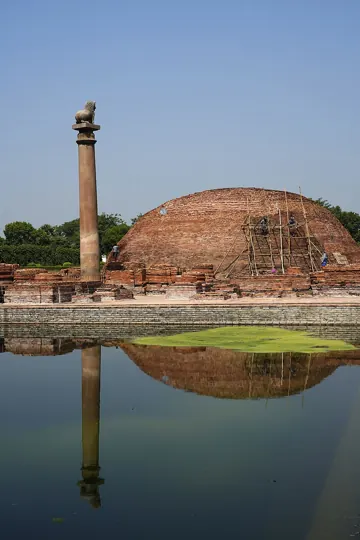
The Vajji confederacy (a union of states), with its capital at Vaishali, joined eight clans including the Lichchhavis, Videhas and Jnatrikas (Mahavira’s clan). The Buddha praised the Vajjis for meeting often and acting together, and based the rules of the sangha on gana practice. But not everyone had a say: dasas and karmakaras (slaves and labourers) worked the land and had no voice.
The gana-sanghas lasted about a thousand years, but in the end the monarchies swallowed most of them. Magadha’s conquest of the Vajjis under Ajatashatru was the turning point. The habit of debate and group decisions lived on, and is often cited as an early Indian democratic tradition.
What UPSC asks
Prelims: gana features such as the santhagara (assembly hall), salaka (voting slips) and the Vajji clans. Mains: ancient Indian democratic traditions. Next likely: ‘mother of democracy’ debates.
The second urbanisation: iron, coins and towns
About a thousand years after the Harappan cities declined, towns rose again in the Ganga plain from about 600 BCE. Historians call this the second urbanisation. Iron tools cleared the thick forests of the middle Ganga valley, and wet-rice farming produced big surpluses that could feed towns, armies and monks.
The archaeological sign of this age is Northern Black Polished Ware (NBPW, about 700–200 BCE), a fine, glossy black pottery used by rich town-dwellers, a bit like the best crockery in a wealthy home. Great towns of the period include Rajagriha, Shravasti, Kaushambi, Champa, Varanasi, Ujjayini and Taxila. Many had moats and ramparts (protective ditches and walls).
A fragment of Northern Black Polished Ware, 500–100 BCE, from Sonkh near Mathura (Government Museum, Mathura). Its mirror-like shine marks the towns of this age.
Trade needed money. Prelims 2026 quoted two statements: Pali texts contain the first definite references to coins, e.g., kahapana, nikkha, kamsa, and kakanika, and archaeology confirms them with punch-marked coins, mostly of silver. Both point to the emergence of urban life and the transition to money economy (c). Punch-marked coins carried symbols such as the sun, a wheel or an elephant, but no king’s name.
Consider the following statements : I. Pali texts contain the first definite references to coins, e.g., kahapana, nikkha, kamsa, and kakanika. II. The literary evidence from Pali texts is corroborated by archaeological evidence of punch-marked coins from many sites, most of them made of silver. The above statements have been associated with which of the following ? 1. Emergence of urban life 2. Transition to money economy Select the answer using the code given below :
- 1 only
- 2 only
- Both 1 and 2
- Neither 1 nor 2
Show answer
Answer: (c) · UPSC provisional key (final key awaited)
Craftsmen and merchants formed guilds, groups like a modern trade association. Prelims 2012 tested statements on the guilds (Shreni) of ancient India. Guilds fixed wages, rules of work, standards and prices, and could judge disputes among their own members, so statements 2 and 3 are right. They were not all registered with a central authority headed by the king, so the answer is 2 and 3 only (c). Rich householders (gahapatis) and merchant-bankers (setthis) became the main supporters of the new faiths.
With reference to the guilds (Shreni) of ancient India that played a very important role in the country’s economy, which of the following statements is/are correct? 1. Every guild was registered with the central authority of the State and the king was the chief administrative authority on them. 2. The wages, rules of work, standards and prices were fixed by the guild. 3. The guild had judicial powers over its own members. Select the correct answer using the codes given below :
- 1 and 2 only
- 3 only
- 2 and 3 only
- 1, 2 and 3
Show answer
Answer: (c) · UPSC official key
States now collected regular taxes: bali, bhaga (a share of the crop, often a sixth) and shulka (customs on goods). With this money kings kept standing armies and paid officials. Writing also returns in this period, leading up to the Brahmi inscriptions of Ashoka.
What UPSC asks
Prelims: coins and urban life (2026); guilds (2012). Mains: second urbanisation, its causes and features. Next likely: new hoards of punch-marked coins.
Mains box: analysis and answer points
- State formation: iron, surplus, taxes, standing armies and towns turned janapadas into states.
- Democratic traditions: gana assemblies debated and voted, but slaves and labourers had no voice.
- Likely next angle: 'mother of democracy' debates.
Practice
Practice MCQs (8)
Early Buddhist texts give a list of sixteen great states, the mahajanapadas, that existed in the age of the Buddha. In which one of the following texts is such a list found?
Answer (b) & explanation
The best-known list of the sixteen mahajanapadas is in the Anguttara Nikaya, a text of the Sutta Pitaka of the Pali canon. NCERT notes that early Buddhist and Jaina texts both mention sixteen mahajanapadas, though the lists vary; the Jaina list is in the Bhagavati Sutra. The other texts named in the options are later or of a different kind.
According to NCERT, the word 'janapada' literally means
Answer (a) & explanation
NCERT (Class VI) explains that the rajas who performed big sacrifices came to be recognised as rajas of janapadas rather than of janas, and that the word janapada literally means the land where the jana set its foot and settled down. About 2500 years ago some janapadas became more important than others and were called mahajanapadas.
With reference to the mahajanapadas, consider the following statements:
1. Most mahajanapadas had a capital city, and many of these were fortified.
2. Gandhara and Kamboja lay in the north-western part of the subcontinent.
3. All the mahajanapadas were monarchies ruled by hereditary kings.
Which of the statements given above is/are correct?
Answer (b) & explanation
NCERT (Class VI) says that most mahajanapadas had a capital city, many of them fortified with huge walls of wood, brick or stone. Gandhara, with its capital at Taxila, and Kamboja lay in the north-west. Statement 3 is wrong: NCERT (Class XII) notes that while most mahajanapadas were ruled by kings, some, known as ganas or sanghas, were oligarchies in which power was shared by a number of men.
Consider the following statements: Statement-I: Although the lists of mahajanapadas vary, names such as Vajji, Magadha, Kosala, Kuru, Panchala, Gandhara and Avanti occur frequently in them. Statement-II: The Buddhist Anguttara Nikaya and the Jaina Bhagavati Sutra give identical lists of the sixteen mahajanapadas.
Which one of the following is correct in respect of the above statements?
Answer (c) & explanation
Statement-I is NCERT's own wording: the lists vary, but some names such as Vajji, Magadha, Kosala, Kuru, Panchala, Gandhara and Avanti occur frequently, which shows that these were among the most important states. Statement-II is wrong: the Anguttara Nikaya and the Bhagavati Sutra both count sixteen, but their lists are not identical; the Jaina list includes names, such as Vanga and Malaya, that the Buddhist list does not.
Which one of the following pairs of an ancient city of the mahajanapada period and the present-day State in which its site lies is NOT correctly matched?
Answer (b) & explanation
Kusinara (Kushinagar), a centre of the Mallas, lies in the Kushinagar district of Uttar Pradesh, not in Bihar. Kaushambi is near Prayagraj in Uttar Pradesh, Champa near Bhagalpur in Bihar and Viratanagara at Bairat in the Jaipur region of Rajasthan.
With reference to the mahajanapada of Vatsa, consider the following statements:
1. Its capital Kaushambi lay on the Yamuna, not far from present-day Prayagraj.
2. Its king Udayana is the hero of Bhasa's Sanskrit play Svapnavasavadatta.
3. In the legend, Udayana's queen Vasavadatta is the daughter of Pradyota, the king of Avanti.
Which of the statements given above are correct?
Answer (d) & explanation
All three are correct. Kaushambi, on the Yamuna near Prayagraj, was the Vatsa capital; NCERT shows a brick fortification wall there, part of it about 2500 years old. Its king Udayana, a contemporary of the Buddha, became a hero of later literature: Bhasa's Svapnavasavadatta tells of his love for Vasavadatta, daughter of Pradyota of Avanti.
Consider the following:
1. Kalinga
2. Kamboja
3. Ashmaka
4. Videha
How many of the above appear as separate mahajanapadas in the list of sixteen given in the Anguttara Nikaya?
Answer (b) & explanation
Only two. The Anguttara Nikaya list is: Kashi, Kosala, Anga, Magadha, Vajji, Malla, Chedi, Vatsa, Kuru, Panchala, Matsya, Shurasena, Ashmaka, Avanti, Gandhara and Kamboja. Kalinga is not in it, and Videha appears only as a member of the Vajji confederacy, not as a separate mahajanapada.
The mahajanapada of Avanti, in the Malwa region, was divided into a northern and a southern part. Their capitals were, respectively,
Answer (c) & explanation
Avanti, roughly the Malwa and Nimar region, had two parts: the northern part with its capital at Ujjayini and the southern part (Avanti Dakshinapatha) with its capital at Mahishmati on the Narmada. Avanti under King Pradyota was a major rival of Magadha until the Shishunagas broke its power.
0 / 0 correct
Write an answer
In 150 words, explain the significance of Mahajanapadas and the Rise of Magadha with one recent example.
Flashcards (12)
Which text lists the sixteen
mahajanapadas? The Buddhist Anguttara Nikaya (the Jain Bhagavati Sutra has a different list).
Which mahajanapada lay south of the
Vindhyas? Asmaka, on the Godavari.
Capital of Avanti?
Ujjayini (and Mahishmati).
Capital of Vatsa?
Kaushambi.
Capital of Anga?
Champa.
Capital of Gandhara?
Taxila.
Capital of the Vajji confederacy?
Vaishali.
Where did a gana assembly meet?
In the santhagara (assembly hall).
Name three gana-sanghas.
Vajjis, Mallas, Shakyas (also Koliyas).
Pottery of the second urbanisation?
Northern Black Polished Ware (NBPW).
What did punch-marked coins lack?
A king's name.
What powers did guilds have?
They fixed wages and prices and judged their own members.
In the news
- 20 Oct 2026Sirpur in Chhattisgarh enters UNESCO’s Tentative List of World Heritage sites
- 15 Oct 2026PM inaugurates five Ladakh projects: Nimmu–Padum–Darcha road, Leh terminal, Hanu hydro
- 14 Oct 2026HAL, NCF and ASI sign MoA for Hampi, Taj Mahal and Bekal Fort
- 11 Oct 2026Birth anniversaries: Jayaprakash Narayan and Nanaji Deshmukh
 Next topic · 6.2 →Mahajanapadas and the Rise of Magadha: Rise of Magadha
Syllabus: Prelims GS-I · History of India and Indian National Movement.