
Chapter 1 · Topic 1.2 · Prelims + Mains2 of 3
Sources of Ancient Indian History: Inscriptions and coins
Key points
- Inscriptions are carved at the time, so they are the most trusted written clues, though royal ones boast.
- Ashoka's edicts: Prakrit language in Brahmi script (Kharosthi in the north-west); Brahmi read by James Prinsep in 1837.
- Coins show kings, money and trade: punch-marked, Indo-Greek, Kushana, Satavahana, Gupta and Roman coins.
Prelims box: facts and traps
| Inscription | Ruler |
|---|---|
| Hathigumpha (Odisha) | Kharavela of Kalinga |
| Junagadh rock (Gujarat), about 150 CE | Rudradaman I (Shaka) |
| Nasik cave | Gautami Balashri |
| Allahabad pillar (Prayag Prashasti) | Samudragupta |
| Aihole (Karnataka), 634 CE | Pulakeshin II |
| Uttaramerur (Tamil Nadu), 10th century | Parantaka I (Chola). |
- James Prinsep deciphered Brahmi in 1837.
- Hoards of Roman coins at Arikamedu and in Tamil Nadu back up what the Periplus and Pliny say about Indo-Roman trade; Pliny complained of Roman gold draining to India.
- Rock Edict III asks them to tour their areas every five years to teach dhamma.
Inscriptions: the most reliable written record
Inscriptions are writings cut on rock, pillars, cave walls, metal plates, seals or temple walls. The study of inscriptions is epigraphy; the study of old scripts (styles of writing) is palaeography. Made at the time, often by rulers, and impossible to quietly edit later like a copied book, inscriptions are among the most reliable sources, though royal ones naturally boast. The Harappan seals carry the oldest writing in India, but that script is still not deciphered (nobody can read it yet).
The oldest inscriptions we can read are Ashoka’s (3rd century BCE). Most are in the Prakrit language written in the Brahmi script. Language is what you speak; script is the letters you write it in, like Hindi written in Devanagari. Brahmi runs left to right and is the parent of most Indian scripts. In the north-west the edicts use Kharosthi, which runs right to left, and in Afghanistan some are in Greek and Aramaic. James Prinsep deciphered Brahmi in 1837. Ashoka calls himself Devanampiya Piyadasi (‘beloved of the gods, of pleasing looks’); his name Ashoka appears in the minor rock edict at Maski in Karnataka and a few others.
Prelims 2020 quoted an inscription and asked which ruler gave this advice to his people: “Whosoever praises his religious sect or blames other sects out of excessive devotion to his own sect, with the view of glorifying his own sect, he rather injures his own sect very severely.” It is Ashoka (option a), in Major Rock Edict XII, his plea for respect among all sects.
Who among the following rulers advised his subjects through this inscription ? “Whosoever praises his religious sect or blames other sects out of excessive devotion to his own sect, with the view of glorifying his own sect, he rather injures his own sect very severely.”
- Ashoka
- Samudragupta
- Harshavardhana
- Krishnadeva Raya
Show answer
Answer: (a) · UPSC official key
Prelims 2025 noted that Ashokan inscriptions suggest that the ‘Pradeshika’, ‘Rajuka’ and ‘Yukta’ were important officers, and asked at which level. Rock Edict III asks them to tour their areas every five years to teach dhamma (Ashoka’s code of good conduct).
Ashokan inscriptions suggest that the ‘Pradeshika’, ‘Rajuka’ and ‘Yukta’ were important officers at the
- village-level administration
- district-level administration
- provincial administration
- level of the central administration
Show answer
Answer: (b) · UPSC official key
Mains 2026 asked candidates to analyze the importance of Ashokan inscriptions for reconstructing Mauryan history. They show the empire’s size (from where edicts are found), the Kalinga war and Ashoka’s regret (Rock Edict XIII), his dhamma, officers, Greek ties, languages and scripts. Limits: only the king’s voice, say little about the economy, and must be read with Megasthenes and the Arthashastra.
Analyze the importance of Ashokan inscriptions for reconstructing Mauryan history.
| Inscription | Ruler | Why it matters |
|---|---|---|
| Hathigumpha (Odisha) | Kharavela of Kalinga | Year-by-year record of a Jain king’s reign |
| Junagadh rock (Gujarat), about 150 CE | Rudradaman I (Shaka) | First long inscription in classical Sanskrit; repair of the Sudarshana lake built under the Mauryas |
| Nasik cave | Gautami Balashri | Achievements of her son, the Satavahana Gautamiputra Satakarni |
| Allahabad pillar (Prayag Prashasti) | Samudragupta | Conquests, written by his court poet Harishena on an Ashokan pillar |
| Aihole (Karnataka), 634 CE | Pulakeshin II | By Ravikirti; records Harsha’s defeat by Pulakeshin |
| Uttaramerur (Tamil Nadu), 10th century | Parantaka I (Chola) | Rules for electing village assembly members by lot |
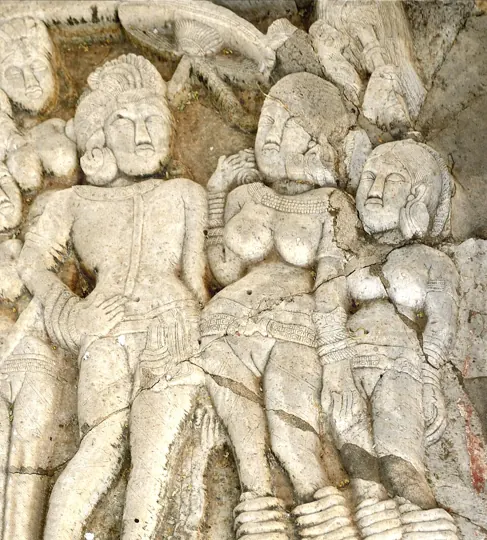
Prelims 2019 asked in which of the following relief sculpture inscriptions is ‘Ranyo Ashoka’ (King Ashoka) mentioned along with the stone portrait of Ashoka. (A relief is a carving raised from flat stone.) The answer is Kanaganahalli (option a), a Buddhist stupa site near Sannati on the Bhima river in Kalaburagi district, Karnataka.
In which of the following relief sculpture inscriptions is ‘Ranyo Ashoka’ (King Ashoka) mentioned along with the stone portrait of Ashoka?
- Kanganahalli
- Sanchi
- Shahbazgarhi
- Sohgaura
Show answer
Answer: (a) · UPSC official key
What UPSC asks
Prelims: edict quotes (2020); Ashokan officers (2025); Kanaganahalli (2019). Mains: Ashokan inscriptions for Mauryan history (2026). Trap: Prakrit is the language, Brahmi the script. Next likely: prashastis (praise poems) and land-grant plates.
Coins: money, kings and trade
The study of coins is numismatics. A coin is a tiny newspaper. Its metal, weight and number show the economy; where foreign coins turn up shows trade; and it tells us about kings: their names, titles, dates, religion and even faces. Some rulers, especially in the north-west after the Mauryas, are known almost only from their coins.
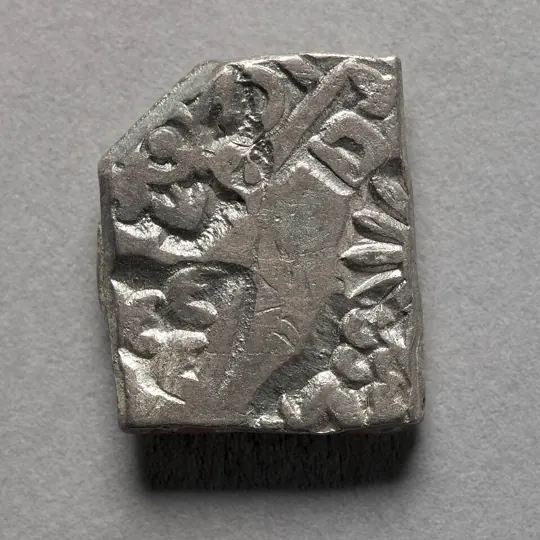
| Coins | Period | Point to remember |
|---|---|---|
| Punch-marked (karshapana) | From about the 6th–5th century BCE | Earliest Indian coins; mostly silver, some copper; symbols punched on, no names |
| Indo-Greek | 2nd–1st century BCE | First Indian coins with the ruler’s portrait and name, often in Greek and Kharosthi |
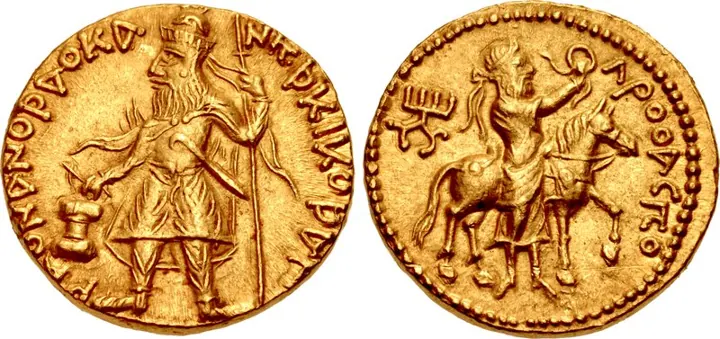
| Kushana | 1st–3rd century CE | Gold issued on a large scale; Kanishka shows Indian, Greek and Iranian deities, including the Buddha |
| Satavahana | 1st century BCE–3rd century CE | Many lead and potin coins; some with ships |
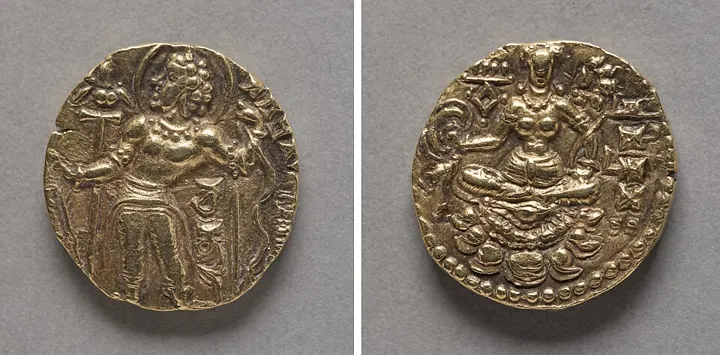
| Gupta | 4th–6th century CE | The most numerous gold coins (dinara); kings shown as archers, horsemen, lion-slayers, even playing the veena |
| Roman | 1st–2nd century CE | Gold and silver hoards in the south show trade with Rome |
Coins also show change. Gupta gold got steadily less pure after the 5th century (debasement), and fewer coins were made in the early medieval period, hinting at a shrinking money economy, a key argument in debates on Indian feudalism. Hoards of Roman coins at Arikamedu and in Tamil Nadu back up what the Periplus and Pliny say about Indo-Roman trade; Pliny complained of Roman gold draining to India.
What UPSC asks
Prelims: coin series and their features. Mains: coins as evidence for economy and trade. Next likely: Indo-Roman trade hoards.
Mains box: analysis and answer points
- Ashokan inscriptions show: the empire's spread, Kalinga (Rock Edict XIII), dhamma, officers, Greek ties, languages and scripts.
- Limits: only the king's voice, little on the economy; read with Megasthenes and the Arthashastra.
- Asked: Mains 2026 (GS Paper I, 10 marks): Analyze the importance of Ashokan inscriptions for reconstructing Mauryan history.
Practice
Practice MCQs (8)
Several thousand copper coins issued by the Yaudheyas of the Punjab-Haryana region (c. first century CE) have been found. Historians use them mainly as evidence that
Answer (c) & explanation
The NCERT text notes that coins were issued not only by kings but also by tribal republics such as the Yaudheyas, and that the thousands of copper Yaudheya coins found point to their participation in economic exchange. Many of these coins carry the legend 'Yaudheya-gana' and the figure of Karttikeya, showing that the gana itself, not a king, was the issuing authority. The Yaudheyas were an indigenous gana-sangha, not a Shaka dynasty, and their coins were of copper, not gold.
The Aihole inscription (634-35 CE), which records the Chalukya king Pulakeshin II's victory over Harshavardhana, was composed by
Answer (a) & explanation
The Aihole prashasti is engraved on the Meguti Jaina temple at Aihole (Bagalkot district, Karnataka). Its author Ravikirti, a Jaina poet at Pulakeshin II's court, claims a fame equal to that of Kalidasa and Bharavi, and the mention of these two poets helps date them. The inscription describes how Harsha's 'harsha' (joy) melted away when he was defeated by Pulakeshin. Harishena wrote Samudragupta's Prayaga prashasti, Banabhatta wrote the Harshacharita, and Vatsabhatti composed the Mandasor inscription of the silk weavers' guild.
The term 'dinara', used in Gupta inscriptions for gold coins, is derived from
Answer (d) & explanation
'Dinara' comes from the Roman denarius (via the gold denarius aureus), reflecting the contact with the Roman world through trade and through the Kushana gold coinage that preceded the Guptas. Gupta inscriptions record gifts and endowments in dinaras, and Gupta gold coins are commonly called dinaras. The Greek drachma gave the later term 'dramma' for silver coins. The Arabic dinar is itself derived from the denarius and came much later, in the seventh century, so it cannot be the source of a Gupta term.
With reference to the punch-marked coins of early India, consider the following statements:
1. They are made mostly of silver and copper.
2. Their symbols were stamped one at a time with separate punches.
3. Texts refer to such coins as karshapanas or panas.
4. They usually carry the names of the issuing kings in the Brahmi script.
Which of the statements given above are correct?
Answer (d) & explanation
Statements 1, 2 and 3 are correct. Punch-marked coins, the earliest coins of the subcontinent (from about the sixth-fifth century BCE), are pieces of metal, mostly silver and sometimes copper, cut to a fixed weight and stamped with symbols (sun, wheel, hill with crescent, animals) using separate punches. Texts such as the Arthashastra and Buddhist works call them karshapana or pana. Statement 4 is wrong: they bear no legends; the identity of the issuers (kings, merchants' guilds or towns) is inferred, not read. Coins with names of rulers appear only with the Indo-Greeks.
With reference to coinage in early India, consider the following statements:
1. The first coins to bear the names and images of rulers were issued by the Indo-Greeks.
2. Gold coins were first issued on a large scale by the Kushanas.
3. The coins of the Satavahanas are mostly of gold.
Which of the statements given above is/are correct?
Answer (b) & explanation
Statements 1 and 2 are correct. Punch-marked coins carried symbols but no names; the NCERT text notes that the first coins to carry the names and images of rulers were issued by the Indo-Greeks, which is why their coins are the main source for the many Indo- Greek kings. The first gold coins were issued around the first century CE by the Kushanas, close in weight to contemporary Roman and Parthian issues. Statement 3 is wrong: Satavahana coinage was mostly of lead, potin and copper, with a smaller series of silver portrait coins.
Gold coins showing Chandragupta I with his queen Kumaradevi, and bearing the legend 'Licchavayah' on the reverse, are taken as evidence of
Answer (a) & explanation
The king-and-queen type coins show Chandragupta I offering a ring or ornament to Kumaradevi, with a goddess on a lion on the reverse and the legend 'Licchavayah' (the Licchavis). Together with the Gupta inscriptions that proudly call Samudragupta 'Licchavi- dauhitra' (daughter's son of the Licchavis), they show the importance of the marriage alliance for the rise of the Guptas. Some scholars think the coins were struck by Samudragupta in memory of his parents, but either way they point to the Licchavi alliance.
With reference to Roman coins found in India, consider the following statements:
1. Most of the hoards have been found in peninsular India rather than in the Ganga plain.
2. The largest number of coins belong to the reigns of Augustus and Tiberius.
3. The Roman writer Pliny the Elder complained of a heavy drain of Roman money to India.
4. Most of the Roman coins found in India are of copper.
How many of the statements given above are correct?
Answer (c) & explanation
Statements 1, 2 and 3 are correct. Roman coin finds are concentrated in peninsular India, especially the Coimbatore region, Karnataka, Andhra and Tamil Nadu, close to the sources of beryl, pepper and textiles. The largest number of coins belong to Augustus and Tiberius (late first century BCE to early first century CE). Pliny grumbled in his Natural History that India drained the empire of large sums every year in exchange for luxuries. Statement 4 is wrong: the hoards consist mainly of gold aurei and silver denarii, which were valued in India largely as bullion.
Which one of the following pairs of a monetary term of ancient and early medieval India and its description is NOT correctly matched?
Answer (d) & explanation
The fourth pair is wrong. Dramma, derived from the Greek drachma, was a silver coin; the term is common in early medieval inscriptions of western and northern India. The other three are correct: karshapana is the textual name of the punch-marked coin; nishka appears in the Rigveda as a gold ornament for the neck and later came to denote a unit of value or coin; and rupaka is the term used for silver coins in the Gupta period, a word related to the later 'rupee'.
0 / 0 correct
Write an answer
In 150 words, explain the significance of Sources of Ancient Indian History with one recent example.
Flashcards (10)
Who deciphered Brahmi, and when?
James Prinsep, 1837.
Which way does Kharosthi run?
Right to left.
Which Ashokan edict pleads for respect
among sects? Major Rock Edict XII.
Where does Ashoka's name first appear in
an edict? Maski minor rock edict, Karnataka.
Who wrote the Allahabad Prashasti?
Harishena, for Samudragupta.
First long inscription in classical Sanskrit?
Rudradaman I's Junagadh inscription, about 150 CE.
Where is the labelled relief portrait of
Ashoka? Kanaganahalli, near Sannati, Karnataka.
Earliest Indian coins?
Punch-marked coins, mostly silver.
Who first put the ruler's portrait and name
on Indian coins? The Indo-Greeks.
Which dynasty issued the most gold coins?
The Guptas.
In the news
- 20 Oct 2026Sirpur in Chhattisgarh enters UNESCO’s Tentative List of World Heritage sites
- 15 Oct 2026PM inaugurates five Ladakh projects: Nimmu–Padum–Darcha road, Leh terminal, Hanu hydro
- 14 Oct 2026HAL, NCF and ASI sign MoA for Hampi, Taj Mahal and Bekal Fort
- 11 Oct 2026Birth anniversaries: Jayaprakash Narayan and Nanaji Deshmukh
 Next topic · 1.3 →Sources of Ancient Indian History: Monuments, excavations and dating
Syllabus: Prelims GS-I · History of India and Indian National Movement.