
Chapter 6 · Topic 6.2 · Prelims + Mains2 of 3
Indian Theatre: Folk theatre and puppetry
Key points
- Folk theatre by state.
- Puppetry types.
Prelims box: facts and traps
| Form | State and detail |
|---|---|
| Jatra | Bengal and Odisha; open-air musical plays, linked with Chaitanya's bhakti |
| Nautanki | Uttar Pradesh; songs in verse with the nagara drum |
| Tamasha | Maharashtra; women lead dancing; Lavani songs |
| Bhavai | Gujarat and Rajasthan; street plays with satire |
| Swang | Haryana and Punjab; mostly sung. |
- Pandit Lakhmi Chand (1903–1945), remembered in Haryana as 'Surya Kavi', is the most celebrated poet-performer of Haryanvi Swang; Haryana's State university of performing and visual arts at Rohtak bears his name.
- Vithabai Narayangaonkar was a leading Tamasha artiste of Maharashtra and received the Sangeet Natak Akademi Award for Tamasha in 1990.
Folk theatre by state
| Form | State and detail |
|---|---|
| Jatra | Bengal and Odisha; open-air musical plays, linked with Chaitanya’s bhakti |
| Nautanki | Uttar Pradesh; songs in verse with the nagara drum |
| Tamasha | Maharashtra; women lead dancing; Lavani songs |
| Bhavai | Gujarat and Rajasthan; street plays with satire |
| Swang | Haryana and Punjab; mostly sung |
| Therukoothu | Tamil Nadu; street theatre at village festivals, Draupadi cult |
| Bhand Pather | Kashmir; satirical play with music |
| Mach | Madhya Pradesh; Malwa song-drama |
Puppetry
| Type | Examples |
|---|---|
| String | Kathputli (Rajasthan), Gombeyatta (Karnataka), Bommalattam (Tamil Nadu), Kundhei (Odisha) |
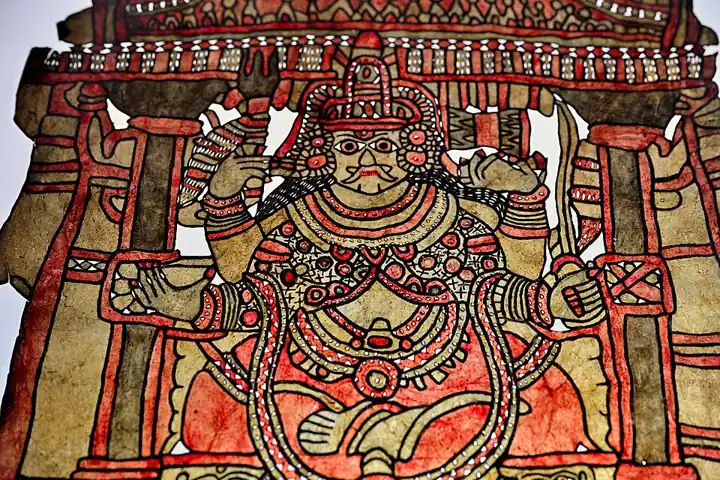
| Shadow | Tholu Bommalata (Andhra), Togalu Gombeyatta (Karnataka), Ravanachhaya (Odisha), Tholpavakoothu (Kerala) |
| Glove | Pavakoothu (Kerala), Gulabo-Sitabo (Uttar Pradesh) |
| Rod | Putul Nach (West Bengal), Yampuri (Bihar) |

Bommalattam of Tamil Nadu combines rods and strings. Ravanachhaya puppets of Odisha are made of deer skin and have no joints.
Mains box: analysis and answer points
- Yellow: folk theatre; white: traditional forms on this chapter's list.
- Bommalattam of Tamil Nadu combines rods and strings.
- Ravanachhaya puppets of Odisha are made of deer skin and have no joints.
- Likely next angle: Tamasha
Practice
Practice MCQs (8)
Consider the following pairs: Traditional theatre — State or Union Territory
1. Maach — Madhya Pradesh
2. Bhand Pather — Jammu and Kashmir
3. Tamasha — Maharashtra
4. Swang — Odisha
How many of the pairs given above are correctly matched?
Answer (c) & explanation
Three pairs are correct. Maach is the musical theatre of Malwa in Madhya Pradesh; Bhand Pather is the satirical theatre of Kashmir; Tamasha is the folk theatre of Maharashtra. Swang belongs to Haryana and its neighbourhood (with Rajasthan, western Uttar Pradesh and Malwa), not to Odisha, whose traditional theatres include Jatra and Prahlad Nataka.
A popular folk theatre of the Bhojpuri-speaking region of Bihar, shaped above all by the playwright-performer Bhikhari Thakur, whose plays dwell on the plight of men who migrate for work and the wives they leave behind, is:
Answer (c) & explanation
Bidesia is the folk theatre of the Bhojpuri belt of Bihar (and adjoining eastern Uttar Pradesh). Its best-known exponent, Bhikhari Thakur (1887–1971), wrote and staged plays such as Bidesia on the pain of migration: the 'bidesi' husband who leaves for distant cities for work and the wife left at home. It also attacked social evils of the day. Jatra is Bengali, Bhaona Assamese and Prahlad Nataka Odia.
Consider the following pairs: Traditional theatre — State
1. Veedhi Natakam — Andhra Pradesh
2. Talamaddale — Karnataka
3. Bayalata — Tamil Nadu
Which of the pairs given above are correctly matched?
Answer (c) & explanation
Veedhi Natakam ('street drama') is a traditional theatre of Andhra Pradesh. Talamaddale, the seated, costume-free form of Yakshagana, belongs to coastal Karnataka. Bayalata ('open-field play') is the general name for open-air folk drama in Karnataka, not Tamil Nadu, whose street theatre is Therukoothu.
Consider the following pairs: Traditional theatre — State
1. Shumang Leela — Manipur
2. Prahlad Nataka — West Bengal
3. Bidesia — Bihar
Which of the pairs given above are correctly matched?
Answer (a) & explanation
Shumang Leela is the courtyard theatre of Manipur, and Bidesia is the Bhojpuri folk theatre of Bihar, associated with Bhikhari Thakur. Prahlad Nataka belongs to the Ganjam district of southern Odisha, not to West Bengal, whose signature folk theatre is Jatra.
Consider the following pairs: Performer — Folk theatre with which chiefly associated
1. Pandit Lakhmi Chand — Swang
2. Vithabai Narayangaonkar — Tamasha
3. Gulab Bai — Bhand Pather
Which of the pairs given above are correctly matched?
Answer (a) & explanation
Pandit Lakhmi Chand (1903–1945), remembered in Haryana as 'Surya Kavi', is the most celebrated poet-performer of Haryanvi Swang; Haryana's State university of performing and visual arts at Rohtak bears his name. Vithabai Narayangaonkar was a leading Tamasha artiste of Maharashtra and received the Sangeet Natak Akademi Award for Tamasha in 1990. Gulab Bai of Kanpur was the pioneering woman performer of Nautanki, not of Kashmir's Bhand Pather.
Consider the following pairs: Traditional theatre — Theme or content
1. Prahlad Nataka — Narasimha's protection of the child-devotee Prahlada from Hiranyakashipu
2. Shumang Leela — contemporary social and political issues, often treated with humour
3. Bhaona — episodes from the life of the Buddha
Which of the pairs given above is/are correctly matched?
Answer (b) & explanation
Prahlad Nataka, the traditional theatre of Ganjam in southern Odisha, enacts the Puranic story of Prahlada and his rescue by Narasimha from his father Hiranyakashipu, with song, verse, masks and a raised stepped platform. Shumang Leela of Manipur takes up social and political issues of the day, usually with humour and satire. Bhaona presents the Vaishnava Ankiya Naats of Assam, whose stories come from the lives of Krishna and Rama, not the Buddha.
Consider the following statements about the folk theatre of Karnataka:
1. Bayalata, literally an 'open-field play', is a general name for open-air folk drama in the State.
2. Doddata (the 'big play') and Sannata (the 'small play') are forms of Bayalata found in north Karnataka.
3. Doddata is performed only by hereditary professional troupes attached to temples under royal patronage.
Which of the statements given above are correct?
Answer (a) & explanation
Bayalata (bayalu = open field, ata = play) is the umbrella term for Karnataka's open-air folk drama; Yakshagana itself is often described as a form of it. In north Karnataka the eastern branch (Mudalapaya) includes Doddata, the 'big play', and Sannata, the 'small play'. Doddata, prevalent in north-eastern Karnataka, is performed by non-professional rural artistes on festival occasions, not by hereditary temple troupes under royal patronage.
With reference to Bhavai, consider the following statements:
1. Asait, a fourteenth-century poet of Siddhpur in north Gujarat, is regarded as the father of the tradition and is credited with composing 360 playlets.
2. It is a temple theatre of the Konkan coast in which masked performers personify the ten incarnations of Vishnu.
3. A performance is made up of independent playlets, each called a vesh, and the long brass trumpet called bhungal is one of its characteristic instruments.
Which of the statements given above are correct?
Answer (c) & explanation
Bhavai is the folk drama of Gujarat, mixing narration, song, dance, farce and social satire, and long linked with festivals of the Mother Goddess such as Navaratri. Tradition regards Asait (Asaita Thakar) of Siddhpur, a fourteenth-century poet, as its father and credits him with 360 vesh. A show strings together independent playlets, each a vesh, and the bhungal, a long brass trumpet, is its signature instrument. Statement 2 describes Dashavatar of the Konkan and Goa.
0 / 0 correct
Write an answer
In 150 words, explain the significance of Indian Theatre with one recent example.
Flashcards (7)
Jatra belongs to?
Bengal (and Odisha).
Tamasha belongs to?
Maharashtra.
Bhavai belongs to?
Gujarat and Rajasthan.
Therukoothu belongs to?
Tamil Nadu.
Kathputli is which type?
String puppets, Rajasthan.
Tholu Bommalata is which type?
Shadow puppets, Andhra.
Putul Nach is which type?
Rod puppets, Bengal.
Read more: related explainers
In the news
- 20 Oct 2026Sirpur in Chhattisgarh enters UNESCO’s Tentative List of World Heritage sites
- 15 Oct 2026PM inaugurates five Ladakh projects: Nimmu–Padum–Darcha road, Leh terminal, Hanu hydro
- 14 Oct 2026HAL, NCF and ASI sign MoA for Hampi, Taj Mahal and Bekal Fort
- 3 Oct 2026Centres of Excellence approved for five newer classical languages
 Next topic · 6.3 →Indian Theatre: Modern Indian theatre
Syllabus: GS-I · Indian culture will cover the salient aspects of Art Forms, literature and Archi…