
Chapter 13 · Topic 13.2 · Prelims + Mains2 of 3
Handicrafts: Stone, wood and metal
Key points
- Wood and toys.
2 PYQs 2015–2024
Prelims box: facts and traps
| Craft | Place |
|---|---|
| Pietra dura (parchin kari) | Agra |
| Marble carving | Makrana, Rajasthan |
| Stone carving | Mamallapuram, Tamil Nadu |
| Soapstone and Konark replicas | Odisha |
| Sandstone jali | Rajasthan, Gwalior. |
Stone crafts
| Craft | Place | Note |
|---|---|---|
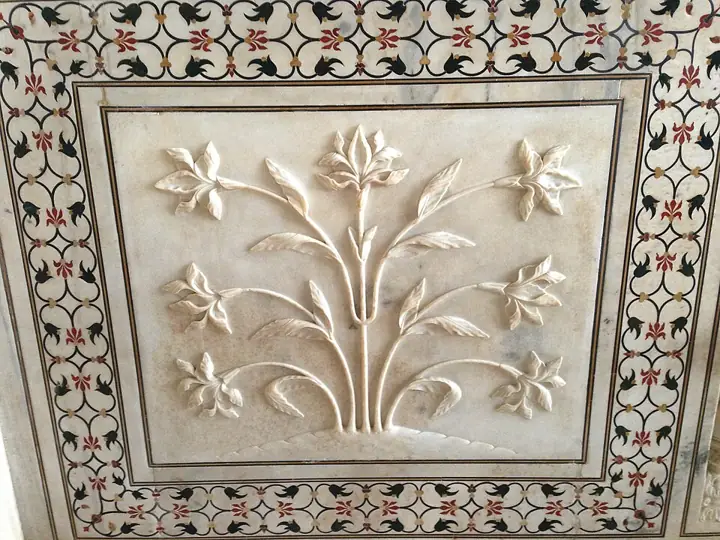
| Pietra dura (parchin kari) | Agra | Semi-precious stones set in marble, as on the Taj Mahal |
| Marble carving | Makrana, Rajasthan | Marble of the Taj Mahal and Victoria Memorial |
| Stone carving | Mamallapuram, Tamil Nadu | Granite carving in the Pallava tradition |
| Soapstone and Konark replicas | Odisha | Pathara kama (stone carving) |
| Sandstone jali | Rajasthan, Gwalior | Pierced stone screens |
Wood crafts and toys
| Craft | Place | Feature |
|---|---|---|
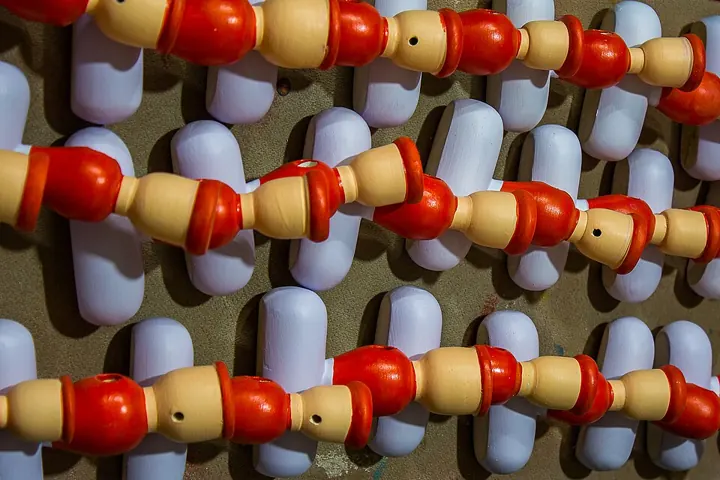
| Channapatna toys | Karnataka | Ivory-wood toys with lacquer; ‘toy town’ |
| Kondapalli toys | Andhra Pradesh | Light tella poniki wood |
| Etikoppaka toys | Andhra Pradesh | Lac-turned toys with natural dyes |
| Sandalwood carving | Mysuru, Karnataka | Fine figurines |
| Walnut wood carving | Kashmir | Deep-carved furniture |
| Khatamband | Kashmir | Ceiling of interlocked wooden pieces |
| Sankheda furniture | Gujarat | Lacquered teak |
Mains box: analysis and answer points
| Craft | Place |
|---|---|
| Pietra dura (parchin kari) | Agra |
| Marble carving | Makrana, Rajasthan |
| Stone carving | Mamallapuram, Tamil Nadu |
| Soapstone and Konark replicas | Odisha |
| Sandstone jali | Rajasthan, Gwalior. |
- Likely next angle: Mamallapuram
Practice
Practice MCQs (8)
Consider the following pairs: Metal craft — State
1. Pembarthi sheet-brass work — Telangana
2. Sarthebari bell-metal ware — Assam
3. Moradabad brassware — Bihar
Which of the pairs given above is/are correctly matched?
Answer (c) & explanation
Pembarthi in Jangaon district, Telangana, is known for sheet-brass work with fine repoussé, used for temple fittings and decorative ware. Sarthebari in Barpeta district, Assam, is the leading centre of bell-metal (kansa) utensils such as the bota and kahi. Moradabad, the 'Peetal Nagri' or brass city, is in Uttar Pradesh, not Bihar, so pair 3 is wrong.
Consider the following statements about Tarakasi:
1. It is a silver filigree craft for which Cuttack in Odisha is famous.
2. Its delicate designs are made by bending, twisting and soldering very fine silver wire.
3. Its objects are made by pouring molten silver into closed moulds.
Which of the statements given above are correct?
Answer (a) & explanation
Tarakasi (tar, wire; kasi, design) is the silver filigree of Cuttack, Odisha. Silver is drawn into hair-thin wire, which is twisted, curled and set into a frame of thicker wire, then soldered, to make jewellery, boxes and the famous Durga Puja ornaments and figurines. It is the opposite of casting: nothing is poured into a mould. Statement 3 is wrong.
Consider the following pairs: Jewellery tradition — Place
1. Kundan setting — Rajasthan
2. Temple jewellery of Nagercoil — Tamil Nadu
3. Gulabi (pink) meenakari — Varanasi
4. Silver filigree of Karimnagar — Telangana
Which of the pairs given above are correctly matched?
Answer (d) & explanation
All four are correct. Kundan, setting stones in highly refined gold foil, is a court tradition of Rajasthan (Jaipur, Bikaner) carried over from Mughal workshops. Nagercoil in Kanyakumari district, Tamil Nadu, makes gold-plated temple jewellery used by Bharatanatyam dancers. Gulabi meenakari of Varanasi uses pink and other pastel enamels on gold or silver and carries a GI. Karimnagar silver filigree, registered as a GI under undivided Andhra Pradesh, is now a Telangana craft.
Consider the following statements: Statement-I: In finished Bidriware, the silver inlay stands out against a deep black body. Statement-II: After inlaying, the object is coated with a paste of a special local soil mixed with ammonium chloride, which blackens the zinc alloy but leaves the silver bright.
Which one of the following is correct in respect of the above statements?
Answer (a) & explanation
Both are correct and II explains I. After casting, engraving and inlay, the Bidri piece is heated and rubbed with a paste of soil traditionally taken from old, unlit parts of the Bidar fort, mixed with ammonium chloride (nausadar) and water. The salts react with the zinc-rich alloy and turn it a lasting black, while the silver does not change. The contrast described in I is thus the direct result of the process in II.
Elongated wrought-iron figures of deities, horse riders, animals and ritual lamps, made by tribal blacksmiths by heating and hammering iron without casting, are a well-known craft of:
Answer (c) & explanation
The wrought-iron craft of Bastar is the work of tribal blacksmiths (Lohars) of south Chhattisgarh. Scrap iron is heated in a small furnace and hammered into slender, stylised figures of gods, riders, animals and multi-wick lamps, with no casting or welding of other metals. It is distinct from the brass and bell-metal Dhokra of the same region, which is cast. Bastar wrought iron craft is registered as a GI of Chhattisgarh.
Consider the following statements about Etikoppaka toys:
1. They are lacquered wooden toys of Andhra Pradesh, turned on a lathe from the soft wood of the ankudu tree.
2. Their colours are traditionally obtained from natural sources such as seeds, bark, roots and leaves.
3. They are carved from sandalwood and left unpainted.
Which of the statements given above are correct?
Answer (a) & explanation
Etikoppaka, a village on the Varaha river in Andhra Pradesh, makes smooth, rounded lacquerware toys. Pieces of soft ankudu wood are turned on a lathe, and coloured lac sticks are pressed on as the piece spins, the heat of friction melting the lac into a glossy coat. The lac is traditionally coloured with natural dyes from seeds, bark, roots and leaves. They are neither sandalwood nor unpainted, so statement 3 is wrong.
Consider the following statements about the Aranmula kannadi:
1. It is made in Kerala.
2. It is a mirror whose reflecting surface is a polished metal alloy, not glass.
3. Like an ordinary glass mirror, it reflects from a coated back surface, which produces a faint double image.
Which of the statements given above are correct?
Answer (d) & explanation
The Aranmula kannadi is a hand-made mirror from Aranmula in Pathanamthitta district, Kerala, made by a few families of traditional metalworkers. Its face is a cast and highly polished metal alloy of copper and tin, the exact recipe being a family secret. Because it is a front-surface mirror, the image is formed at the polished face itself and there is no secondary reflection, unlike a glass mirror with a silvered back. Statement 3 is wrong. It is a GI of Kerala.
Consider the following pairs: Craft — Technique
1. Koftgari — gold or silver wire hammered into a roughened steel surface
2. Meenakari — coloured enamel fused onto a metal surface by firing
3. Thewa — gold sheet worked with designs and fused onto coloured glass
4. Bidri — designs raised by hammering a copper sheet from the back
Which of the pairs given above are correctly matched?
Answer (d) & explanation
Koftgari, the damascening of Rajasthan (Udaipur, Alwar, Jaipur), hammers gold or silver wire into a cross-hatched steel surface, classically on swords and shields. Meenakari fuses powdered enamel colours onto gold, silver or copper; Jaipur is the main centre. Thewa, from Pratapgarh in Rajasthan, fuses finely worked gold sheet onto coloured glass. Raising designs by hammering from the back is repoussé; Bidri is silver inlay on a blackened zinc alloy. Pair 4 is wrong.
0 / 0 correct
Prelims PYQs on this topic (1)
Kalamkari painting refers to
Answer (a) & explanation
Kalamkari ("pen-work") is a hand-painted or block-printed cotton textile of South India (a), mainly Andhra Pradesh. The Srikalahasti style is drawn freehand with a bamboo kalam and shows scenes from the epics and temple themes. The Machilipatnam style uses carved wooden blocks. Both use natural dyes and have GI tags. It is not a North-East bamboo craft (b), a Himalayan woollen cloth (c) or a silk cloth of the North-West (d).
Notice how Kalamkari links art, trade and history: Machilipatnam's printed cloth was a major export when European companies traded on the Coromandel coast.
Answer as per the official UPSC answer key.
Mains PYQs on this topic (1)
Write an answer
In 150 words, explain the significance of Handicrafts with one recent example.
Flashcards (3)
Pietra dura is called locally?
Parchin kari (Agra).
Channapatna toys state?
Karnataka.
Kondapalli and Etikoppaka toys state?
Andhra Pradesh.
In the news
- 20 Oct 2026Sirpur in Chhattisgarh enters UNESCO’s Tentative List of World Heritage sites
- 15 Oct 2026PM inaugurates five Ladakh projects: Nimmu–Padum–Darcha road, Leh terminal, Hanu hydro
- 14 Oct 2026HAL, NCF and ASI sign MoA for Hampi, Taj Mahal and Bekal Fort
- 3 Oct 2026Centres of Excellence approved for five newer classical languages
 Next topic · 13.3 →Handicrafts: Revision
Syllabus: GS-I · Indian culture will cover the salient aspects of Art Forms, literature and Archi…