
Chapter 3 · Topic 3.3 · Prelims + Mains3 of 3
Indian Paintings: Modern and folk painting
Key points
- Kalighat: pilgrim watercolours, Kolkata.
- Abanindranath Tagore: Bharat Mata (1905).
- Kalamkari: Srikalahasti pen, Machilipatnam block.
- Warli: Maharashtra; Madhubani: Bihar.
Prelims box: facts and traps
- Nandalal Bose: Haripura posters (1938), Constitution art.
- Kalamkari = hand-painted cotton (Prelims 2015).
- Phad: Rajasthan scrolls; Pattachitra: Odisha.
Colonial and modern painting
| Movement | Detail |
|---|---|
| Company painting | Indian artists painting for Britons: Patna, Murshidabad, Tanjore |
| Kalighat (Kolkata) | Quick watercolours sold to pilgrims; gods and social satire |
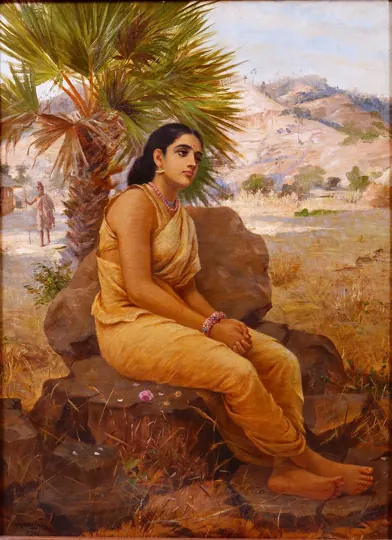
| Raja Ravi Varma | Oil paintings of epic scenes; oleograph prints spread his images |
| Bengal School | Abanindranath Tagore (Bharat Mata, 1905), Nandalal Bose; rejected Western academic style |
| Later modern | Amrita Sher-Gil; the Progressive Artists’ Group (M. F. Husain, S. H. Raza) |
Nandalal Bose made the Haripura Congress posters (1938) and illustrated the original Constitution of India.
What UPSC asks: Kalighat. Ravi Varma. Bengal School.
Folk and regional painting
| Form | State and detail |
|---|---|
| Madhubani (Mithila) | Bihar; women painters; double lines, no empty space; GI tag |
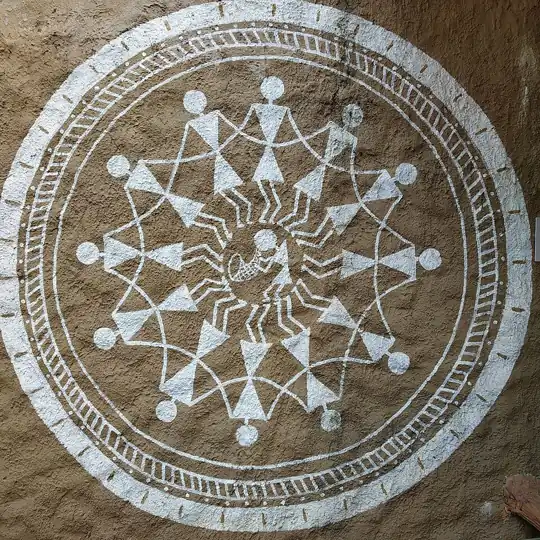
| Warli | Maharashtra; white rice paste on mud walls; circles, triangles, lines |
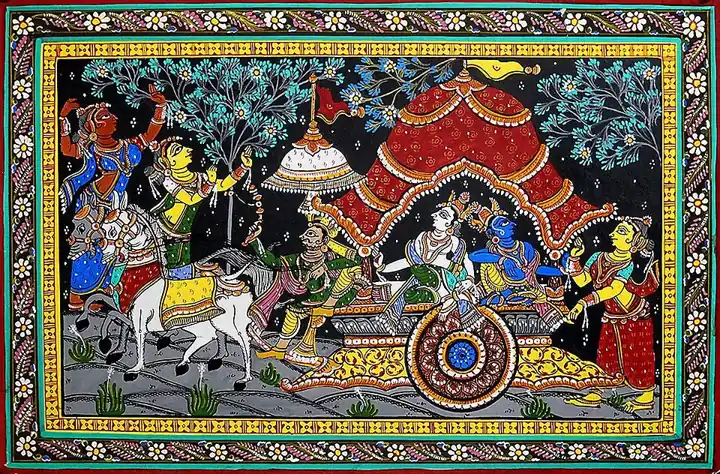
| Pattachitra | Odisha; cloth paintings, Jagannath themes |
| Phad | Rajasthan; long scrolls of Pabuji and Devnarayan |
| Pichhwai | Nathdwara, Rajasthan; cloth hangings behind Shrinathji |
| Gond | Madhya Pradesh; dots and lines filling animal forms |
| Cheriyal scrolls | Telangana; narrative scrolls |
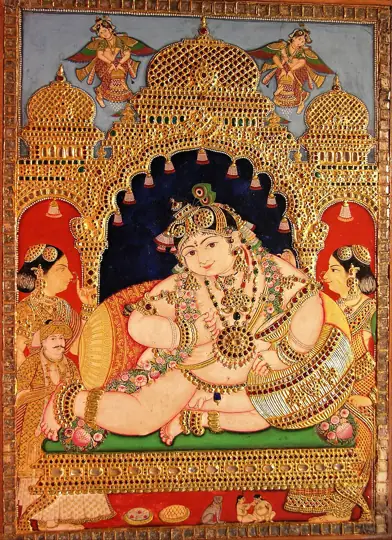
| Tanjore | Tamil Nadu; Maratha-era patronage; raised gesso work, gold foil and glass pieces; Krishna icons |
| Mysore | Karnataka; Wodeyar patronage; thinner gesso and muted gold, finer detail than Tanjore |
Prelims 2015: ‘Kalamkari painting refers to’ ‘a hand-painted cotton textile in South India’ (answer a). Srikalahasti (Andhra Pradesh) draws with a pen (kalam). Machilipatnam uses blocks.
Kalamkari painting refers to
- a hand-painted cotton textile in South India
- a handmade drawing on bamboo handicrafts in North-East India
- a block-painted woollen cloth in Western Himalayan region of India
- a hand-painted decorative silk cloth in North-Western India
Show answer
Answer: (a) · UPSC official key
What UPSC asks: Kalamkari (Prelims 2015). State pairs. GI tags.
Mains box: analysis and answer points
- Bengal School and nationalism.
- Folk art and GI tags as livelihood.
Practice
Practice MCQs (8)
Consider the following statements about Amrita Sher-Gil:
1. Trained in Paris, she combined European modernist training with Indian subjects, drawing also on Ajanta and the miniature traditions.
2. She was a founder member of the Progressive Artists' Group in 1947.
Which of the statements given above is/are correct?
Answer (a) & explanation
Amrita Sher-Gil (1913–1941), born in Budapest to a Sikh father and a Hungarian mother, trained at the École des Beaux-Arts in Paris. After returning to India in 1934 she painted Indian village women and everyday life, and her South Indian trilogy (1937) and later works show the impact of Ajanta and the Pahari and Mughal miniatures; statement 1 is correct. She died in 1941, six years before the Progressive Artists' Group was formed, so statement 2 is false.
Raja Ravi Varma (1848–1906) is best known for:
Answer (b) & explanation
Raja Ravi Varma of Kilimanoor (Travancore) mastered European academic oil painting and used it for Indian subjects: scenes from the epics and Puranas such as Shakuntala, Damayanti and Lakshmi. In 1894 he set up a lithographic press near Bombay (later moved to Malavli, near Lonavala) whose cheap oleographs carried his images of gods into homes across India. The Bengal School arose partly as a reaction against his Western realism.
Consider the following statements about the Bengal School of painting:
1. Led by Abanindranath Tagore, it turned away from Western academic realism towards Indian and wider Asian traditions.
2. E. B. Havell, principal of the Government School of Art, Calcutta, supported the movement.
Which of the statements given above is/are correct?
Answer (c) & explanation
The Bengal School, emerging in the early 1900s with the Swadeshi mood, drew on Mughal and Rajput miniatures, Ajanta and Japanese ink-wash methods, rejecting the oil realism of the art schools and of Ravi Varma; Abanindranath Tagore was its leading figure, so statement 1 is correct. E. B. Havell, principal of the Government School of Art in Calcutta, championed Indian art traditions, reformed the school's teaching and worked closely with Abanindranath. Statement 2 is correct.
Consider the following places:
1. Patna
2. Tanjore (Thanjavur)
3. Basohli
4. Chawand
How many of the above were important centres of Company painting in the late eighteenth and nineteenth centuries?
Answer (b) & explanation
Company painting was made by Indian artists for British patrons in centres of East India Company power and trade: Murshidabad, Patna (the Patna Kalam), Benares, Lucknow, Delhi, and in the south Tanjore and Trichinopoly. Basohli is an early Pahari centre of the late 17th century, and Chawand was the Mewar capital where the 1605 Ragamala was painted; neither is a Company centre. So two.
With reference to Nandalal Bose, consider the following statements:
1. He led the artists who illustrated the original calligraphed manuscript of the Constitution of India.
2. He was asked to design the emblems of the Bharat Ratna and Padma awards.
3. He headed Kala Bhavana, the art school of Visva-Bharati at Santiniketan.
Which of the statements given above are correct?
Answer (d) & explanation
Nandalal Bose (1882–1966), Abanindranath's pupil, and his students at Santiniketan decorated the pages of the handwritten Constitution with scenes from Indian history, from Mohenjo-daro to the freedom movement; statement 1 is correct. At Nehru's request he sketched the emblems for the Bharat Ratna and the Padma awards instituted in 1954; statement 2 is correct. He was the principal of Kala Bhavana, Visva-Bharati, from 1922; statement 3 is correct.
The painting 'Bharat Mata' (1905), showing a saffron-clad, four-armed woman holding a book, sheaves of paddy, a white cloth and a rosary, was painted by:
Answer (d) & explanation
Abanindranath Tagore painted 'Bharat Mata' in 1905, at the height of the Swadeshi movement against the partition of Bengal. Done in the Bengal School's soft watercolour manner, it shows Mother India as a calm, ascetic figure offering learning (book), food (paddy), clothing and spiritual strength (rosary). Sister Nivedita praised it and wished to spread it widely. Ravi Varma died in 1906 and worked in oils, Nandalal Bose was Abanindranath's pupil, and Sher-Gil belongs to the 1930s.
Consider the following statements about the Progressive Artists' Group:
1. It was founded in Bombay in 1947.
2. F. N. Souza, S. H. Raza and M. F. Husain were among its founding members.
3. Its main aim was to revive the wash technique and themes of the Bengal School.
Which of the statements given above are correct?
Answer (c) & explanation
The Progressive Artists' Group was formed in Bombay in 1947, the year of Independence, so statement 1 is correct. Its founders were F. N. Souza, S. H. Raza, M. F. Husain, K. H. Ara, S. K. Bakre and H. A. Gade, so statement 2 is correct. The group turned towards international modernism (expressionism, cubism, post-impressionism) and explicitly broke with the revivalist Bengal School, so statement 3 is false.
Under the Antiquities and Art Treasures Act, 1972, the works of nine modern artists have been declared 'art treasures' that cannot be exported. Which one of the following groups consists only of such artists?
Answer (a) & explanation
The nine artists whose works are notified as art treasures are Rabindranath Tagore, Abanindranath Tagore, Gaganendranath Tagore, Nandalal Bose, Raja Ravi Varma, Amrita Sher-Gil, Jamini Roy, Sailoz Mookherjea and Nicholas Roerich. Their works need permission from the Archaeological Survey of India to leave the country. Members of the Progressive Artists' Group (Husain, Raza, Souza), Tyeb Mehta, Akbar Padamsee, V. S. Gaitonde and the sculptor-painter Ramkinkar Baij are not on the list.
0 / 0 correct
Write an answer
In 150 words, explain the significance of Indian Paintings with one recent example.
Flashcards (5)
Who painted Bharat Mata (1905)?
Abanindranath Tagore.
How did Ravi Varma's images spread?
Oleograph prints.
Who illustrated the Constitution?
Nandalal Bose.
What is Kalamkari?
Hand-painted cotton textile, South India.
Phad scrolls tell whose story?
Pabuji and Devnarayan.
Read more: related explainers
In the news
- 20 Oct 2026Sirpur in Chhattisgarh enters UNESCO’s Tentative List of World Heritage sites
- 15 Oct 2026PM inaugurates five Ladakh projects: Nimmu–Padum–Darcha road, Leh terminal, Hanu hydro
- 14 Oct 2026HAL, NCF and ASI sign MoA for Hampi, Taj Mahal and Bekal Fort
- 3 Oct 2026Centres of Excellence approved for five newer classical languages
 Next chapter · 4. Indian Music →Indian Music: Evolution, vocal forms and gharanas
Syllabus: GS-I · Indian culture will cover the salient aspects of Art Forms, literature and Archi…