
Chapter 3 · Topic 3.1 · Prelims + Mains1 of 3
Indian Paintings: Rock art and murals
Key points
- Bhimbetka (MP): 700+ shelters, Wakankar 1957, UNESCO 2003.
- Mesolithic: most rock paintings, hunting and dancing.
- Murals: Ajanta, Bagh, Sittanavasal, Lepakshi.
- Sanchi: sculpture, not paintings (Prelims 2013).
Prelims box: facts and traps
- Bhimbetka: found by V.S. Wakankar (1957), UNESCO 2003.
- Ajanta: Padmapani, Cave 1.
- Bagh: Hallisalasya dance (Prelims 2026).
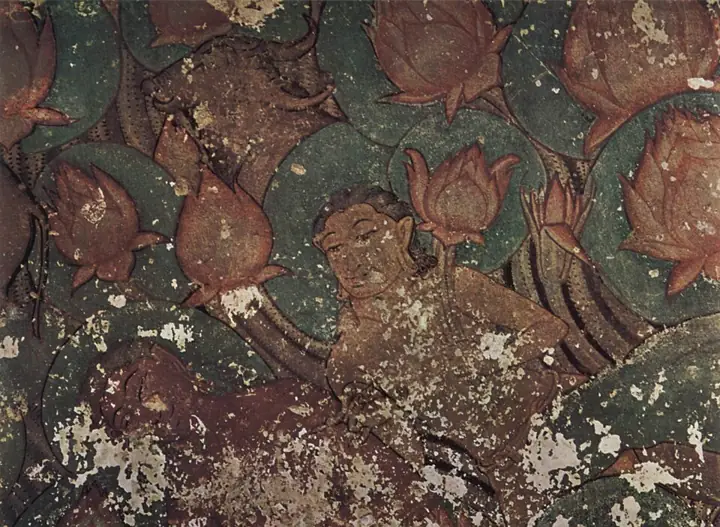
- Sittanavasal: Jain cave, Pandya-era lotus pond.
Prehistoric rock painting
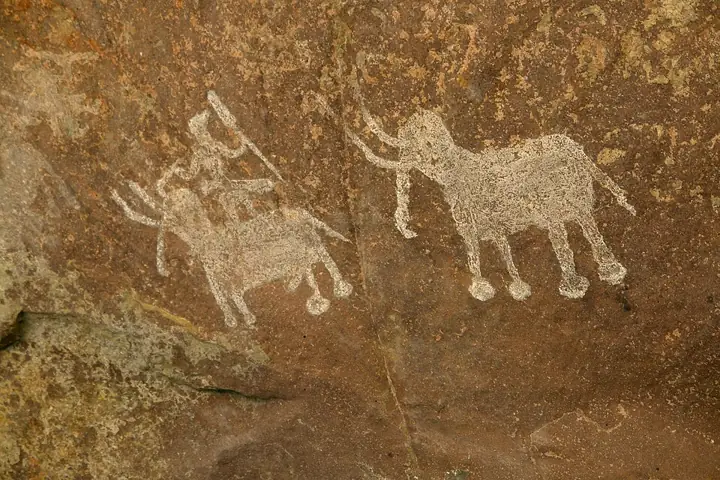
Painting questions are mostly Prelims one-liners: which site, which school, which state, which material. The story starts in rock shelters.
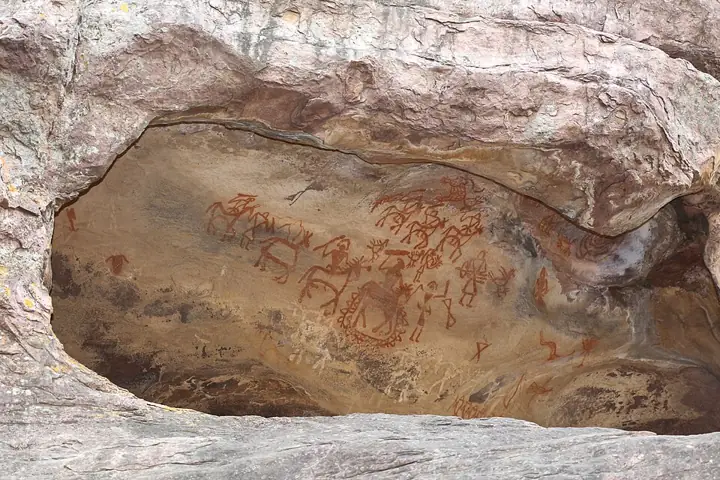
| Site or period | Detail |
|---|---|
| Bhimbetka (MP) | Over 700 shelters; found by V. S. Wakankar (1957); UNESCO site (2003) |
| Upper Palaeolithic | Linear figures of large animals, in green and dark red |
| Mesolithic | Most paintings: hunting, dancing, food gathering, animals; red and white |
| Chalcolithic | Contact with farming communities; pottery and metal tools appear |
| Other sites | Jogimara (Chhattisgarh), Lakhudiyar (Uttarakhand), Kupgallu (Karnataka) |
Mains 2015: ‘Mesolithic rock-cut architecture of India not only reflects the cultural life of the times but also a fine aesthetic sense comparable to modern painting. Critically evaluate this comment.’ Cultural life: hunts, group dances, honey collection, childbirth. Aesthetic sense: movement, X-ray style animals (bones shown inside), layered scenes, near-abstract stick figures. Limits: few colours, no depth, uncertain dates.
Mesolithic rock-cut architecture of India not only reflects the cultural life of the times but also a fine aesthetic sense comparable to modern painting. Critically evaluate this comment.
What UPSC asks: Bhimbetka facts. Mesolithic themes (Mains 2015).
The great murals
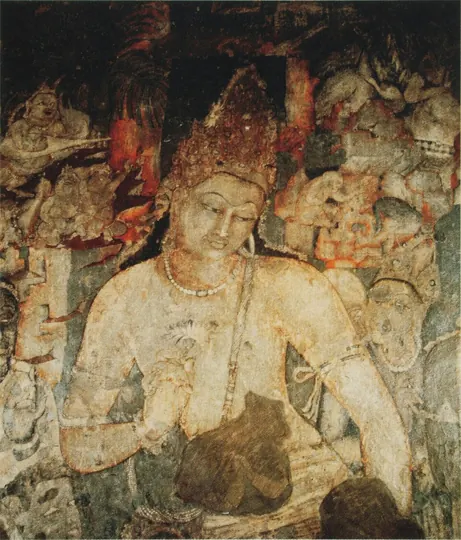
| Site | Detail |
|---|---|
| Ajanta (Maharashtra) | Buddhist; 2nd century BCE to 5th century CE; Jataka stories; Padmapani (Cave 1) |
| Bagh (MP) | Buddhist, Gupta-era; close to Ajanta in style; Rang Mahal (Cave 4) |
| Ellora | Paintings in the Kailasa and Jain caves |
| Sittanavasal (Tamil Nadu) | Jain cave; 9th-century Pandya-era painting of a lotus pond |
| Thanjavur | Chola paintings in the Brihadisvara temple passage |
| Lepakshi (AP) | Vijayanagara ceiling paintings, Veerabhadra temple |
| Kerala | Temple and palace murals, e.g. Mattancherry Palace |
Prelims 2013 asked which of Ajanta Caves, Lepakshi Temple and Sanchi Stupa are ‘also known for mural paintings ‘. A mural is a painting made straight on a wall. Ajanta and Lepakshi are. Sanchi is known for sculpture (answer b).
Consider the following historical places : 1. Ajanta Caves 2. Lepakshi Temple 3. Sanchi Stupa Which of the above places is/are also known for mural paintings?
- 1 only
- 1 and 2 only
- 1, 2 and 3
- None
Show answer
Answer: (b) · UPSC official key
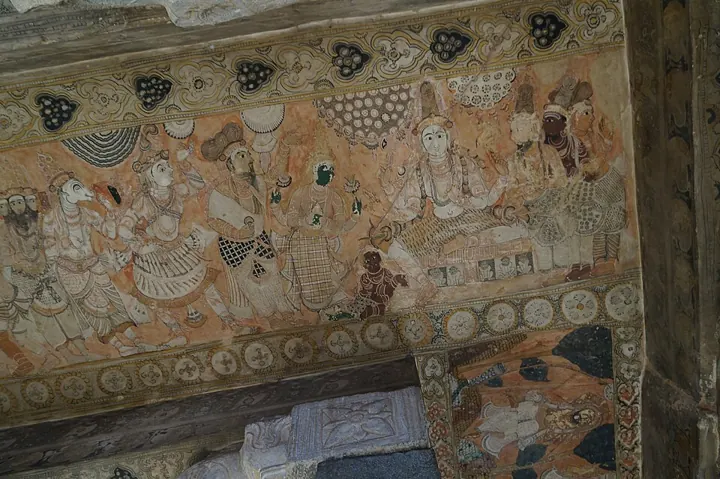
Prelims 2026 asked what ‘The Hallisalasya painting in the Bagh Caves represents ‘. It shows a joyous folk dance: a woman dancing in a ring of women musicians (book key a).
The Hallisalasya painting in the Bagh Caves represents :
- A joyous folk dance
- Buddha in a meditative pose
- The depiction of Shiva and Parvati on Kailasha
- Samudramanthan (Churning of the Ocean)
Show answer
Answer: (a) · UPSC provisional key (final key awaited)
What UPSC asks: Ajanta and Lepakshi (Prelims 2013). Hallisalasya (Prelims 2026). Sittanavasal next.
Mains box: analysis and answer points
- Rock art as history of daily life (Mains 2015).
- Ajanta as the peak of classical murals.
Practice
Practice MCQs (8)
The narrative wall paintings of the Ajanta caves mainly illustrate:
Answer (a) & explanation
Ajanta is a Buddhist monastic site. Its murals narrate Jataka stories of the Buddha's previous births (such as the Mahajanaka, Vessantara and Chhaddanta Jatakas) and events from his life, with Bodhisattvas, celestial beings and scenes of courtly and daily life serving these stories. Epic narratives belong to later Hindu temple murals, and Kalpasutra scenes to Western Indian Jain manuscripts.
Consider the following statements about the paintings of Ajanta:
1. The earliest surviving paintings, in Caves 9 and 10, belong to around the second-first century BCE.
2. Many of the later caves and their paintings were produced in the fifth century CE under Vakataka patronage.
Which of the statements given above is/are correct?
Answer (c) & explanation
Ajanta has two main phases. The early chaitya and vihara caves, especially Caves 9 and 10, carry paintings of about the 2nd–1st century BCE, in the Satavahana period. The second and larger phase came in the 5th century CE, when the Vakataka court, including Harishena's minister Varahadeva (Cave 16 inscription), patronised new caves such as 1, 2, 16 and 17. Both statements are correct.
Arrange the following painting traditions in chronological order, from the earliest to the latest:
1. Mesolithic rock paintings of Bhimbetka
2. Paintings of Ajanta Cave 10
3. Ceiling murals of the Veerabhadra temple, Lepakshi
4. Murals of the Brihadishvara temple, Thanjavur
Select the correct answer using the code given below:
Answer (b) & explanation
The Mesolithic paintings of Bhimbetka are prehistoric, thousands of years older than anything else here. Ajanta Cave 10 carries paintings of about the 2nd–1st century BCE. The Thanjavur murals date to Rajaraja I's Chola temple, completed around 1010 CE. The Lepakshi ceiling murals are Vijayanagara work of the 16th century. Order: 1-2-4-3.
With reference to prehistoric rock paintings in India, consider the following statements:
1. Upper Palaeolithic paintings are mostly linear figures in green and dark red of large animals such as bison, elephants and rhinos.
2. Red pigment was obtained from haematite, known in India as geru.
3. The first rock paintings in India were discovered at Bhimbetka by V. S. Wakankar, before the discovery of the Altamira cave in Spain.
Which of the statements given above are correct?
Answer (b) & explanation
NCERT describes Upper Palaeolithic paintings as linear representations, in green and dark red, of huge animals and stick-like humans, so statement 1 is correct. Pigments came from ground minerals: red from haematite (geru), green from a variety of chalcedony and white probably from limestone, so statement 2 is correct. Rock paintings were first found in India in 1867–68 by Archibald Carlleyle, twelve years before Altamira; Wakankar discovered Bhimbetka much later, in 1957–58. Statement 3 is false.
Consider the following:
1. Mattancherry Palace
2. Padmanabhapuram Palace
3. Vadakkunnathan temple, Thrissur
4. Sittanavasal cave
How many of the above are known for murals in the Kerala mural tradition?
Answer (c) & explanation
Kerala murals (roughly 16th–19th century) use bold outlines, a palette dominated by ochre, red and green, and full, rounded figures from the epics and Puranas. The Ramayana panels of Mattancherry Palace (Kochi), the murals of Padmanabhapuram Palace (the old Travancore seat, now in Kanyakumari district of Tamil Nadu) and the temple walls of Vadakkunnathan at Thrissur all belong to this tradition. Sittanavasal is a Jain cave of the Pandya period in Tamil Nadu, outside it. So three.
In the rock shelters of Bhimbetka, the largest number of paintings belong to which period, in which hunting scenes predominate and the figures become smaller?
Answer (d) & explanation
NCERT groups Bhimbetka's art into periods. The largest number of paintings belong to Period II, the Mesolithic, when themes multiply, figures become smaller and hunting scenes predominate, along with animals, dancing and family groups. Upper Palaeolithic figures are fewer and large; Chalcolithic paintings show contact with agricultural communities and pottery.
The Bagh caves, whose Buddhist wall paintings are closely related in style to those of Ajanta, are located in which district of Madhya Pradesh?
Answer (a) & explanation
The Bagh caves are Buddhist viharas cut into the hills by the Baghani river in Dhar district, in the Malwa region of western Madhya Pradesh. Their paintings (c. late 5th–6th century CE) are close to the later Ajanta style, with the well-known hallisaka dance scene in Cave 4. Raisen has Bhimbetka and Sanchi, Vidisha has Udayagiri, and Mandsaur is known for the Yashodharman pillars.
With reference to the Chola murals of the Brihadishvara temple at Thanjavur, consider the following statements:
1. They were brought to light in the twentieth century from beneath a later layer of Nayaka- period paintings.
2. Their themes include Shiva as Tripurantaka and Shiva as Nataraja.
3. They include a portrait of the patron Rajaraja I with his guru Karuvurar.
Which of the statements given above are correct?
Answer (d) & explanation
The Chola paintings in the circumambulatory passage of the Brihadishvara temple were found in 1931 beneath a later layer of Nayaka paintings, so statement 1 is correct. NCERT lists their themes as narrations of Shiva, Shiva in Kailasa, Tripurantaka and Nataraja, so statement 2 is correct. They also show the patron Rajaraja I with his mentor Karuvurar (Kuruvar), so statement 3 is correct.
0 / 0 correct
Write an answer
In 150 words, explain the significance of Indian Paintings with one recent example.
Flashcards (8)
Who discovered the Bhimbetka paintings?
V. S. Wakankar (1957).
Which period has most Bhimbetka
paintings? The Mesolithic.
Where is the Padmapani painting?
Ajanta, Cave 1.
What does the Hallisalasya painting show?
A folk dance (Bagh Caves).
Which Jain cave has a lotus pond painting?
Sittanavasal, Tamil Nadu.
Which dynasty made the Lepakshi
paintings? Vijayanagara.
Which Jain text was most illustrated?
The Kalpasutra.
Which state is Warli from?
Maharashtra.
Read more: related explainers
In the news
- 20 Oct 2026Sirpur in Chhattisgarh enters UNESCO’s Tentative List of World Heritage sites
- 15 Oct 2026PM inaugurates five Ladakh projects: Nimmu–Padum–Darcha road, Leh terminal, Hanu hydro
- 14 Oct 2026HAL, NCF and ASI sign MoA for Hampi, Taj Mahal and Bekal Fort
- 3 Oct 2026Centres of Excellence approved for five newer classical languages
 Next topic · 3.2 →Indian Paintings: Miniature traditions
Syllabus: GS-I · Indian culture will cover the salient aspects of Art Forms, literature and Archi…