
Chapter 8 · Topic 8.1 · Prelims + Mains1 of 3
Indian Religions & Philosophy: Six schools and Buddhism
Key points
- Six astika schools: Sankhya, Yoga, Nyaya, Vaisheshika, Mimamsa, Vedanta.
- Vedanta: Shankara (Advaita), Ramanuja, Madhva, Vallabha.
- Nirvana: the flame of desire put out (Prelims 2013).
- Fourth council: Kashmir, Kanishka; Mahayana rises.
1 PYQ 2012–2021
Prelims box: facts and traps
- Vaisheshika: Kanada, atoms. Nyaya: Gautama, logic.
- Nayaputta = Mahavira, not Buddha (Prelims 2024).
- Sthaviravadins are not Mahayana (Prelims 2020).
- Sautrantika and Sammitiya: Buddhist, not Jain (Prelims 2017).
On this page (3 sections)
Hindu thought and the six schools
Philosophy questions test exact doctrines: which sect said what, which text belongs to which faith, which saint taught which path.
Astika schools accept the authority of the Vedas. Nastika schools reject it: Charvaka (also called Lokayata, which believed only in what the senses show), Buddhism, Jainism and Ajivika. Think of astika and nastika as two teams: one accepts the Vedas as the rulebook, the other does not.
| School | Founder | Core idea |
|---|---|---|
| Sankhya | Kapila | Dualism of purusha (spirit) and prakriti (matter) |
| Yoga | Patanjali | Discipline of body and mind (Yoga Sutras) |
| Nyaya | Gautama | Logic and valid knowledge |
| Vaisheshika | Kanada | Atoms (paramanu) and categories |
| Mimamsa | Jaimini | Vedic ritual and duty |
| Vedanta | Badarayana | Brahman; Brahma Sutras |
| Vedanta school | Teacher |
|---|---|
| Advaita (non-dualism) | Shankaracharya |
| Vishishtadvaita (qualified non-dualism) | Ramanuja |
| Dvaita (dualism) | Madhvacharya |
| Shuddhadvaita (Pushti Marg) | Vallabhacharya |
What UPSC asks: Founders of the six schools. Astika vs nastika. Vedanta schools.
Buddhism: teachings
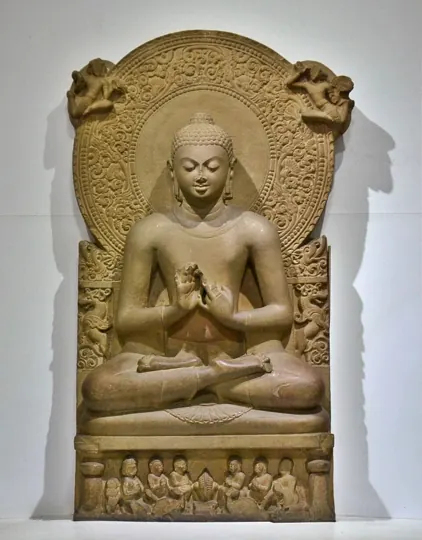
| Idea | Meaning |
|---|---|
| Four Noble Truths | Suffering, its cause (desire), its end, the path |
| Eightfold Path | Right view, resolve, speech, action, livelihood, effort, mindfulness, concentration |
| Middle Path | Between luxury and harsh austerity |
| Triratna | Buddha, Dhamma, Sangha |
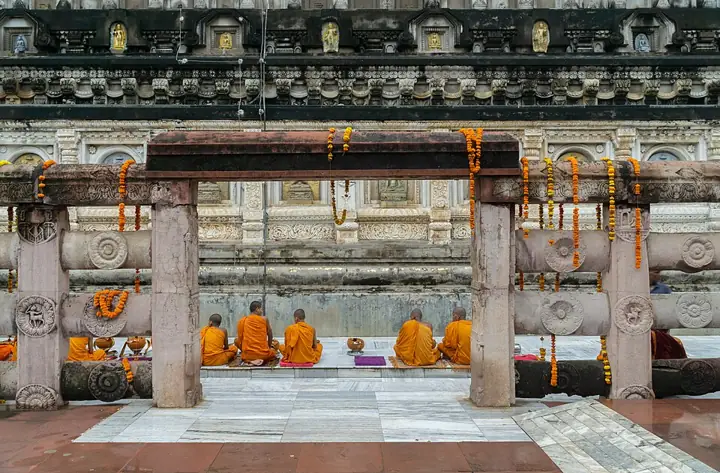
Prelims 2013 asked ‘Which one of the following describes best the concept of Nirvana in Buddhism?’ The answer is ‘The extinction of the flame of desire’ (a).
Which one of the following describes best the concept of Nirvana in Buddhism?
- The extinction of the flame of desire
- The complete annihilation of self
- A state of bliss and rest
- A mental stage beyond all comprehension
Show answer
Answer: (a) · UPSC official key
Prelims 2024 asked which epithets (titles) ‘Gautama Buddha was generally known by’. Shakyamuni and Tathagata are right. Nayaputta was Mahavira’s name (answer b).
With reference to ancient India, Gautama Buddha was generally known by which of the following epithets ? 1. Nayaputta 2. Shakyamuni 3. Tathagata Select the correct answer using the code given below :
- 1 only
- 2 and 3 only
- 1, 2 and 3
- None of the above are epithets of Gautama Buddha
Show answer
Answer: (b) · UPSC official key
Prelims 2020 matched terms. ‘Parivrajaka — Renunciant and Wanderer’ and ‘Upasaka — Lay follower of Buddhism ‘ are right; a Shramana was an ascetic outside the Vedic priesthood, not a high-status priest (answer b).
With reference to the cultural history of India, consider the following pairs : 1. Parivrajaka — Renunciant and Wanderer 2. Shramana — Priest with a high status 3. Upasaka — Lay follower of Buddhism Which of the pairs given above are correctly matched ?
- 1 and 2 only
- 1 and 3 only
- 2 and 3 only
- 1, 2 and 3
Show answer
Answer: (b) · UPSC official key
What UPSC asks: Nirvana (Prelims 2013). Epithets (Prelims 2024). Terms (Prelims 2020).
Buddhist councils and sects
| Council | Place, patron, result |
|---|---|
| First | Rajagriha, Ajatashatru; Vinaya and Sutta compiled |
| Second | Vaishali, Kalashoka; split into Sthaviravadins and Mahasanghikas |
| Third | Pataliputra, Ashoka; Abhidhamma added |
| Fourth | Kashmir (Kundalavana), Kanishka; Mahayana rises |
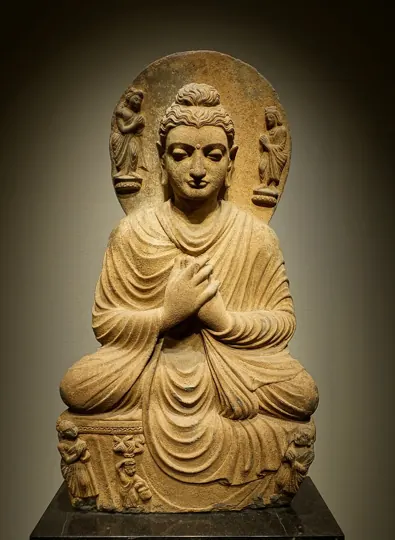
Prelims 2020: ‘Sthaviravadins belong to Mahayana Buddhism’ is wrong. They were the early Theravada line. ‘Lokottaravadin sect was an offshoot of Mahasanghika sect of Buddhism ‘ is right. So is the Mahasanghikas’ deification of the Buddha (treating him as a god), which fostered Mahayana. Answer b.
With reference to the religious history of India, consider the following statements : 1. Sthaviravadins belong to Mahayana Buddhism. 2. Lokottaravadin sect was an offshoot of Mahasanghika sect of Buddhism. 3. The deification of Buddha by Mahasanghikas fostered the Mahayana Buddhism. Which of the statements given above is/are correct ?
- 1 and 2 only
- 2 and 3 only
- 3 only
- 1, 2 and 3
Show answer
Answer: (b) · UPSC official key
Prelims 2017: ‘Sautrantika and Sammitiya were the sects of Jainism ‘ is wrong. They were Buddhist. The Sarvastivadin view that phenomena ‘existed forever in a latent form’ (hidden, not yet visible) is right. Answer b.
With reference to the religious history of India, consider the following statements : 1. Sautrantika and Sammitiya were the sects of Jainism. 2. Sarvastivadin held that the constituents of phenomena were not wholly momentary, but existed forever in a latent form. Which of the statements given above is/are correct ?
- 1 only
- 2 only
- Both 1 and 2
- Neither 1 nor 2
Show answer
Answer: (b) · UPSC official key
Mains 2020: ‘Pala period is the most significant phase in the history of Buddhism in India. Enumerate.’ Points: Nalanda and Vikramashila, Vajrayana, Atisha’s mission to Tibet, and Pala bronzes.
Pala period is the most significant phase in the history of Buddhism in India. Enumerate.
What UPSC asks: Sects (Prelims 2020, 2017). Pala Buddhism (Mains 2020). Councils.
Mains box: analysis and answer points
- Pala period and Buddhism (Mains 2020): Nalanda, Vikramashila, Atisha.
- Astika and nastika debate as India's tradition of argument.
- Middle Path and ethics today.
Practice
Prelims PYQs on this topic (1)
Who among the following is associated with ‘Songs from Prison’, a translation of ancient Indian religious lyrics in English?
Answer (c) & explanation
Gandhi is linked with "Songs from the Prison" (c). In Yeravda jail in 1930, Gandhi translated Sanskrit hymns and lyrics from the Ashram Bhajanavali into English. John S. Hoyland put them into verse, and they came out in 1934 as "Songs from the Prison". Option (a) is wrong: Tilak wrote the Gita Rahasya in Mandalay jail. Option (b) is wrong: Nehru wrote The Discovery of India in Ahmednagar Fort jail. Option (d) is wrong: Sarojini Naidu wrote her own poems, such as The Golden Threshold, and was called the "Nightingale of India".
Notice that Gandhi also wrote From Yeravda Mandir there. His autobiography, The Story of My Experiments with Truth, was written in Gujarati.
Answer as per the official UPSC answer key.
Write an answer
In 150 words, explain the significance of Indian Religions & Philosophy with one recent example.
Flashcards (10)
Founder of Sankhya?
Kapila.
Vaisheshika founder and idea?
Kanada; atoms.
Who taught Advaita?
Shankaracharya.
Nirvana in Buddhism?
Extinction of the flame of desire.
Was Nayaputta an epithet of the Buddha?
No; it was Mahavira's.
Who is an Upasaka?
A lay follower of Buddhism.
Lokottaravada grew out of?
Mahasanghika.
Sautrantika and Sammitiya were sects of?
Buddhism.
Fourth Buddhist Council patron?
Kanishka.
Which period built Vikramashila?
Pala.
Read more: related explainers
In the news
- 20 Oct 2026Sirpur in Chhattisgarh enters UNESCO’s Tentative List of World Heritage sites
- 15 Oct 2026PM inaugurates five Ladakh projects: Nimmu–Padum–Darcha road, Leh terminal, Hanu hydro
- 14 Oct 2026HAL, NCF and ASI sign MoA for Hampi, Taj Mahal and Bekal Fort
- 3 Oct 2026Centres of Excellence approved for five newer classical languages
 Next topic · 8.2 →Indian Religions & Philosophy: Jainism and Sikhism
Syllabus: GS-I · Indian culture will cover the salient aspects of Art Forms, literature and Archi…