
Chapter 12 · Topic 12.3 · Prelims + Mains3 of 3
Languages: Scripts of India
Key points
- Scripts.
5 PYQs 2012–2021
Prelims box: facts and traps
| Script | Detail |
|---|---|
| Indus | Still undeciphered |
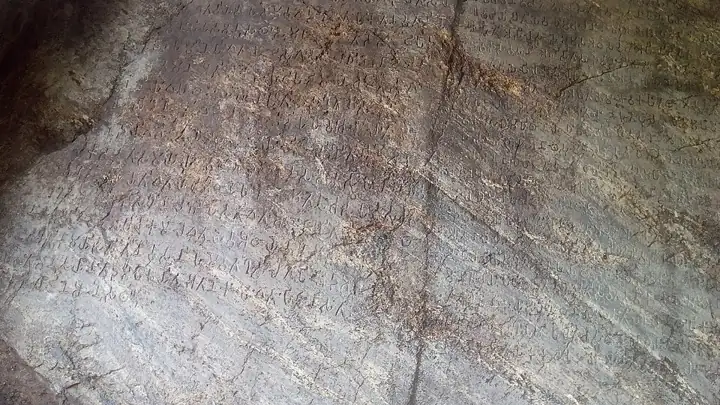
| Brahmi | Ashoka's edicts; read left to right; deciphered by James Prinsep (1837); parent of most Indian scripts |
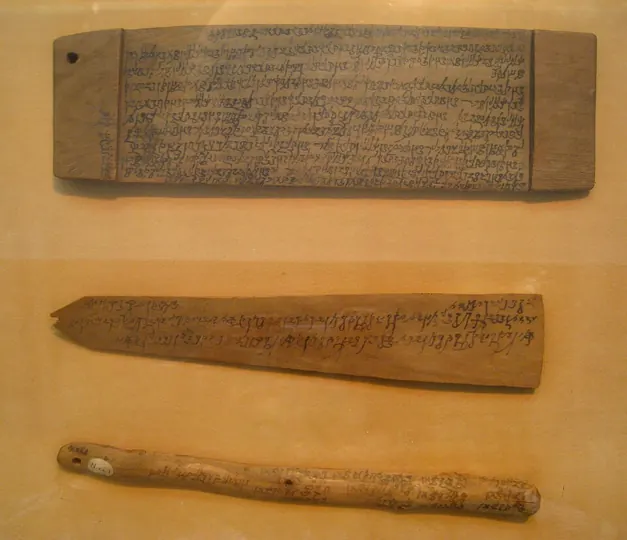
| Kharosthi | Northwest (Shahbazgarhi, Mansehra edicts); right to left |
| Siddhamatrika to Nagari | Gupta-period script led to Devanagari |
| Grantha, Vatteluttu | South India; Grantha used for Sanskrit in Tamil Nadu. |
- Article 350A asks States to provide instruction in the mother tongue at the primary stage, Article 350B provides for the Special Officer for Linguistic Minorities, and Article 351 directs the development of Hindi.
- Article 349 required the President's previous sanction, during the first fifteen years, for any Bill changing the language of courts and laws under Article 348(1).
- Article 350B was inserted by the Seventh Amendment, 1956, following the States Reorganisation Commission's recommendations, since the new linguistic States would contain linguistic minorities.
- Trap: “Article 344 — Special Officer for Linguistic Minorities” is wrong. Article 344 concerns the Official Language Commission and the Committee of Parliament; the Special Officer is under Article 350B.
- Trap: “A State can adopt as its official language only a language listed in the Eighth Schedule” is wrong. Article 345 has no Eighth Schedule condition — Mizoram uses Mizo and English, Meghalaya uses English, and Sikkim recognises several languages not in the Schedule.
Scripts of India
| Script | Detail |
|---|---|
| Indus | Still undeciphered |
| Brahmi | Ashoka’s edicts; read left to right; deciphered by James Prinsep (1837); parent of most Indian scripts |
| Kharosthi | Northwest (Shahbazgarhi, Mansehra edicts); right to left |
| Siddhamatrika to Nagari | Gupta-period script led to Devanagari |
| Grantha, Vatteluttu | South India; Grantha used for Sanskrit in Tamil Nadu |
| Sharada | Kashmir |
| Gurmukhi | Standardised by Guru Angad |
| Modi | Cursive script for Marathi |
| Ol Chiki | Santali; created by Raghunath Murmu (1925) |
Mains box: analysis and answer points
- Kharosthi on wooden tablets, Niya (3rd century CE).
- Likely next angle: Ol Chiki
Practice
Practice MCQs (8)
Which ancient script is the ancestor of most modern scripts of India, such as Devanagari, Bengali, Tamil and Kannada, as well as several scripts of South-East Asia?
Answer (a) & explanation
Brahmi, seen in Ashoka's inscriptions across most of India in the 3rd century BCE, is the parent of nearly all later Indian scripts. Over centuries it branched into northern forms (Gupta, Siddhamatrika, Nagari, leading to Devanagari, Bengali and Gurmukhi) and southern forms (leading to Tamil, Kannada, Telugu and Malayalam). Through Pallava-period scripts it also reached South-East Asia. James Prinsep deciphered Brahmi in 1837. Kharosthi was a separate script of the north-west that died out without descendants in India.
In India, the status of a 'classical language' is conferred through:
Answer (d) & explanation
'Classical language' is not a constitutional category. The status is conferred by an executive decision of the Union Government — announced through a Cabinet decision or government notification — on the advice of the expert committee. This is different from the Eighth Schedule, which lists languages in the Constitution and can be changed only by a constitutional amendment, as with the 71st (1992) and 92nd (2003) Amendments.
Which Article entitles every person to submit a representation for the redress of any grievance to any officer or authority of the Union or a State in any of the languages used in the Union or in the State?
Answer (a) & explanation
Article 350 guarantees that a person may submit a representation for redress of grievance to any Union or State authority in any language used in the Union or the State. Article 350A asks States to provide instruction in the mother tongue at the primary stage, Article 350B provides for the Special Officer for Linguistic Minorities, and Article 351 directs the development of Hindi. Together, Articles 350–350B form the main language safeguards for individuals and minorities.
Consider the following statements about the official languages of States:
1. The legislature of a State may adopt one or more of the languages in use in the State, or Hindi, as its official language.
2. Two or more States may agree that Hindi shall be the official language for communication between them.
3. A State can adopt as its official language only a language listed in the Eighth Schedule.
Which of the statements given above is/are correct?
Answer (a) & explanation
Statement 1 is correct: Article 345 lets a State legislature adopt, by law, any one or more of the languages in use in the State, or Hindi. Statement 2 is correct: under Article 346, the Union's official language is used for communication between States and between a State and the Union, but two or more States may agree to use Hindi between themselves. Statement 3 is incorrect: Article 345 has no Eighth Schedule condition — Mizoram uses Mizo and English, Meghalaya uses English, and Sikkim recognises several languages not in the Schedule. Hence 1 and 2 only.
Article 351 directs the Union to develop Hindi so that it can serve as a medium of expression of the composite culture of India. For its vocabulary, Hindi is to draw primarily on:
Answer (d) & explanation
Article 351 asks the Union to promote the spread of Hindi and to enrich it by assimilating the forms, style and expressions of Hindustani and of the other languages in the Eighth Schedule, and by drawing, wherever necessary or desirable, for its vocabulary primarily on Sanskrit and secondarily on other languages. The article is a directive for the Union, not an enforceable right.
Consider the following statements about the Special Officer for Linguistic Minorities:
1. The officer is appointed by the President.
2. The office was created by inserting Article 350B through the Seventh Amendment Act, 1956.
3. The officer reports directly to the Speaker of the Lok Sabha.
Which of the statements given above is/are correct?
Answer (c) & explanation
Statement 1 is correct: under Article 350B, the President appoints a Special Officer for Linguistic Minorities, known as the Commissioner for Linguistic Minorities. Statement 2 is correct: Article 350B was inserted by the Seventh Amendment, 1956, following the States Reorganisation Commission's recommendations, since the new linguistic States would contain linguistic minorities. Statement 3 is incorrect: the officer reports to the President, who lays the reports before each House of Parliament and sends them to the State governments concerned. Hence 1 and 2 only.
Consider the following pairs of Articles and their subjects:
1. Article 120 — Language to be used in Parliament
2. Article 210 — Language to be used in the State Legislature
3. Article 349 — Special procedure for enacting certain laws relating to language
4. Article 344 — Special Officer for Linguistic Minorities
Which of the pairs given above are correctly matched?
Answer (a) & explanation
Pair 1 is correct: Article 120 says business in Parliament is transacted in Hindi or English, and the presiding officer may permit a member to speak in the mother tongue. Pair 2 is correct: Article 210 is the parallel provision for State Legislatures, allowing the State's official language(s), Hindi or English. Pair 3 is correct: Article 349 required the President's previous sanction, during the first fifteen years, for any Bill changing the language of courts and laws under Article 348(1). Pair 4 is incorrect: Article 344 concerns the Official Language Commission and the Committee of Parliament; the Special Officer is under Article 350B. Hence 1, 2 and 3 only.
Who chaired the first Official Language Commission, set up by the President in 1955 under Article 344?
Answer (d) & explanation
The first Official Language Commission (1955) was chaired by B. G. Kher, former Chief Minister of Bombay. It recommended steps for the progressive use of Hindi. Its report was examined by the Committee of Parliament under Article 344(4), chaired by Govind Ballabh Pant (1957). K. M. Munshi, with N. Gopalaswami Ayyangar, framed the compromise on language (the Munshi–Ayyangar formula) in the Constituent Assembly.
0 / 0 correct
Prelims PYQs on this topic (5)
Consider the following statements :
- 1. 21st February is declared to be the International Mother Language Day by UNICEF.
- 2. The demand that Bangla has to be one of the national languages was raised in the Constituent Assembly of Pakistan.
Which of the above statements is/are correct?
Answer (b) & explanation
Only statement 2 is correct (b). Statement 1 is wrong: UNESCO, not UNICEF, declared 21 February as International Mother Language Day in 1999. The date marks the students killed by police in Dhaka on 21 February 1952 during the Bhasha Andolan (Language Movement). Statement 2 is right: in February 1948, Dhirendranath Datta asked the Constituent Assembly of Pakistan to accept Bangla as a state language beside Urdu and English.
Notice that the language movement fed Bengali nationalism, which led to the creation of Bangladesh in 1971. Bangla became a state language of Pakistan in 1956. The Shaheed Minar in Dhaka honours the martyrs.
UNICEF and UNESCO are a standard swap. Culture and language days come from UNESCO.
Answer as per the official UPSC answer key.
With reference to India, the terms ‘Halbi, Ho and Kui’ pertain to
Answer (d) & explanation
Halbi, Ho and Kui are tribal languages (d). Halbi is an Indo-Aryan language spoken in Bastar (Chhattisgarh) and nearby areas. Ho is a Munda (Austroasiatic) language of Jharkhand and Odisha, with its own Warang Chiti script. Kui is a Dravidian language of the Kandha (Khond) people in Odisha. They are not dance forms (a), musical instruments (b) or cave paintings (c).
Notice the Eighth Schedule, which lists 22 languages; tribal languages in it are Santali (with its Ol Chiki script) and Bodo, added by the 92nd Amendment (2003). Demands remain to add Ho, Mundari and Kurukh. Notice the four language families of India: Indo-Aryan, Dravidian, Austroasiatic and Tibeto-Burman.
Answer as per the official UPSC answer key.
Which one of the following was given classical language status recently?
Answer (a) & explanation
Odia became India's sixth classical language in 2014 (a), after Tamil (2004), Sanskrit (2005), Telugu and Kannada (2008) and Malayalam (2013). In 2015, Konkani (b), Bhojpuri (c) and Assamese (d) did not have the status.
Since then the list has grown: in October 2024, Marathi, Pali, Prakrit, Assamese and Bengali were added, making eleven in all. So today Assamese is also classical, though Konkani and Bhojpuri are not. Notice how such questions can change over time; always read them in their year and know the latest position too.
Assamese was not classical in 2015. It was added only in 2024, so the answer then was Odia.
Answer as per the official UPSC answer key.
Consider the following languages :
- 1. Gujarati
- 2. Kannada
- 3. Telugu
Which of the above has/have been declared as ‘Classical Language/Languages’ by the Government?
Answer (c) & explanation
Telugu and Kannada were declared classical languages in 2008, after Tamil (2004) and Sanskrit (2005). So 2 and 3 are correct. Gujarati has never received the status, which rules out options (a) and (d); option (b) misses Kannada.
Malayalam followed in 2013 and Odia in 2014. In October 2024 Marathi, Pali, Prakrit, Assamese and Bengali were added, taking the total to eleven. The criteria include high antiquity of early texts (1,500–2,000 years), a body of ancient literature valued as heritage, and an original literary tradition. Notice how this links language policy to the Eighth Schedule and to cultural history.
Answer as per the official UPSC answer key.
The Nagara, the Dravida and the Vesara are the
Answer (c) & explanation
Three styles of temple architecture is correct (c). Nagara is the north Indian style, with a curved shikhara over the sanctum, as at Khajuraho. Dravida is the south Indian style, with a pyramid-shaped vimana and tall gopurams, as at Thanjavur's Brihadeeswara. Vesara is the mixed Deccan style of the later Chalukyas and Hoysalas, as at Belur and Halebidu. (a), (b) and (d) are wrong: these are not racial, linguistic or musical terms.
Notice the texts and sub-styles: the Shilpa Shastras name these styles; Nagara has Odisha (rekha deul) and Rajasthan sub-styles. The Hoysala temples became a World Heritage Site in 2023. Trap: 'Dravida' also names a language family, but here it is architecture.
Answer as per the official UPSC answer key.
Write an answer
In 150 words, explain the significance of Languages with one recent example.
Flashcards (4)
Who deciphered Brahmi?
James Prinsep (1837).
Which script is written right to left?
Kharosthi.
Script of Santali?
Ol Chiki.
Who standardised Gurmukhi?
Guru Angad.
In the news
- 20 Oct 2026Sirpur in Chhattisgarh enters UNESCO’s Tentative List of World Heritage sites
- 15 Oct 2026PM inaugurates five Ladakh projects: Nimmu–Padum–Darcha road, Leh terminal, Hanu hydro
- 14 Oct 2026HAL, NCF and ASI sign MoA for Hampi, Taj Mahal and Bekal Fort
- 3 Oct 2026Centres of Excellence approved for five newer classical languages
 Next chapter · 13. Handicrafts →Handicrafts: Weaves, pottery and metal
Syllabus: GS-I · Indian culture will cover the salient aspects of Art Forms, literature and Archi…