
Chapter 4 · Topic 4.1 · Prelims + Mains1 of 3
Emotional Intelligence: Meaning, components, EQ vs IQ
Key points
- EI is recognising, understanding and managing your own emotions and influencing others'.
- Goleman's five components: self-awareness, self-regulation, motivation, empathy, social skills.
- EI can be learned; IQ is fairly stable.
- Both needed: IQ for technical work, EQ for leadership and teamwork.
What emotional intelligence is
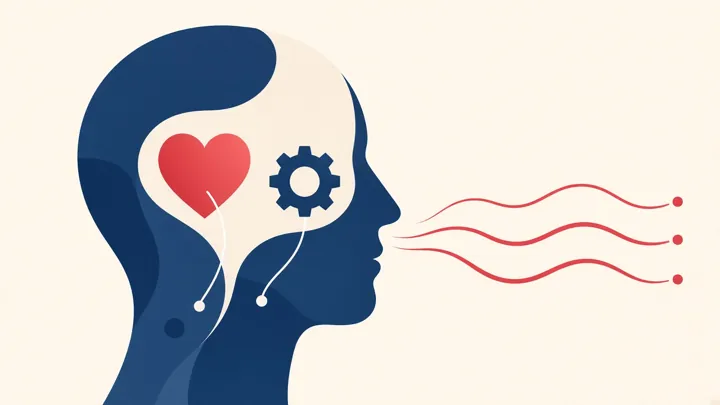
Like a car’s driver and brakes: feelings are the engine, EI is the skill of steering and braking.
| Component | Meaning | Public-service example |
|---|---|---|
| Self-awareness | knowing your emotions and their effect | noticing you are irritable before a hearing |
| Self-regulation | controlling impulses, staying calm | not shouting at an angry crowd |
| Motivation | inner drive beyond money or status | working late during a flood |
| Empathy | sensing others’ feelings | understanding a farmer’s fear of land loss |
| Social skills | managing relationships, influence | building consensus among departments |
Five-component EI model (teaching framework).
Mains 2013 asked what EI is, how it can be developed, and how it helps ethical decisions.
- Develop it through reflection and journaling, feedback, mindfulness, role-plays and mentoring.
- In ethics it helps you spot your own bias, calm anger or fear before you decide, and see how a decision will affect others.
What is ’emotional intelligence’ and how can it be developed in people? How does it help an individual in taking ethical decisions?
Mains 2020 asked for the main components and whether they can be learned. Yes: unlike IQ, which is fairly stable, EI skills improve with practice, just as a sportsperson learns composure under pressure. Officer training often includes such modules.
What are the main components of emotional intelligence (EI)? Can they be learned? Discuss.
What UPSC asks: EI means knowing and managing emotions; the five components. Next likely angle: EI can be learned.
EQ versus IQ
IQ measures reasoning ability; EQ (emotional quotient) measures emotional intelligence.
| Basis | IQ | EQ |
|---|---|---|
| Measures | reasoning, memory, logic | handling emotions and people |
| Changeable? | fairly stable | can be developed |
| Helps with | technical problems | leadership, teamwork, conflict |
| Risk if alone | clever but cold decisions | warm but weak decisions |
Teaching comparison.
Mains 2023 quoted the view that what really matters for success, character, happiness and lifelong achievement is a set of emotional skills, your EQ, not just cognitive abilities measured by IQ tests. A balanced answer: EQ matters a lot for leading people and for well-being. But IQ is still needed for hard technical work. The best officers have both.
“What really matters for success, character, happiness and lifelong achievements is a definite set of emotional skills — your EQ — not just purely cognitive abilities that are measured by conventional IQ tests.” Do you agree with this view? Give reasons in support of your answer.
Mains 2019 quoted: “Emotional Intelligence is the ability to make your emotions work for you instead of against you.” Example: an officer faces an angry group. She stays calm, listens and promises a reply by a fixed date. Shouting back would only make the fight worse.
“Emotional Intelligence is the ability to make your emotions work for you instead of against you”. Do you agree with this view? Discuss.
What UPSC asks: IQ is stable, EQ develops; both are needed. Next likely angle: making emotions work for you.
Mains box: analysis and answer points
- 2013: develop EI through reflection, feedback, mindfulness, role-plays, mentoring. 2019: make emotions work for you.
Practice
Write an answer
In 150 words, explain the significance of Emotional Intelligence with one recent example.
Flashcards (8)
Define emotional intelligence.
Recognising and managing emotions in self and others.
Five components of EI?
Self-awareness, self-regulation, motivation, empathy, social skills.
Can EI be learned?
Yes, with practice.
One way to develop EI?
Reflection and feedback.
IQ vs EQ: which is more stable?
IQ.
Risk of IQ alone?
Clever but cold decisions.
Risk of EQ alone?
Warm but weak decisions.
EI: emotions work ...?
For you instead of against you.
Read more: related explainers
 Next topic · 4.2 →Emotional Intelligence: Regulating emotions and EI at work
Syllabus: GS-IV · Emotional intelligence-concepts, and their utilities and application in administ…