
Chapter 8 · Topic 8.1 · Prelims + Mains1 of 3
Indian Economic Geography: Crops, irrigation and the Green Revolution
Key points
- Seasons and crops: kharif (2013, 2019), rainfed crops (2012), Gujarat (2011), pulses (2020),
- Irrigation: salinization (2011), drip (2016), groundwater (2023, 2024); Green Revolution and the
Prelims box: facts and traps
| Season | Sown and harvested |
|---|---|
| Kharif | Sown with the south-west monsoon (June–July), harvested September– October |
| Rabi | Sown October–December, harvested March–April |
| Zaid | A short summer season between rabi and kharif (March–June), mostly irrigated. |
- With assured irrigation, fertiliser, credit and minimum support prices, Punjab, Haryana and western Uttar Pradesh led a boom: India's wheat harvest roughly doubled between 1965 and 1972.
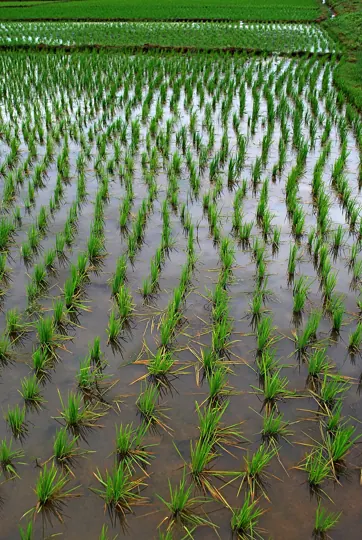
- Rice needs heat and over 100 cm of rain or irrigation: West Bengal leads, with Uttar Pradesh and Punjab next.
- In 1876 Henry Wickham carried about 70,000 seeds to Kew Gardens in London; the seedlings were sent to Ceylon and then to Malaya and other parts of South-east Asia, which became the world's great plantation rubber region.
- Trap (UPSC Prelims 2016): “Reduction in soil salinity” is incorrect.
- Trap (UPSC Prelims 2020, pulse production in India): “Green gram alone accounts for nearly half of pulse production” is incorrect. “In the last three decades, while the production of kharif pulses has increased, the production of rabi pulses has decreased” is incorrect.
Cropping seasons and major crops
Indian farming runs on the monsoon. About half of the net sown area still has no assured irrigation, so the rains decide what is sown and when. That is why the farm year has three seasons, and why UPSC keeps asking which crop belongs to which season and where it grows.
| Season | Sown and harvested | Main crops |
|---|---|---|
| Kharif | Sown with the south-west monsoon (June–July), harvested September– October | Rice, maize, jowar, bajra, ragi, cotton, groundnut, soybean, tur (arhar), moong, urad, jute |
| Rabi | Sown October–December, harvested March–April | Wheat, barley, gram, mustard, peas, lentil |
| Zaid | A short summer season between rabi and kharif (March–June), mostly irrigated | Watermelon, muskmelon, cucumber, vegetables, fodder, moong |
Prelims 2013 listed four crops: 1. Cotton 2. Groundnut 3. Rice 4. Wheat, and asked which are kharif. Cotton, groundnut and rice (option c); wheat is the classic rabi crop. Prelims 2019 tested the kharif map with area figures: Area under rice cultivation is the highest among kharif crops, and cotton covers more area than sugarcane, so statements 1 and 3 were right (option a).
Consider the following crops : 1. Cotton 2. Groundnut 3. Rice 4. Wheat Which of these are Kharif crops?
- 1 and 4
- 2 and 3 only
- 1, 2 and 3
- 2, 3 and 4
Show answer
Answer: (c) · UPSC official key
With reference to the cultivation of Kharif crops in India in the last five years, consider the following statements : 1. Area under rice cultivation is the highest. 2. Area under the cultivation of jowar is more than that of oilseeds. 3. Area of cotton cultivation is more than that of sugarcane. 4. Area under sugarcane cultivation has steadily decreased. Which of the statements given above are correct?
- 1 and 3 only
- 2, 3 and 4 only
- 2 and 4 only
- 1, 2, 3 and 4
Show answer
Answer: (a) · UPSC official key
Where crops grow follows soil, rain and temperature. Rice needs heat and over 100 cm of rain or irrigation: West Bengal leads, with Uttar Pradesh and Punjab next. Wheat likes a cool, moist sowing season and a warm, dry harvest: Uttar Pradesh, Madhya Pradesh and Punjab. Sugarcane is led by Uttar Pradesh and Maharashtra. Cotton grows on the black soils of Gujarat, Maharashtra and Telangana. Jute
is a crop of the West Bengal delta. Tea is led by Assam, coffee by Karnataka, and natural rubber by Kerala.
Many crops survive on rain alone. Prelims 2012 asked which of 1. Groundnut 2. Sesamum 3. Pearl millet are predominantly rainfed: all three (option d). Prelims 2011 described a state whose northern part is arid and semi-arid, with cotton in its centre and cash crops ahead of food crops. That is Gujarat (option b): Kutch and north Gujarat are dry, and the black-soil centre grows cotton and groundnut.
Consider the following crops of India : 1. Groundnut 2. Sesamum 3. Pearl millet Which of the above is/are predominantly rainfed crop/crops?
- 1 and 2 only
- 2 and 3 only
- 3 only
- 1, 2 and 3
Show answer
Answer: (d) · UPSC official key
A state in India has the following characteristics : 1. Its northern part is arid and semi-arid. 2. Its central part produces cotton. 3. Cultivation of cash crops is predominant over food crops. Which one of the following states has all of the above characteristics ?
- Andhra Pradesh
- Gujarat
- Karnataka
- Tamil Nadu
Show answer
Answer: (b) · UPSC official key
Pulses are India’s protein, and India is the world’s largest producer, consumer and importer of them. Prelims 2020 said: Black gram can be cultivated as both kharif and rabi crop. That is true. But gram (chana), not green gram, makes up about half of pulse output, and rabi pulses have
grown, not fallen. So only statement 1 was right (option a). Prelims 2021 asked which one is the least water-efficient crop: sugarcane (option a), which needs over 2,000 mm of water in a season against a few hundred for millets and red gram.
With reference to pulse production in India, consider the following statements : 1. Black gram can be cultivated as both kharif and rabi crop. 2. Green gram alone accounts for nearly half of pulse production. 3. In the last three decades, while the production of kharif pulses has increased, the production of rabi pulses has decreased. Which of the statements given above is/are correct ?
- 1 only
- 2 and 3 only
- 2 only
- 1, 2 and 3
Show answer
Answer: (a) · UPSC official key
Among the following, which one is the least water-efficient crop?
- Sugarcane
- Sunflower
- Pearl millet
- Red gram
Show answer
Answer: (a) · UPSC official key
Plantation crops need special conditions. Mains 2014 asked: Whereas the British planters had developed tea gardens all along the Shivaliks and Lesser Himalayas from Assam to Himachal Pradesh, in effect they did not succeed beyond the Darjeeling area. Explain. Tea wants 150–300 cm of rain spread through the year, acidic well-drained slopes, warmth and no frost. In Darjeeling and Assam these come together. Westward, rainfall falls, winters bring frost and snow, and the growing season is short, so only small pockets such as Kangra survived. Labour, transport to Kolkata port and capital had also gathered in the east.
Whereas the British planters had developed tea gardens all along the Shivaliks and Lesser Himalayas from Assam to Himachal Pradesh, in effect they did not succeed beyond the Darjeeling area. Explain.
Irrigation, groundwater and the Green Revolution
Irrigation lets a farmer grow a second crop and use high-yielding seed. Wells and tube wells water well over half of India’s net irrigated area, far ahead of canals and tanks. Canals dominate in the Indo- Gangetic plain, tanks in the hard-rock south (Tamil Nadu, Telangana) and wells nearly everywhere.
Too much water brings its own harm. Prelims 2011 explained that salinization occurs when the irrigation water accumulated in the soil evaporates, leaving behind salts and minerals, and asked for its effect. It makes some soils impermeable (option b), as in parts of Punjab, Haryana and the Indira Gandhi Canal command. Prelims 2016 asked the advantages of practising drip irrigation: less weed growth and less soil erosion (option c), because water goes only to the root. It does not cut soil salinity on its own.
Salinization occurs when the irrigation water accumulated in the soil evaporates, leaving behind salts and minerals. What are the effects of salinization on the irrigated land ?
- It greatly increases the crop production
- It makes some soils impermeable
- It raises the water table
- It fills the air spaces in the soil with water
Show answer
Answer: (b) · UPSC official key
Which of the following is/are the advantage/advantages of practising drip irrigation? 1. Reduction in weed 2. Reduction in soil salinity 3. Reduction in soil erosion Select the correct answer using the code given below.
- 1 and 2 only
- 3 only
- 1 and 3 only
- None of the above is an advantage of practising drip irrigation
Show answer
Answer: (c) · UPSC official key
Prelims 2023 quoted the UN World Water Development Report 2022: India extracts more than a quarter of the world’s groundwater withdrawal each year. That is true. But the reason given, drinking water and sanitation for its people, was wrong, because nearly 90% of the groundwater drawn goes to irrigation. So Statement-I was correct and Statement-II incorrect (option c).
Consider the following statements :
Statement-I : According to the United Nations’ World Water Development Report, 2022, India extracts more than a quarter of the world’s groundwater withdrawal each year.
Statement-II : India needs to extract more than a quarter of the world’s groundwater each year to satisfy the drinking water and sanitation needs of almost 18% of world’s population living in its territory.
Which one of the following is correct in respect of the above statements?
- Both Statement-I and Statement-II are correct and Statement-II is the correct explanation for Statement-I
- Both Statement-I and Statement-II are correct and Statement-II is not the correct explanation for Statement-I
- Statement-I is correct but Statement-II is incorrect
- Statement-I is incorrect but Statement-II is correct
Show answer
Answer: (c) · UPSC official key
Mains 2024 asked: The groundwater potential of the gangetic valley is on a serious decline. Mains 2024 How may it affect the food security of India? The Ganga plain grows much of India’s wheat and rice on tube wells. Falling water tables raise pumping costs, dry up shallow wells, push arsenic and fluoride into drinking water, and threaten the rice–wheat system that feeds the public distribution system. Answers: Atal Bhujal Yojana, crop diversification away from paddy, micro-irrigation, and pricing power for farm pumps.
The groundwater potential of the gangetic valley is on a serious decline. How may it affect the food security of India?
The Green Revolution began in the mid-1960s with high-yielding dwarf wheat bred by Norman Borlaug, brought to India under scientists led by M.S. Swaminathan. With assured irrigation, fertiliser, credit and minimum support prices, Punjab, Haryana and western Uttar Pradesh led a boom: India’s wheat harvest roughly doubled between 1965 and 1972. Rice followed later.
Mains 2014 asked: Why did the Green Revolution in India virtually by-pass the eastern region despite fertile soil and good availability of water? The east had tiny, fragmented holdings and insecure tenancy left over from the zamindari system, frequent floods, few tube wells and little rural power, weak credit, markets and procurement, and seeds bred for Punjab’s conditions rather than its own flood-prone rice lands. ‘Bringing Green Revolution to Eastern India’ (2010–11) was launched to close that gap.
Why did the Green Revolution in India virtually by-pass the eastern region despite fertile soil and good availability of water?
Mains 2023 asked how India went from being net food importer in 1960s to a net food exporter. High-yielding seeds, irrigation, minimum support prices and public procurement built grain surpluses. Later came dairy (Operation Flood), horticulture, fisheries and marine exports. India is now the world’s largest rice exporter. The cost: heavy pressure on groundwater and soils, which the next phase has to fix.
From being net food importer in 1960s, India has emerged as a net food exporter to the world. Provide reasons.
Mains box: analysis and answer points
- But the reason given, drinking water and sanitation for its people, was wrong, because nearly 90% of the groundwater drawn goes to irrigation.
- About half of the net sown area still has no assured irrigation, so the rains decide what is sown and when.
- That is why the farm year has three seasons, and why UPSC keeps asking which crop belongs to which season and where it grows.
- Likely next angle: Millets push; pulses self-reliance mission
- Asked: Mains 2014 (GS Paper I, 10 marks): Whereas the British planters had developed tea gardens all along the Shivaliks and Lesser Himalayas from Assam to Himachal Pradesh, in effect they did not succeed beyond the Darjeeling area. Explain.
Practice
Practice MCQs (8)
The Para rubber tree (Hevea brasiliensis), now grown widely in the plantations of South-east Asia and Kerala, is native to which one of the following regions?
Answer (a) & explanation
Hevea brasiliensis is native to the Amazon basin. In 1876 Henry Wickham carried about 70,000 seeds to Kew Gardens in London; the seedlings were sent to Ceylon and then to Malaya and other parts of South-east Asia, which became the world's great plantation rubber region. In India rubber was introduced under British rule and is now grown chiefly in Kerala.
Consider the following crops:
1. Tea
2. Sugarcane
3. Banana
4. Gram
How many of the above are grown as important plantation crops in India?
Answer (c) & explanation
Three are. NCERT X defines plantation as commercial farming in which a single crop is grown on a large area with capital-intensive inputs and migrant labour, and names tea, coffee, rubber, sugarcane and banana as important plantation crops of India. Gram is a rabi pulse grown mostly under rain-fed conditions on ordinary farms; it is not a plantation crop.
Consider the following statements about the Green Revolution in India:
1. High-yielding varieties of wheat from Mexico and of rice from the Philippines became available for cultivation by the mid-1960s.
2. The package technology of HYV seeds and chemical fertilisers was first introduced in the irrigated areas of Punjab, Haryana, western Uttar Pradesh, Andhra Pradesh and Gujarat.
3. From the very beginning, the new technology spread most rapidly in the rain-fed drylands of central India.
How many of the statements given above are correct?
Answer (b) & explanation
Two statements are correct. NCERT XII records that HYV seeds of wheat (Mexico) and rice (Philippines) were available by the mid-1960s and that the package technology was introduced in the irrigated areas of Punjab, Haryana, western Uttar Pradesh, Andhra Pradesh and Gujarat, because assured irrigation was a basic prerequisite. Statement 3 is wrong: the Green Revolution was initially confined to irrigated areas, causing regional disparities until the 1970s, after which it spread to eastern and central India.
Consider the following statements about the degradation of cultivable land in India:
1. In irrigated areas, a large tract of agricultural land has lost fertility due to the alkalisation and salinisation of soils and waterlogging.
2. In irrigated areas, leguminous crops have been displaced from the cropping pattern and the duration of fallow has been reduced by multiple cropping, which has weakened natural fertilisation such as nitrogen fixation.
Which of the statements given above is/are correct?
Answer (c) & explanation
Both statements are correct. NCERT XII calls land degradation from a faulty strategy of irrigation and agricultural development particularly alarming in irrigated areas, where alkalisation, salinisation and waterlogging have reduced fertility and excess chemicals have accumulated in the soil. It adds that leguminous crops have been displaced and fallows shortened by multiple cropping, obliterating natural fertilisation such as nitrogen fixation. Rain- fed areas suffer mainly from water and wind erosion.
In 1988 the Planning Commission initiated agro-climatic planning to induce regionally balanced agricultural development. Into how many agro-climatic regions was the country divided for this purpose?
Answer (b) & explanation
NCERT XII notes that the Planning Commission, turning to the problems of rain-fed areas, initiated agro-climatic planning in 1988. Under the Agro-Climatic Regional Planning approach India was divided into 15 agro-climatic regions, from the Western and Eastern Himalayan regions through the Gangetic plains, plateaus and coastal plains to the Islands region. The figure 20 belongs to the separate agro-ecological regions of ICAR's NBSS&LUP, which were later split into 60 sub-regions.
The 'Corn Belt' of the United States, where maize grown in rotation with soyabean is largely fed to hogs and cattle, lies mainly in
Answer (d) & explanation
The Corn Belt is the traditional farming region of the Midwestern United States, chiefly Iowa, Illinois and Indiana with parts of neighbouring States. Its deep prairie soils, hot humid summers and adequate rain suit maize and soyabean, much of which is fed to hogs and cattle, making it a classic area of commercial mixed crop-and-livestock farming.
Following the Green Revolution, which one of the following crops was displaced from the cropping pattern of Haryana, Punjab and northern Rajasthan, largely by wheat?
Answer (a) & explanation
NCERT XII notes that gram, a mostly rain-fed rabi pulse of central, western and north-western India, was displaced from the cropping pattern by wheat in Haryana, Punjab and northern Rajasthan after the Green Revolution. Both are rabi crops competing for the same winter season, and assured irrigation made high-yielding wheat more profitable. Gram is now grown mainly in Madhya Pradesh, Uttar Pradesh, Maharashtra, Andhra Pradesh, Telangana and Rajasthan.
Consider the following statements about the agro-ecological regions of India:
1. ICAR's National Bureau of Soil Survey and Land Use Planning delineated 20 agro-ecological regions on the basis of bioclimate, physiography, soils and the length of the growing period.
2. The length of the growing period is longest in the hot arid region of western Rajasthan and Kachchh.
3. The islands of Andaman and Nicobar and Lakshadweep form a separate agro-ecological region.
Which of the statements given above is/are correct?
Answer (c) & explanation
Statements 1 and 3 are correct. The NBSS&LUP divided India into 20 agro- ecological regions (later 60 sub-regions) by superimposing maps of bioclimate, physiography, soils and the length of growing period (LGP), the number of days when moisture and temperature allow crop growth. The Andaman–Nicobar and Lakshadweep islands form region 20, a hot humid to per-humid island region. Statement 2 is wrong: the hot arid western plain and Kachchh have the shortest growing period, under 90 days; the longest periods (over 210 days) occur in the humid north-east, the Western Ghats coast and the islands.
0 / 0 correct
Write an answer
In 150 words, explain the significance of Indian Economic Geography with one recent example.
Flashcards (9)
Which of cotton, groundnut, rice, wheat is
not kharif? Wheat.
Least water-efficient crop: sugarcane,
sunflower, pearl millet, red gram? Sugarcane.
Which pulse makes up about half of India's
pulse output? Gram (chana).
State with arid north, cotton centre and
cash crops ahead of food crops? Gujarat.
Why did tea not succeed west of
Darjeeling? Less rain, frost and snow in winter, short season.
Main effect of salinization?
It makes some soils impermeable.
Largest source of irrigation in India?
Wells and tube wells (groundwater).
Share of world groundwater withdrawal by
India? More than a quarter.
Which region did the Green Revolution
bypass? The east.
Read more: related explainers
In the news
- 25 Oct 2026Cauvery panel tells Karnataka to release 3,000 cusecs to Tamil Nadu: Article 262 and the inter-State water dispute
- 22 Oct 2026Haryana’s first private power distributor: what a parallel licence means for Gurugram and Nuh
- 21 Oct 2026Rubio at Jamnagar: US pitches oil and Venezuelan crude to India’s ‘refining superpower’
- 19 Oct 2026Pumped storage hydropower: India’s roadmap for 100 GW of ‘water batteries’ by 2035-36
 Next topic · 8.2 →Indian Economic Geography: Minerals and energy
Syllabus: GS-I · Distribution of key natural resources across the world (including South Asia and…