
Critical Minerals and the National Critical Mineral Mission: India’s List of 30, Rare Earths, Lithium, MMDR Amendment 2023, KABIL, Global Partnerships and Challenges (UPSC Notes + PYQs)
UPSC has already asked about this. Read the story with these questions in mind.
- Prelims 2026Which of the following statements about Rare Earth Elements (REEs) and Critical Minerals is/are correct ?Solve it below ↓
- Prelims 2025In the context of electric vehicle batteries, consider the following elementsSolve it below ↓
See all 5 PYQs
- Prelims 2025Consider the following statements: Some rare earth elements are used in the manufacture of flat television screens and computer monitors. …Solve it below ↓
- Prelims 2012Recently, there has been a concern over the short supply of a group of elements called ‘rare earth metals’. Why?Solve it below ↓
- Prelims 2025Consider the following statements: India has joined the Minerals Security Partnership as a member. …Solve with answer →
Why some minerals are “critical”
The phone in your pocket, the battery in an electric scooter and the magnet in a wind turbine all depend on elements most people have never heard of: neodymium, dysprosium, gallium, germanium. A mineral is called critical when it is both economically important and its supply is at risk, often because one country controls mining or processing. Coal and iron ore are important but abundant in India, so they are not critical. Lithium is essential for batteries and India has almost none in production, so it is.
The concern is not theoretical. China mines about 60-70% of the world’s rare earths and processes close to 90%, and it also dominates the refining of lithium, cobalt and graphite. In April 2025 China placed export controls on several rare earth elements and magnets, and Indian makers of electric vehicles and electronics soon faced shortages. The Democratic Republic of Congo produces most of the world’s cobalt, and Indonesia leads in nickel. For India’s goals of 500 GW non-fossil capacity, electric mobility, semiconductors and defence production, secure supply of these minerals is now a strategic question.
- BatteriesLithium, cobalt, nickel, graphite
- MagnetsNeodymium, dysprosium
- ChipsGallium, germanium, silicon
- Defence and aerospaceTitanium, tungsten
India’s list and legal reform
In June 2023 the Ministry of Mines released a list of 30 critical minerals, including lithium, cobalt, nickel, graphite, rare earth elements, tungsten, titanium, vanadium, gallium, germanium, indium, silicon, tin, phosphorus and potash. The list will be reviewed periodically.
The Mines and Minerals (Development and Regulation) Amendment Act, 2023 then:
- removed six minerals, including lithium, beryllium, titanium, niobium, tantalum and zirconium, from the list of atomic minerals, so private firms can explore and mine them;
- created Part D in the First Schedule listing critical and strategic minerals and allowed the Centre to auction their blocks, though revenue goes to States;
- introduced an exploration licence for deep-seated and critical minerals.
Since then the Centre has held several tranches of critical mineral auctions, and the Budget removed customs duty on many critical minerals and scrap.
National Critical Mineral Mission
| Feature | Details |
|---|---|
| Approval | Union Cabinet, 29 January 2025 |
| Period | 2024-25 to 2030-31 |
| Money | ₹16,300 crore from the Centre and about ₹18,000 crore expected from PSUs |
| Exploration | GSI to take up 1,200 exploration projects by 2030-31, including offshore |
| Overseas assets | Help PSUs and private firms acquire mines abroad |
| Stockpile | A National Critical Mineral Stockpile |
| Processing | Mineral processing parks and incentives |
| Recycling | Recovery from e-waste, batteries and mine tailings |
| Research | Centres of Excellence on critical minerals |
Two follow-up schemes stand out. In September 2025 the Cabinet approved a ₹1,500 crore recycling incentive scheme for critical minerals. In November 2025 it approved about ₹7,280 crore to build capacity for sintered rare earth permanent magnets, around 6,000 tonnes a year, the part of the chain where China’s controls hurt most.
- 1Exploration by GSI and private firms
- 2Auction and mining
- 3Processing and refining
- 4Products such as magnets and cells
- 5Recycling and stockpile
India’s resources
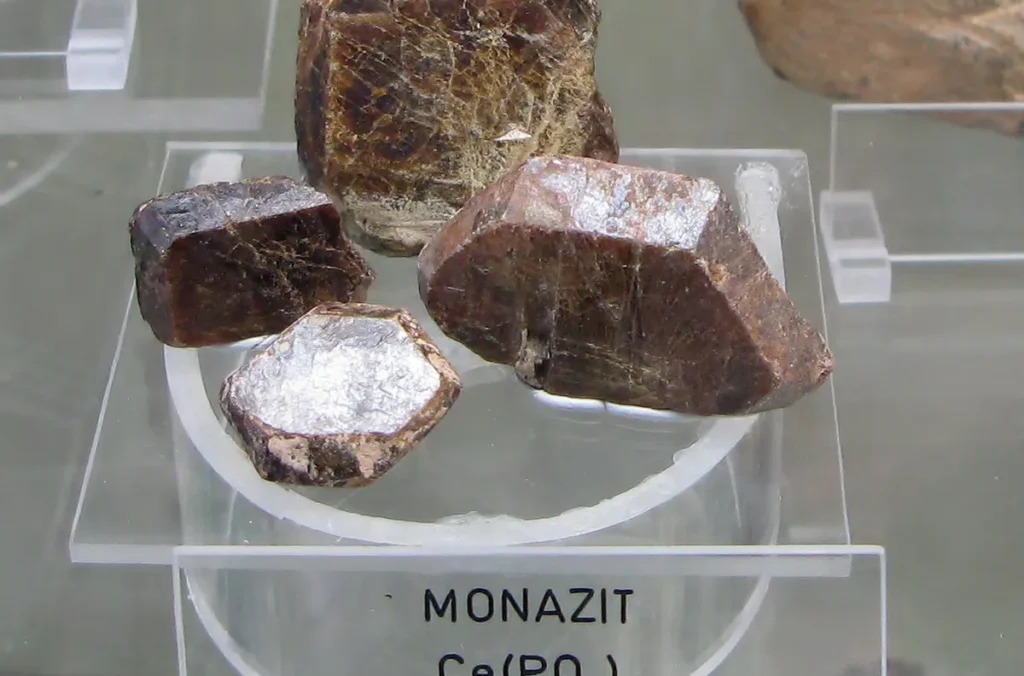
India holds about 6% of the world’s rare earth reserves, mainly in monazite beach sands along the coasts of Kerala, Tamil Nadu, Odisha and Andhra Pradesh, but produces less than 1% of global output. Mining of monazite was long reserved for the public sector, mainly IREL (India) Ltd. In 2023 the Geological Survey of India reported inferred lithium resources of 5.9 million tonnes in Reasi district of Jammu and Kashmir, though the first auction drew a weak response because of uncertainty about grade. Graphite is found in Jharkhand, Odisha and Arunachal Pradesh, and some cobalt and nickel occur with copper and chromite ores.
Going abroad and partnering
- KABIL (Khanij Bidesh India Ltd), a joint venture of NALCO, Hindustan Copper and MECL, signed a deal in 2024 for lithium exploration blocks in Catamarca, Argentina, and is working on assets in Australia and Chile.
- Minerals Security Partnership: India joined this US-led grouping in June 2023.
- Quad Critical Minerals Initiative, launched in July 2025, and talks under the India-US TRUST framework.
- Agreements with Australia, Japan, the UK, the EU and several African and Latin American nations; G20 and IPEF supply chain dialogues.
Challenges
- Exploration gap: India explores only a small part of its obvious geological potential; deep-seated deposits need costly technology.
- Processing: even if ore is mined, refining and separation skills sit mainly in China.
- Investor risk: low prices set by China, long gestation and uncertain grades deter private miners.
- Environment and people: mining in forests and tribal areas raises issues of displacement, consent under PESA and the Forest Rights Act, and pollution, especially from rare earth processing waste.
- Geopolitics: competition among big powers and resource nationalism in producing countries make overseas deals harder.
- Recycling: e-waste is largely handled by the informal sector, losing valuable metals.
- China dominates refining
- Few Indian reserves in production
- Export controls
- Long project gestation
Way forward
Fund exploration with public data so that auctions offer well-understood blocks. Build processing and magnet capacity with long-term offtake contracts. Create a credible stockpile for the most at-risk minerals. Formalise e-waste and battery recycling with extended producer responsibility. Invest in battery chemistries that need less cobalt and lithium, such as sodium-ion. Use diplomacy through the Quad, MSP and bilateral deals while protecting the rights of local and tribal communities at home. The aim is not autarky but diversified, resilient supply.
PYQ trend
Prelims has repeatedly asked about rare earths, EV battery minerals and critical minerals. Mains GS-I asks about mineral resources and mining; GS-III about energy transition and supply chains.
Critical Minerals: UPSC angle
For UPSC CSE
Prelims: minerals and uses, list, institutions, partnerships. Mains GS-I: distribution of mineral resources; GS-III: energy security, manufacturing, supply chains; GS-II: Quad and international groupings.
Critical Minerals UPSC PYQs (Prelims)
Questions UPSC has actually asked, from the official papers. Pick an option to check yourself.
Which of the following statements about Rare Earth Elements (REEs) and Critical Minerals is/are correct ?
– 1. Modern technological innovations including Artificial Intelligence, robotics and space exploration extensively utilise Rare Earth Elements (REEs).
– 2. China has the highest share in mining of REEs followed by India.
– 3. The Government of India launched the National Critical Mineral Mission (NCMM) in 2025 to establish a robust framework for self-reliance in the critical mineral sector.
– 4. Rare Earth Elements are a set of 13 metallic elements.
Select the answer using the code given below :
REEs go into magnets, chips, batteries and satellites. China leads mining by far, but the next producers are the USA, Myanmar and Australia, not India. The NCMM was approved in January 2025. There are 17 rare earths: the 15 lanthanides plus scandium and yttrium. Answer as per the official UPSC key · Battle IAS PYQ bankAnswer (a) & why
In the context of electric vehicle batteries, consider the following elements :
– I. Cobalt
– II. Graphite
– III. Lithium
– IV. Nickel
How many of the above usually make up battery cathodes?
A lithium-ion cathode is a lithium metal oxide, such as nickel-manganese-cobalt (NMC), nickel-cobalt-aluminium or lithium iron phosphate. So lithium, nickel and cobalt go into cathodes. Graphite is the usual anode material. Answer as per the official UPSC key · Battle IAS PYQ bankAnswer (c) & why
Consider the following statements :
Statement I : Some rare earth elements are used in the manufacture of flat television screens and computer monitors.
Statement II : Some rare earth elements have phosphorescent properties.
Which one of the following is correct in respect of the above statements?
Rare earths such as europium, terbium and yttrium are used as phosphors, the materials that glow red, green and blue in screens and LED lighting. Their light-giving property is why screens use them, so Statement II explains Statement I. Answer as per the official UPSC key · Battle IAS PYQ bankAnswer (a) & why
Recently, there has been a concern over the short supply of a group of elements called ‘rare earth metals’. Why?
– 1. China, which is the largest producer of these elements, has imposed some restrictions on their export.
– 2. Other than China, Australia, Canada and Chile, these elements are not found in any country.
– 3. Rare earth metals are essential for the manufacture of various kinds of electronic items and there is a growing demand for these elements.
Which of the statements given above is/are correct?
In 2010 China, which produced over 90% of rare earths, cut export quotas just as demand for magnets, phones, batteries and wind turbines was rising. Rare earths are found in many countries, including India (monazite sands), the USA and Brazil. Answer as per the official UPSC key · Battle IAS PYQ bankAnswer (c) & why
Mains PYQs on this topic
Questions from the official UPSC Mains papers (2023-2026 in the Battle IAS Mains bank), newest first. Each links to a model answer.
- UPSC Mains 2025 · GS Paper III · Q17 · 15 marks
Mineral resources are fundamental to the country’s economy and these are exploited by mining. Why is mining considered an environmental hazard ? Explain the remedial measures required to reduce the environmental hazard due to mining.
Quick quiz
How many critical minerals did India notify in 2023?
30 critical minerals.Answer (c)
KABIL is a joint venture of
NALCO, HCL and MECL.Answer (b)
India’s main source of rare earth elements is
Monazite sands of coastal States.Answer (b)
FAQs
What are critical minerals?
Minerals that are essential for the economy and national security but face supply risk because of scarcity, concentration of production or geopolitics.
What is the National Critical Mineral Mission?
A 2025 mission with ₹16,300 crore of central funds, plus PSU spending, to boost exploration, mining, processing, recycling, overseas acquisition and stockpiling of critical minerals.
Why is China important here?
It mines most rare earths and processes about 90% of them, and also leads in refining lithium, cobalt and graphite.
What did the MMDR Amendment 2023 change?
It opened six former atomic minerals to private mining, let the Centre auction critical mineral blocks and created exploration licences.
Where has lithium been found in India?
Inferred resources of 5.9 million tonnes were reported in Reasi district of Jammu and Kashmir in 2023.
Spotted an error? Tell us. We correct within 48 hours.
Image: Ra'ike (see also: de:Benutzer:Ra'ike), Wikimedia Commons, CC BY-SA 3.0
How to use this in Mains
If asked: UPSC Mains 2025, GS-III: Mineral resources are fundamental to the country’s economy and these are exploited by mining. Why is mining considered an environmental hazard ? Explain the remedial measures required to reduce the environmental hazard due to mining.
Quote: “Processing: even if ore is mined, refining and separation skills sit mainly in China.”
Use it: A sharp body point on why mining alone will not secure critical minerals.
In the news
J&K’s first mineral block auctions: two limestone blocks in Anantnag
On 2 October 2026 the Ministry of Mines reported that two limestone blocks in Anantnag, Koot-Kapran and Wantrag, had been auctioned, a first for the UT of Jammu and Kashmir. The J&K Government entrusted the auction to the Union Ministry of Mines, which used a transparent competitive process under the Central mineral auction system.
2 Oct 2026
Auction launched for two offshore polymetallic nodule blocks in the Andaman Sea
On 1 October 2026 the Ministry of Mines launched the auction of two offshore mineral blocks in the Andaman Sea, Sewell Rise-01 and West Sewell Ridge-01 off Great Nicobar, for Composite Licence. Together they cover over 1,632 sq km and hold polymetallic nodules and crusts with cobalt, nickel, manganese, copper and rare earth elements.
1 Oct 2026
NMDC commissions slurry pipeline and pellet plant linking Bailadila mines to Nagarnar
NMDC Ltd has commissioned a 2 million tonne per annum pellet plant at Nagarnar, Chhattisgarh, as part of a ₹5,427 crore project. It also includes an iron ore processing plant at Bacheli and a 135 km, 15 MTPA slurry pipeline carrying ore concentrate from the Bailadila mines to Nagarnar instead of by road.
27 Sep 2026
16th round of commercial coal mine auctions launched; CMDPAs signed for six mines
On 17 September 2026 the Coal Ministry launched the 16th round of commercial coal mine auctions, offering 25 blocks in nine States: 21 fully explored and four partially explored. Agreements were also signed for six mines sold in earlier rounds. Since commercial mining opened in 2020, 147 mines have been auctioned.
17 Sep 2026