
Chapter 2 · Topic 2.1 · Prelims + Mains1 of 3
India and its Neighbourhood: Neighbourhood First, Pakistan, Afghanistan
Key points
- Neighbourhood First puts South Asian neighbours first: connectivity, trade, aid and crisis help.
- SAGAR (Indian Ocean islands) was widened to MAHASAGAR in 2025.
- Project Mausam (Mains 2015) revives Indian Ocean cultural links and builds soft power.
- After Pahalgam (April 2025), the Indus Waters Treaty of 1960 was kept in abeyance and ICP Attari closed.
- ISAF withdrawal from Afghanistan (2014) raised terror, Pakistan-role and drug risks for India.
- Afghanistan's Central Asian neighbours: Tajikistan, Turkmenistan, Uzbekistan (Prelims 2022).
Prelims box: facts and traps
| Item | Fact |
|---|---|
| SAGAR to MAHASAGAR | Widened in 2025 |
| Indus Waters Treaty (1960) | Kept in abeyance after Pahalgam, April 2025 |
| Afghanistan's Central Asian neighbours | Tajikistan, Turkmenistan, Uzbekistan |
| Kartarpur corridor | Pilgrim link to a Sikh shrine in Pakistan |
- Trap: Kyrgyzstan and Azerbaijan do not border Afghanistan.
Neighbourhood First and SAGAR
Think of a family that looks after its own street first. Neighbourhood First works the same way. It means roads, rail and power links, trade, development help and fast support in a crisis. SAGAR (Security and Growth for All in the Region) extends this to the Indian Ocean islands. It was widened to MAHASAGAR in 2025 (PIB, see Basics of Indian Foreign Policy).
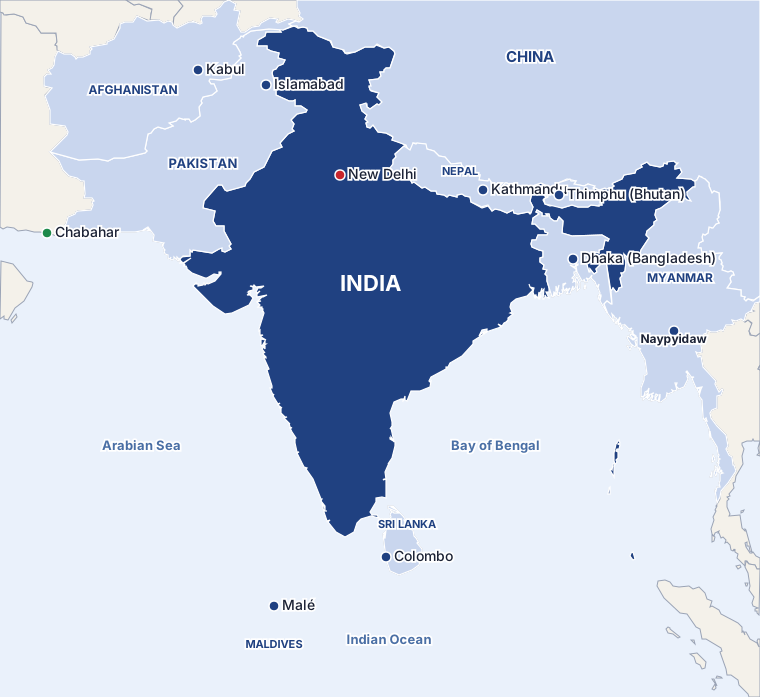
Mains 2015 asked whether Project ‘Mausam’ has a strategic dimension. Mausam is a culture ministry project that revives old monsoon-driven sea and trade links across the Indian Ocean. The answer is yes. It builds soft power (being liked, not feared) and offers a cultural counter-story to China’s Maritime Silk Road.
Project ‘Mausam’ is considered a unique foreign policy initiative of the Indian Government to improve relationship with its neighbors. Does the project have a strategic dimension? Discuss.
| Neighbour | Main opportunity | Main irritant |
|---|---|---|
| Pakistan | Trade, people-to-people | Cross-border terrorism |
| China | Trade, climate, BRICS/SCO | Border, BRI, trade deficit |
| Nepal | Open border, hydropower | Map and boundary issues |
| Bhutan | Hydropower, security | Doklam-type pressures |
| Bangladesh | Connectivity, trade | Water sharing, migration |
| Sri Lanka | Trade, energy, ports | Fishermen, Chinese presence |
| Maldives | Maritime security | Political swings |
| Myanmar | Act East gateway | Instability, refugees |
Pakistan and Afghanistan
Mains 2015 asked whether soft power like sports and cultural exchanges could build goodwill between India and Pakistan, given terrorism and mistrust. It helps a little. Examples are cricket diplomacy, the Kartarpur corridor for Sikh pilgrims, and shared music and cinema. But it cannot replace the core condition, which is an end to cross-border terrorism.
Terrorist activities and mutual distrust have clouded India-Pakistan relations. To what extent the use of soft power like sports and cultural exchanges could help generate goodwill between the two countries? Discuss with suitable examples.
After the Pahalgam terrorist attack (April 2025), the Cabinet Committee on Security decided on “Keeping in abeyance the Indus Waters Treaty of 1960 with immediate effect, until Pakistan credibly and irrevocably abjures its support for cross-border terrorism”. “In abeyance” means put on hold. It also closed the Integrated Check Post Attari, the main land crossing (PIB).
Mains 2013 asked about the withdrawal of the International Security Assistance Force (ISAF), the NATO-led force, from Afghanistan in 2014. The risks for India were:
- terror groups regrouping,
- a bigger role for Pakistan,
- threats to Indian projects and people,
- drug flows.
India’s approach has been development aid (roads, dams, the Parliament building), training, and talking to all regional players.
The proposed withdrawal of International Security Assistance Force (ISAF) from Afghanistan in 2014 is fraught with major security implications for the countries of the region. Examine in light of the fact that India is faced with a plethora of challenges and needs to safeguard its own strategic interests.
Prelims 2022 asked which of Azerbaijan, Kyrgyzstan, Tajikistan, Turkmenistan and Uzbekistan border Afghanistan. Answer (c): 3, 4 and 5 only (Tajikistan, Turkmenistan, Uzbekistan).
Consider the following countries : 1. Azerbaijan 2. Kyrgyzstan 3. Tajikistan 4. Turkmenistan 5. Uzbekistan Which of the above have borders with Afghanistan ?
- 1, 2 and 5 only
- 1, 2, 3 and 4 only
- 3, 4 and 5 only
- 1, 2, 3, 4 and 5
Show answer
Answer: (c) · UPSC official key
What UPSC asks: Prelims: map questions on who borders whom. Mains: soft power with Pakistan, the Indus Waters Treaty in abeyance (2025) and India’s stakes in Afghanistan.
Mains box: analysis and answer points
- Mausam (Mains 2015): soft power plus a strategic counter to China's Maritime Silk Road.
- Pakistan: soft power helps at the margins, but terror must end first.
- Afghanistan: aid, training and talking to all regional players.
- Next likely angle: opportunity vs irritant with each neighbour.
Practice
Practice MCQs (8)
The dedicated air freight corridor between India and Afghanistan, whose first cargo flight from Kabul reached New Delhi in June 2017, was mainly meant to:
Answer (b) & explanation
The India–Afghanistan air freight corridor, agreed in September 2016, was inaugurated on 19 June 2017 when the first cargo flight from Kabul, carrying about 60 tonnes of goods including medicinal plants such as asafoetida, landed in New Delhi. Its purpose was to give landlocked Afghanistan's exporters, especially of fresh and dry fruit and herbs, quick access to Indian markets while bypassing Pakistan, which does not allow overland transit of goods between India and Afghanistan across its territory. It complemented the sea–land route through Chabahar in Iran rather than replacing any road. It was a commercial corridor, not a defence supply line.
Arrange the following India–Pakistan engagements in chronological order:
1. Lahore Declaration
2. Tashkent Declaration
3. Agra Summit
4. Simla Agreement
Select the correct answer using the code given below.
Answer (d) & explanation
The Tashkent Declaration was signed on 10 January 1966 after the 1965 war. The Simla Agreement followed on 2 July 1972 after the 1971 war. The Lahore Declaration was signed on 21 February 1999 during Prime Minister Vajpayee's bus journey to Lahore. The Agra Summit between Vajpayee and General Pervez Musharraf took place in July 2001 and ended without a joint declaration. So the order is 2-4-1-3.
With reference to the Agreement on Strategic Partnership between India and Afghanistan of October 2011, consider the following statements:
1. It was the first such strategic partnership agreement that Afghanistan signed with any country.
2. Under it, India agreed to assist, as mutually determined, in the training, equipping and capacity building of the Afghan National Security Forces.
3. It replaced the India–Afghanistan Treaty of Friendship of January 1950.
Which of the statements given above are correct?
Answer (a) & explanation
Statement 1 is correct: the Agreement on Strategic Partnership, signed in New Delhi on 4 October 2011 by Prime Minister Manmohan Singh and President Hamid Karzai, was reported as the first strategic partnership agreement Afghanistan signed with any country. Statement 2 is correct: in its political and security pillar, India agreed to assist, as mutually determined, in the training, equipping and capacity-building programmes for the Afghan National Security Forces. Statement 3 is wrong: the agreement did not replace the Treaty of Friendship of 4 January 1950; on the contrary, it reaffirmed the 1950 treaty as the basis of the relationship. The agreement also covered trade, capacity development and people-to-people ties. Hence 1 and 2 only.
Consider the following Indian humanitarian operations and the country in which each was carried out:
1. Operation Maitri – Nepal
2. Operation Neer – Maldives
3. Operation Brahma – Myanmar
4. Operation Cactus – Sri Lanka In how many of the above rows is the country correctly matched?
Answer (c) & explanation
Operation Maitri (April 2015) was India's rescue and relief mission after the Nepal earthquake. Operation Neer (December 2014) supplied drinking water to Male when a fire disabled its desalination plant. Operation Brahma (March–April 2025) delivered relief after the 28 March 2025 earthquake in Myanmar. Operation Cactus (November 1988), however, was the military operation that foiled a coup attempt in the Maldives, not Sri Lanka. Hence three rows are correct.
With reference to India's 'Neighbourhood First' policy, consider the following statements:
1. The Ministry of External Affairs describes the policy as consultative, non-reciprocal and outcome-oriented.
2. Myanmar is covered both by this policy and by India's 'Act East' policy.
3. Under the policy, India extends development assistance to a neighbour only after the neighbour offers matching concessions.
Which of the statements given above are correct?
Answer (a) & explanation
Statement 1 is correct: in its reply to Lok Sabha (Q. 262, 13 December 2024) the MEA called the Neighbourhood First policy 'consultative, non-reciprocal and outcome- oriented', focused on connectivity, development assistance and capacity building. Statement 2 is correct: the MEA's Myanmar brief says India engages Myanmar under both its 'Act East' and 'Neighbourhood First' policies, since Myanmar is the only ASEAN country adjoining India. Statement 3 is wrong: it contradicts the non-reciprocal character of the policy. Hence 1 and 2 only.
With reference to trade agreements under SAARC, consider the following statements:
1. The idea of the SAARC Preferential Trading Arrangement (SAPTA) was first mooted by Sri Lanka at the Sixth SAARC Summit held in Colombo in 1991.
2. SAPTA was signed in 1993 and came into force in the same year.
3. The SAARC Agreement on Trade in Services (SATIS) was signed at the Sixteenth SAARC Summit held in Thimphu in 2010.
Which of the statements given above are correct?
Answer (c) & explanation
Statement 1 is correct: Sri Lanka's Department of Commerce records that the proposal to liberalise trade among SAARC members was first mooted by Sri Lanka at the Sixth SAARC Summit in Colombo in December 1991. SAPTA was meant as the first step towards a South Asian Free Trade Area. Statement 2 is wrong: SAPTA was signed in Dhaka on 11 April 1993, but it entered into force only on 7 December 1995, after the members had ratified it. It exchanged tariff concessions product by product on a positive list, and was later overtaken by SAFTA, whose trade liberalisation programme aims to bring tariffs down to 0–5 per cent. Statement 3 is correct: SATIS, which carries SAARC's agenda from goods to services, was signed at the Sixteenth Summit in Thimphu on 29 April 2010. Hence 1 and 3 only.
Consider the following statements regarding the 'Gujral Doctrine' (1996–97):
1. India would not ask for reciprocity from Bangladesh, Bhutan, the Maldives, Nepal and Sri Lanka, but would give what it could in good faith.
2. Pakistan was named among the neighbours to which this non-reciprocity would apply.
3. No South Asian country should allow its territory to be used against the interest of another country of the region.
4. All disputes should be settled through peaceful bilateral negotiations.
How many of the statements given above are correct?
Answer (c) & explanation
The Gujral Doctrine, set out by I.K. Gujral as External Affairs Minister and later Prime Minister, had five principles. The first was non-reciprocity towards Bangladesh, Bhutan, the Maldives, Nepal and Sri Lanka, so statement 1 is correct and statement 2 is wrong: Pakistan was deliberately left out of that list. The others were: no use of one's territory against another country of the region (statement 3), non-interference in internal affairs, respect for territorial integrity and sovereignty, and settlement of disputes through peaceful bilateral negotiations (statement 4). Hence three statements are correct.
Consider the following statements: Statement-I: The 19th SAARC Summit, scheduled to be hosted by Pakistan in Islamabad in November 2016, did not take place. Statement-II: India, Bangladesh, Bhutan and Afghanistan conveyed to the SAARC Chair that they would not be able to participate in that Summit.
Which one of the following is correct in respect of the above statements?
Answer (a) & explanation
Statement-I is correct: the MEA's SAARC brief (June 2026) records that the 19th Summit, to be hosted by Pakistan in 2016, has not taken place, and the 18th Summit at Kathmandu (November 2014) remains the last one held. Statement-II is correct: after the September 2016 Uri attack, India, Bangladesh, Bhutan and Afghanistan informed Nepal, then SAARC Chair, that they could not attend, and the Summit was postponed. Because SAARC decides by unanimity and half its members stayed away, the Summit could not go ahead, so Statement-II explains Statement-I.
0 / 0 correct
Write an answer
In 150 words, explain the significance of India and its Neighbourhood with one recent example.
Flashcards (7)
Neighbourhood First means?
Priority to South Asian neighbours.
Project Mausam strategic?
Yes: soft power vs Maritime Silk Road.
Soft power with Pakistan?
Helps at margins; terror is core.
IWT decision 2025?
Kept in abeyance (PIB).
IWT year?
1960.
Afghan neighbours (2022 PYQ)?
Tajikistan, Turkmenistan, Uzbekistan.
BRI belongs to?
China.
Read more: related explainers
In the news
- 24 Oct 2026Jaishankar in Baku: India and Azerbaijan try to reset ties strained over Operation Sindoor
- 23 Oct 2026India–Bangladesh ties: tied by geography, divided by politics, and what New Delhi should learn
- 23 Oct 2026Face-off with China continues in Arunachal: ITBP chief confirms stand-off at Asaphila
- 22 Oct 2026Badr pact: Pakistan, Türkiye, Qatar and Indonesia sign a defence-industry MoU in Doha
 Next topic · 2.2 →India and its Neighbourhood: China, Sri Lanka, Maldives