
Chapter 14 · Topic 14.1 · Prelims + Mains1 of 3
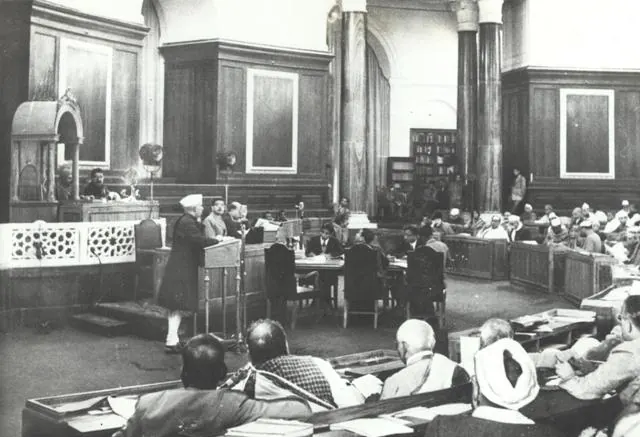
Constituent Assembly: Formation and composition
Key points
- Idea: M.N. Roy 1934; Congress demand 1935; August Offer 1940 accepted it in principle; Cripps 1942.
- Cabinet Mission: 389 seats (296 British India, 93 princely states); about one seat per million people.
- Provincial members elected by provincial assemblies (Prelims 2013).
- First sitting 9 December 1946; Sachchidananda Sinha provisional president (Prelims 2024); Rajendra Prasad president 11 December 1946.
4 PYQs 2013–2022
Prelims box: facts and traps
- Constituted: November 1946 under the Cabinet Mission Plan (May 1946).
- 1946 result: Congress 208, League 73, others 15.
- After partition: strength fell to 299.
- Trap: the 93 princely-state seats were not filled at first; the States joined later in 1947.
- Trap: the Wavell Plan failed at Simla (1945); the Mountbatten Plan (June 1947) dealt with partition, not the Assembly's set-up.
How the Assembly came about
The idea that Indians should write their own constitution grew with the freedom struggle. A constitution is a country’s rulebook, like a housing society’s rules. This chapter looks at it as history; the Polity chapter of the same name covers the constitutional detail.
| Year | Step |
|---|---|
| 1934 | M.N. Roy first put forward the idea of a Constituent Assembly |
| 1935 | Congress officially demanded one |
| 1938 | Nehru: it must be elected by adult franchise, without outside interference |
| 1940 | August Offer: Britain accepted the demand in principle |
| 1942 | Cripps proposals: a constitution-making body after the war |
| 1946 | Cabinet Mission plan set its size and method; elections held in July–August 1946 |
| Cabinet Mission scheme | Detail |
|---|---|
| Total seats | 389: 296 for British India (292 provinces + 4 chief commissioners’ provinces) and 93 for princely states |
| Ratio | Roughly one seat for every million people |
| Method | Provincial members chosen by the provincial legislative assemblies, by proportional representation with the single transferable vote; seats split among Muslims, Sikhs and general |
| Princely states | Representatives nominated by the rulers |
Prelims 2013 asked how ‘the Members of the Constituent Assembly from the Provinces were’ chosen. Answer: elected by the Provincial Legislative Assemblies, not directly by the people.
With reference to Indian History, the Members of the Constituent Assembly from the Provinces were
- directly elected by the people of those Provinces
- nominated by the Indian National Congress and the Muslim League
- elected by the Provincial Legislative Assemblies
- selected by the Government for their expertise in constitutional matters
Show answer
Answer: (c) · UPSC official key
What UPSC asks: Prelims: the steps 1934–46 and indirect election (2013).
Composition and first sitting
| Item | Detail |
|---|---|
| 1946 result | Congress 208, Muslim League 73, small groups and independents 15 (of the 296 British Indian seats) |
| First sitting | 9 December 1946; the Muslim League boycotted |
| Provisional president | Dr Sachchidananda Sinha, the oldest member |
| President | Dr Rajendra Prasad, elected 11 December 1946 |
| Vice-presidents | H.C. Mukherjee and V.T. Krishnamachari |
| Constitutional adviser | Sir B.N. Rau |
| After partition | Members from areas going to Pakistan left; strength fell to 299 |
Prelims 2024 asked: ‘Who was the Provisional President of the Constituent Assembly before Dr. Rajendra Prasad took over?’ Answer: Dr Sachchidananda Sinha.
Who was the Provisional President of the Constituent Assembly before Dr. Rajendra Prasad took over ?
- C. Rajagopalachari
- Dr. B.R. Ambedkar
- T.T. Krishnamachari
- Dr. Sachchidananda Sinha
Show answer
Answer: (d) · UPSC official key
The Assembly included people from almost every community and region, and fifteen women, but it was not elected by adult franchise (every adult voting). Critics called it unrepresentative and Congress-dominated; Granville Austin wrote that ‘the Congress was the Assembly, and the Assembly was India’.
What UPSC asks: Prelims: Sinha (2024), Prasad and Rau. Mains: the criticism.
Mains box: analysis and answer points
- Representative? Every community and region and fifteen women, but no adult franchise.
- Criticism: Congress-dominated; Austin: 'the Congress was the Assembly, and the Assembly was India'.
- Next likely angle: 389 seats.
Practice
Practice MCQs (8)
Consider the following statements:
1. The first meeting of the Constituent Assembly was held on 9 December 1946.
2. The Muslim League attended the first meeting of the Constituent Assembly.
Which of the statements given above is/are correct?
Answer (a) & explanation
Statement 1 is correct: the Constituent Assembly held its first meeting on 9 December 1946. Statement 2 is incorrect: the Muslim League boycotted the meeting, insisting on a separate State of Pakistan; so only 211 members attended. The League's members never took part in the Assembly as a body, and after partition the members from areas that went to Pakistan formed a separate Constituent Assembly there. The Indian Assembly went on to elect its permanent President on 11 December 1946.
The idea of a Constituent Assembly for India was first put forward in 1934 by
Answer (a) & explanation
The idea of a Constituent Assembly for India was first put forward in 1934 by M. N. Roy, a pioneer of the communist movement in India. The Indian National Congress took it up as an official demand in 1935. In 1938, Jawaharlal Nehru declared that the constitution of free India must be framed by a Constituent Assembly elected on the basis of adult franchise, without outside interference. The British accepted the demand in principle only in the August Offer of 1940.
Following the French practice of letting the oldest member preside, who was elected the temporary President of the Constituent Assembly at its first meeting?
Answer (b) & explanation
At its first meeting on 9 December 1946, the Assembly elected Sachchidananda Sinha, its oldest member, as temporary President, following the French practice of letting the senior-most member preside at an inaugural sitting. On 11 December 1946, Rajendra Prasad was elected the permanent President. H. C. Mukherjee and V. T. Krishnamachari later served as Vice-Presidents, and B. N. Rau was the Assembly's constitutional adviser, who prepared the first draft of the Constitution.
With reference to the demand for a Constituent Assembly, consider the following statements:
1. The Indian National Congress first officially demanded a Constituent Assembly in 1946.
2. The British Government accepted the demand in principle in the August Offer of 1940.
Which of the statements given above is/are correct?
Answer (b) & explanation
Statement 2 is correct: in the August Offer of 1940, the British Government accepted in principle that framing India's constitution was primarily the responsibility of Indians, after the war. The Cripps Proposals of 1942 offered a constitution-making body but were rejected. Statement 1 is incorrect: the Congress first officially demanded a Constituent Assembly in 1935. The year 1946 is when the Assembly was actually constituted under the Cabinet Mission Plan.
The Constituent Assembly of India was constituted in November 1946 under the scheme formulated by the
Answer (c) & explanation
The Constituent Assembly was constituted in November 1946 under the scheme of the Cabinet Mission Plan, announced in May 1946. The Plan fixed the total strength, the allotment of seats to provinces and princely States, and the method of election by provincial assemblies. The Cripps Proposals (1942) had offered an elected constitution-making body after the war but were rejected. The Wavell Plan failed at the Simla Conference of 1945, and the Mountbatten Plan of June 1947 dealt with partition.
In the elections to the Constituent Assembly held in July–August 1946, the Indian National Congress won
Answer (c) & explanation
Elections to the 296 seats allotted to British India were held in July–August 1946. The Indian National Congress won 208 seats, the Muslim League won 73, and small groups and independents won 15. The 93 seats for the princely States were not filled at that stage, because the States stayed away until later in 1947. The Congress majority shaped the Assembly's work, though it also drew in members from outside the party, such as B. R. Ambedkar.
Which one of the following statements about the Constituent Assembly as constituted in 1946 is NOT correct?
Answer (d) & explanation
Option (d) is the incorrect statement. The representatives of the princely States were to be nominated by the heads of the States, the rulers, not elected by their people. So the Assembly was a partly elected and partly nominated body. Its provincial members were indirectly elected by the provincial legislative assemblies, and those assemblies had been chosen on a limited franchise. Critics later used these points to argue that the Assembly was not fully representative, though its members came from most sections of society.
Consider the following statements about the Constituent Assembly as planned in 1946:
1. 296 seats were allotted to British India.
2. 93 seats were allotted to the princely States.
3. Seats were reserved for women in every province.
4. Seats in each province were divided only between Hindus and Muslims.
How many of the statements given above are correct?
Answer (b) & explanation
Only two statements are correct. Of the 389 seats under the Cabinet Mission scheme, 296 were allotted to British India (292 from the eleven Governors' provinces and 4 from the Chief Commissioners' provinces) and 93 to the princely States. Statement 3 is incorrect: there was no reservation for women, though about fifteen women did become members. Statement 4 is incorrect: provincial seats were divided among three communities, General, Muslim and Sikh, the last only in Punjab.
0 / 0 correct
Prelims PYQs on this topic (4)
With reference to the proposals of Cripps Mission, consider the following statements :
- 1. The Constituent Assembly would have members nominated by the Provincial Assemblies as well as the Princely States.
- 2. Any Province, which is not prepared to accept the new Constitution would have the right to sign a separate agreement with Britain regarding its future status.
Which of the statements given above is/are correct ?
Answer (b) & explanation
Only statement 2 is correct (b). Statement 2 is right: under the Cripps proposals (March 1942), any province unwilling to accept the new constitution could stay out and sign a separate agreement with Britain, with the same status as the Indian Union. Statement 1 is wrong because of one word: the constitution-making body would be elected by the provincial assemblies through proportional representation, while only the princely states would nominate their members.
Notice why both sides rejected it. Congress objected to the provincial opt-out, which looked like a seed of Partition, and to nominated princes; Gandhi reportedly called the offer a "post-dated cheque". The League wanted Pakistan clearly accepted. The failure of Cripps led straight to the Quit India call in August 1942.
Elected versus nominated: only the princely states nominated.
Answer as per the official UPSC answer key.
In the context of Colonial India, Shah Nawaz Khan, Prem Kumar Sehgal and Gurbaksh Singh Dhillon are remembered as
Answer (d) & explanation
They were officers of the Indian National Army (d). Shah Nawaz Khan, Prem Kumar Sehgal and Gurbaksh Singh Dhillon, a Muslim, a Hindu and a Sikh, were INA officers tried together for treason at the Red Fort in November 1945. Bhulabhai Desai led the defence, with Nehru and Tej Bahadur Sapru on the team. Protests across the country forced the government to remit their sentences. They were not linked with the Swadeshi movement (a), the Interim Government (b) or the Drafting Committee (c).
Notice the slogan "Lal Qila se aai awaaz, Sehgal, Dhillon, Shah Nawaz". The INA trials, along with the Royal Indian Navy mutiny (1946), showed the British they could no longer rely on Indian forces.
Answer as per the official UPSC answer key.
With reference to Indian National Movement, consider the following pairs :
| Person | Position held
| 1. Sir Tej Bahadur Sapru | President, All India Liberal Federation
| 2. K. C. Neogy | Member, The Constituent Assembly
| 3. P. C. Joshi | General Secretary, Communist Party of India
Which of the pairs given above is/are correctly matched?
Answer (d) & explanation
All three pairs are correct (d). Sir Tej Bahadur Sapru was a leading Liberal, a Moderate who left the Congress, and he presided over the All India Liberal Federation (1923 and 1927). He also drafted much of the Nehru Report (1928). K.C. Neogy was a member of the Constituent Assembly, later a Union minister, and chaired the First Finance Commission (1951). P.C. Joshi was the first General Secretary of the Communist Party of India (1935–47).
Notice the Liberals' roots: the National Liberal Federation, formed in 1918 by Moderates such as Surendranath Banerjea who backed the Montagu–Chelmsford reforms. Sapru also defended INA officers at the Red Fort trials (1945).
Answer as per the official UPSC answer key.
With reference to Indian History, the Members of the Constituent Assembly from the Provinces were
Answer (c) & explanation
Elected by the Provincial Legislative Assemblies is correct (c). Under the Cabinet Mission Plan (1946), the provincial members of the Constituent Assembly were indirectly elected by the members of the Provincial Legislative Assemblies through proportional representation by single transferable vote. Seats were roughly one per million population, divided among Muslims, Sikhs and General. (a) is wrong: there was no direct election. (b) is wrong: parties did not nominate members. (d) is wrong: the government did not select experts. Members from the princely states were nominated by the rulers.
Notice the numbers: the Assembly had 389 members (292 provinces, 93 princely states, 4 chief commissioners' provinces), reduced to 299 after Partition. It first met on 9 December 1946. Trap: 'directly elected' sounds democratic but was not the method.
Answer as per the official UPSC answer key.
Write an answer
In 150 words, explain the significance of Constituent Assembly with one recent example.
Flashcards (8)
Who first proposed a Constituent
Assembly? M.N. Roy, 1934.
Which offer first accepted the demand in
principle? August Offer, 1940.
Total seats under the Cabinet Mission plan?
389.
How were provincial members chosen?
Elected by the provincial assemblies (single transferable vote).
Date of the first sitting?
9 December 1946.
Provisional president?
Dr Sachchidananda Sinha.
Who was the constitutional adviser?
Sir B.N. Rau.
Strength after partition?
299.
Read more: related explainers
In the news
 Next topic · 14.2 →Constituent Assembly: Objectives Resolution and committees
Syllabus: GS-I · Modern Indian history from about the middle of the eighteenth century until the…