
Chapter 14 · Topic 14.2 · Prelims + Mains2 of 3
Constituent Assembly: Objectives Resolution and committees
Key points
- Objectives Resolution moved by Nehru on 13 December 1946, adopted 22 January 1947; it became the Preamble.
- Indian Independence Act 1947 made the Assembly sovereign and also India's first Parliament.
- Drafting Committee set up 29 August 1947; chairman B.R. Ambedkar; seven members.
4 PYQs 2013–2022
Prelims box: facts and traps
- Committee chairs: Nehru (Union Powers, Union Constitution, States); Patel (Provincial Constitution, Advisory); Prasad (Rules, Steering).
- Draft: published February 1948; moved 4 November 1948.
- Second reading: 15 November 1948 to 17 October 1949; third reading from 14 November 1949.
- Trap: Rajendra Prasad did not chair the Drafting Committee.
The Objectives Resolution and the Act of 1947
On 13 December 1946 Jawaharlal Nehru moved the Objectives Resolution. It was adopted on 22 January 1947 and later became the Preamble.
| Objectives Resolution | Detail |
|---|---|
| India | An independent sovereign republic |
| Power | All power derived from the people |
| People | Justice (social, economic, political), equality, freedoms of thought, expression, belief, worship and association |
| Safeguards | For minorities, backward and tribal areas, and depressed classes |
| Structure | A union with autonomous units holding residuary powers (later changed) |
| Later | Became the Preamble of the Constitution of India |
| Indian Independence Act, 1947: effects | Detail |
|---|---|
| Sovereign body | The Assembly could make any constitution and even repeal British laws for India |
| Two roles | Constitution-maker (chaired by Rajendra Prasad) and the first Parliament of free India (chaired by G.V. Mavalankar) |
| League’s seats | Members from the Pakistan areas withdrew |
What UPSC asks: Prelims: Nehru’s resolution became the Preamble. Next likely angle: two roles.
Committees and the Drafting Committee
| Major committee | Chairman |
|---|---|
| Union Powers Committee | Jawaharlal Nehru |
| Union Constitution Committee | Jawaharlal Nehru |
| States Committee | Jawaharlal Nehru |
| Provincial Constitution Committee | Vallabhbhai Patel |
| Advisory Committee (rights, minorities, tribal areas) | Vallabhbhai Patel |
| Rules of Procedure; Steering | Rajendra Prasad |
| Drafting Committee | B.R. Ambedkar |
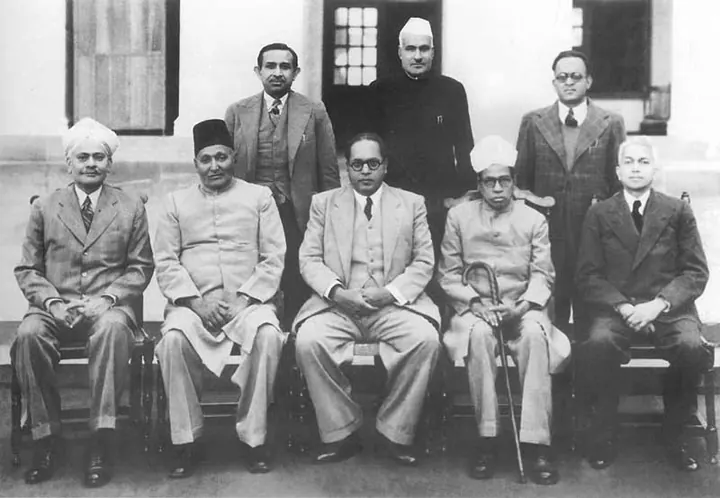
Patel’s body was the Advisory Committee on Fundamental Rights, Minorities and Tribal and Excluded Areas. Its sub-committees on Fundamental Rights and on Minorities were chaired by J.B. Kripalani and H.C. Mukherjee.
| Drafting Committee (set up 29 August 1947) | Detail |
|---|---|
| Members (7) | B.R. Ambedkar (chairman), N. Gopalaswamy Ayyangar, Alladi Krishnaswamy Ayyar, K.M. Munshi, Syed Mohammad Saadullah, N. Madhava Rau (in place of B.L. Mitter), T.T. Krishnamachari (in place of D.P. Khaitan, who died in 1948) |
| Draft | Published in February 1948; people had eight months to comment |
| Readings | Moved by Ambedkar on 4 November 1948; three readings followed |
What UPSC asks: Prelims: chairmen and members.
Mains box: analysis and answer points
- Two roles: Constitution-maker under Rajendra Prasad; Parliament under G.V. Mavalankar.
- Objectives Resolution: the philosophy of the Constitution.
- Next likely angle: two roles after 1947.
Practice
Practice MCQs (8)
The Drafting Committee of the Constituent Assembly, which prepared the Draft Constitution, was chaired by
Answer (a) & explanation
The Drafting Committee, set up on 29 August 1947, was chaired by B. R. Ambedkar. Its task was to turn the reports and decisions of the Assembly's committees into a Draft Constitution, and Ambedkar later piloted that draft through the House, which is why he is called the chief architect of the Constitution. Rajendra Prasad was the President of the Assembly, B. N. Rau was its Constitutional Adviser, who prepared an earlier draft but was not a member, and K. M. Munshi was a member of the committee, not its chairman.
Consider the following statements:
1. Jawaharlal Nehru was a member of the Drafting Committee.
2. Sardar Vallabhbhai Patel was a member of the Drafting Committee.
Which of the statements given above is/are correct?
Answer (d) & explanation
Both statements are incorrect. Neither Jawaharlal Nehru nor Sardar Patel was a member of the Drafting Committee. Nehru chaired the Union Powers, Union Constitution and States Committees, and Patel chaired the Provincial Constitution Committee and the Advisory Committee on rights and minorities. The Drafting Committee was deliberately made up mainly of legal experts, such as Alladi Krishnaswamy Ayyar, N. Gopalaswamy Ayyangar and K. M. Munshi, under B. R. Ambedkar.
Consider the following persons:
1. Alladi Krishnaswamy Ayyar
2. Syed Mohammad Saadullah
3. Rajendra Prasad
4. B. N. Rau
How many of the above were members of the Drafting Committee?
Answer (b) & explanation
Only two. Alladi Krishnaswamy Ayyar, a leading jurist from Madras, and Syed Mohammad Saadullah, from Assam, were members of the seven-member Drafting Committee. Rajendra Prasad was the President of the Constituent Assembly and chaired procedural committees, not the Drafting Committee. B. N. Rau was the Constitutional Adviser, an official who prepared the first draft for the Assembly's use, but he was never a member of the committee.
With reference to changes in the membership of the Drafting Committee, consider the following statements:
1. N. Madhava Rau replaced B. L. Mitter, who resigned on grounds of ill-health.
2. T. T. Krishnamachari replaced D. P. Khaitan, who died in 1948.
Which of the statements given above is/are correct?
Answer (c) & explanation
Both statements are correct. Two original members of the Drafting Committee were replaced. B. L. Mitter resigned on grounds of ill-health, and N. Madhava Rau took his place. D. P. Khaitan died in 1948, and T. T. Krishnamachari took his place. The committee's strength therefore stayed at seven. T. T. Krishnamachari went on to be a prominent Union Finance Minister, while V. T. Krishnamachari, a different person, was a Vice-President of the Assembly.
How many members did the Drafting Committee of the Constituent Assembly have?
Answer (b) & explanation
The Drafting Committee had seven members: B. R. Ambedkar (chairman), N. Gopalaswamy Ayyangar, Alladi Krishnaswamy Ayyar, K. M. Munshi, Syed Mohammad Saadullah, N. Madhava Rau and T. T. Krishnamachari. The last two came in place of B. L. Mitter, who resigned, and D. P. Khaitan, who died in 1948. So, although nine people served on it at different times, the committee's strength was always seven. Most members were eminent lawyers, chosen for their legal skill rather than political standing.
Dr. B. R. Ambedkar introduced the final Draft Constitution in the Assembly, opening its first reading, on
Answer (c) & explanation
B. R. Ambedkar introduced the final Draft Constitution in the Assembly on 4 November 1948, opening the first reading, a general discussion that lasted five days. The second reading, a clause-by-clause consideration, ran from 15 November 1948 to 17 October 1949, and the third reading began on 14 November 1949. The Constitution was passed on 26 November 1949. The other dates belong to other events: 29 August 1947, the setting up of the Drafting Committee, and 9 December 1946, the Assembly's first sitting.
Consider the following statements:
1. The first Draft Constitution was published in February 1948.
2. The first draft was adopted unchanged, and no revised draft was ever published.
Which of the statements given above is/are correct?
Answer (a) & explanation
Statement 1 is correct: the Drafting Committee published the first Draft Constitution in February 1948. Statement 2 is incorrect: the people of India were given eight months to discuss the draft and propose amendments. In the light of public comments, criticisms and suggestions, the committee prepared a second draft, published in October 1948. Ambedkar then introduced the final draft in the Assembly on 4 November 1948. The process shows the Assembly's attempt to make drafting consultative.
Which one of the following statements about the Constitution as passed by the Constituent Assembly on 26 November 1949 is NOT correct?
Answer (d) & explanation
Option (d) is the incorrect statement. On 26 November 1949 the Assembly declared the motion on the Constitution carried, and the Constitution as passed had a Preamble, 395 Articles, 22 Parts and 8 Schedules. But only some provisions came into force at once: those on citizenship, elections, the provisional Parliament, temporary and transitional provisions, and short title. The remaining provisions, the greater part, came into force on 26 January 1950, which is therefore called the date of commencement.
0 / 0 correct
Prelims PYQs on this topic (4)
In the context of Colonial India, Shah Nawaz Khan, Prem Kumar Sehgal and Gurbaksh Singh Dhillon are remembered as
Answer (d) & explanation
They were officers of the Indian National Army (d). Shah Nawaz Khan, Prem Kumar Sehgal and Gurbaksh Singh Dhillon, a Muslim, a Hindu and a Sikh, were INA officers tried together for treason at the Red Fort in November 1945. Bhulabhai Desai led the defence, with Nehru and Tej Bahadur Sapru on the team. Protests across the country forced the government to remit their sentences. They were not linked with the Swadeshi movement (a), the Interim Government (b) or the Drafting Committee (c).
Notice the slogan "Lal Qila se aai awaaz, Sehgal, Dhillon, Shah Nawaz". The INA trials, along with the Royal Indian Navy mutiny (1946), showed the British they could no longer rely on Indian forces.
Answer as per the official UPSC answer key.
With reference to the proposals of Cripps Mission, consider the following statements :
- 1. The Constituent Assembly would have members nominated by the Provincial Assemblies as well as the Princely States.
- 2. Any Province, which is not prepared to accept the new Constitution would have the right to sign a separate agreement with Britain regarding its future status.
Which of the statements given above is/are correct ?
Answer (b) & explanation
Only statement 2 is correct (b). Statement 2 is right: under the Cripps proposals (March 1942), any province unwilling to accept the new constitution could stay out and sign a separate agreement with Britain, with the same status as the Indian Union. Statement 1 is wrong because of one word: the constitution-making body would be elected by the provincial assemblies through proportional representation, while only the princely states would nominate their members.
Notice why both sides rejected it. Congress objected to the provincial opt-out, which looked like a seed of Partition, and to nominated princes; Gandhi reportedly called the offer a "post-dated cheque". The League wanted Pakistan clearly accepted. The failure of Cripps led straight to the Quit India call in August 1942.
Elected versus nominated: only the princely states nominated.
Answer as per the official UPSC answer key.
With reference to Indian National Movement, consider the following pairs :
| Person | Position held
| 1. Sir Tej Bahadur Sapru | President, All India Liberal Federation
| 2. K. C. Neogy | Member, The Constituent Assembly
| 3. P. C. Joshi | General Secretary, Communist Party of India
Which of the pairs given above is/are correctly matched?
Answer (d) & explanation
All three pairs are correct (d). Sir Tej Bahadur Sapru was a leading Liberal, a Moderate who left the Congress, and he presided over the All India Liberal Federation (1923 and 1927). He also drafted much of the Nehru Report (1928). K.C. Neogy was a member of the Constituent Assembly, later a Union minister, and chaired the First Finance Commission (1951). P.C. Joshi was the first General Secretary of the Communist Party of India (1935–47).
Notice the Liberals' roots: the National Liberal Federation, formed in 1918 by Moderates such as Surendranath Banerjea who backed the Montagu–Chelmsford reforms. Sapru also defended INA officers at the Red Fort trials (1945).
Answer as per the official UPSC answer key.
With reference to Indian History, the Members of the Constituent Assembly from the Provinces were
Answer (c) & explanation
Elected by the Provincial Legislative Assemblies is correct (c). Under the Cabinet Mission Plan (1946), the provincial members of the Constituent Assembly were indirectly elected by the members of the Provincial Legislative Assemblies through proportional representation by single transferable vote. Seats were roughly one per million population, divided among Muslims, Sikhs and General. (a) is wrong: there was no direct election. (b) is wrong: parties did not nominate members. (d) is wrong: the government did not select experts. Members from the princely states were nominated by the rulers.
Notice the numbers: the Assembly had 389 members (292 provinces, 93 princely states, 4 chief commissioners' provinces), reduced to 299 after Partition. It first met on 9 December 1946. Trap: 'directly elected' sounds democratic but was not the method.
Answer as per the official UPSC answer key.
Write an answer
In 150 words, explain the significance of Constituent Assembly with one recent example.
Flashcards (8)
Who moved the Objectives Resolution and
when? Nehru, 13 December 1946.
When was it adopted?
22 January 1947.
Who chaired the Assembly as a legislature?
G.V. Mavalankar.
Who chaired the Provincial Constitution
Committee? Vallabhbhai Patel.
Who chaired the Union Powers Committee?
Jawaharlal Nehru.
Who chaired the Fundamental Rights sub-
committee? J.B. Kripalani.
When was the Drafting Committee set up?
29 August 1947.
Who replaced D.P. Khaitan in the Drafting
Committee? T.T. Krishnamachari.
In the news
 Next topic · 14.3 →Constituent Assembly: Adoption and enactment
Syllabus: GS-I · Modern Indian history from about the middle of the eighteenth century until the…