
Chapter 2 · Topic 2.3 · Prelims + Mains3 of 3
Constituent Assembly: People of the Assembly
Key points
- Rajendra Prasad was President of the Assembly; Ambedkar chaired the Drafting Committee; B.N. Rau made the first draft; Sachchidananda Sinha was the temporary President.
- Fifteen women members, including Dakshayani Velayudhan (the only Dalit woman) and Begum Aizaz Rasul.
- Criticisms: not elected by all adults, Congress-dominated, slow. Replies exist for each.
- Ambedkar's three warnings (25 November 1949): no 'grammar of anarchy', no hero-worship, build social democracy.
2 PYQs 2015–2024
Prelims box: facts and traps
- Committee chairs: Rajendra Prasad (Rules, Steering, Finance, Flag); Nehru (Union Powers, Union Constitution, States); Patel (Advisory, Provincial Constitution).
- Other facts: Secretary H.V.R. Iyengar; calligraphy Prem Behari Narain Raizada; illustrations by Nandalal Bose's team; seal: the elephant.
- Trap: Hansa Mehta presented the national flag on 14 August 1947 for the women of India.
People of the Assembly
- Dr. Rajendra Prasad: President of the Assembly; chaired the Rules, Steering, Finance and Flag committees; later the first President of India.
- Jawaharlal Nehru: moved the Objectives Resolution, which set out the Constitution’s aims; chaired the Union Powers, Union Constitution and States committees.
- Sardar Patel: chaired the Advisory Committee and the Provincial Constitution Committee; integrated the princely states.
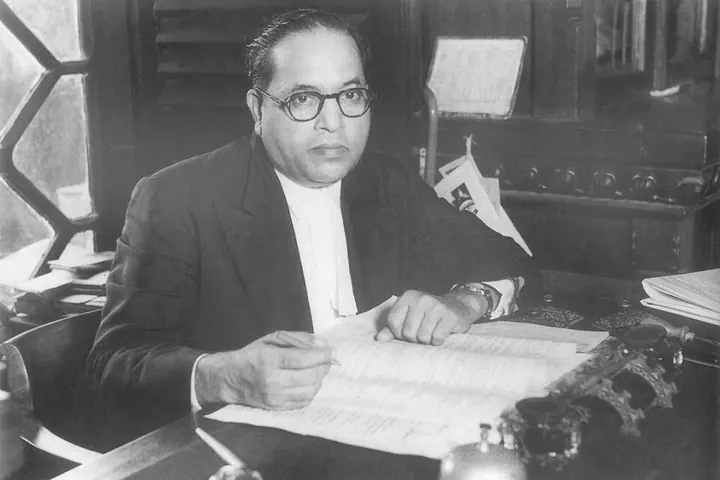
- Dr. B.R. Ambedkar: Chairman of the Drafting Committee; piloted (guided) the draft through the Assembly.
- B.N. Rau: Constitutional Advisor; prepared the first draft.
- Sachchidananda Sinha: oldest member; temporary President at the first sitting.
Fifteen women sat in the Assembly, among them Sarojini Naidu, Hansa Mehta, Durgabai Deshmukh, Rajkumari Amrit Kaur, Ammu Swaminathan, Dakshayani Velayudhan (the only Dalit woman member) and Begum Aizaz Rasul (the only Muslim woman member after Partition). Hansa Mehta presented the national flag to the Assembly on behalf of the women of India on 14 August 1947.
| Other facts | Detail |
|---|---|
| Secretary | H.V.R. Iyengar |
| Chief draftsman | S.N. Mukherjee |
| Calligraphy | Prem Behari Narain Raizada (English); Vasant Krishan Vaidya (Hindi) |
| Illustrations | Artists of Santiniketan led by Nandalal Bose, with Beohar Rammanohar Sinha |
| Symbol (seal) | The elephant |
What UPSC asks: Prelims: women members, signatures, the seal and the calligraphers. Mains: women members’ contribution, as a Society or History angle. Next likely angle: facts on Dakshayani Velayudhan and Begum Aizaz Rasul.
Criticism, Ambedkar’s warnings and the Mains angle
Each criticism with its reply (adult franchise means every adult votes):
| Criticism | Reply |
|---|---|
| Not representative: not elected on adult franchise | Members came from every major community and region; the 1946 elections reflected the main parties |
| Not sovereign: created by British proposals | The Independence Act made it fully sovereign; it repealed the British Acts itself |
| Took too long | Other constitutions took less, but India’s had to settle language, minorities, federalism and the princely states |
| Dominated by the Congress | Granville Austin: ‘The Assembly was a one-party body in an essentially one-party country. The Assembly was the Congress and the Congress was India.’ Yet many non-Congress experts, such as Ambedkar, were brought in |
| Lawyer-politicians; Hindu-dominated | Common criticisms; the debates show wide participation |
Mains GS1 2015 asked whether the Assembly could have finished its historic task in just three years without the experience of the Government of India Act, 1935. The answer uses both chapters: the Act supplied the federal frame, the Governor, the Federal Court and the PSCs; the Assembly supplied rights, adult franchise and a republic, and the committees and B.N. Rau’s draft made the speed possible.
It would have been difficult for the Constituent Assembly to complete its historic task of drafting the Constitution for Independent India in just three years but for the experience gained with the Government of India Act, 1935. Discuss.
In his last speech (25 November 1949), Ambedkar gave three warnings. First, give up ‘the grammar of anarchy’ (civil disobedience, non-cooperation, satyagraha) once constitutional methods are open. Second, do not lay liberties at the feet of a great man, since hero-worship in politics leads to dictatorship. Third, build social democracy, because political equality with social and economic inequality is ‘a life of contradictions’. His caution on civil disobedience was the theme of a 2026 GS4 question too.
What UPSC asks: not a Prelims area. Mains: role of the 1935 Act (GS1 2015); Ambedkar’s warnings, also in GS4. Next likely angle: the ‘grammar of anarchy’ applied to present-day protest.
→ Basic Structure How courts use the Assembly debates to read the Constitution.
Mains box: analysis and answer points
- 2015 (GS1): the 1935 Act gave the frame (federalism, Governor, Federal Court, PSCs); the Assembly added rights, adult franchise and a republic; committees and B.N. Rau's draft gave speed.
- Ambedkar's warnings: useful in GS4 (civil disobedience in a democracy) and essays.
- Next likely angle: the 'grammar of anarchy' applied to present-day protest.
Practice
Prelims PYQs on this topic (2)
Who was the Provisional President of the Constituent Assembly before Dr. Rajendra Prasad took over ?
Answer (d) & explanation
Dr. Sachchidananda Sinha was the Provisional President (d). At the first sitting of the Constituent Assembly on 9 December 1946, the oldest member, Dr. Sachchidananda Sinha, was made temporary President, following the French practice. Dr. Rajendra Prasad was elected permanent President on 11 December 1946. Option (a) is wrong: C. Rajagopalachari was not its President. Option (b) is wrong: Dr. B.R. Ambedkar chaired the Drafting Committee. Option (c) is wrong: T.T. Krishnamachari was a member of that committee.
Notice other key roles: H.C. Mukherjee was Vice-President, B.N. Rau the Constitutional Adviser, and Nehru moved the Objectives Resolution on 13 December 1946. The Constitution was adopted on 26 November 1949.
famous names from the Assembly. Each had a different role, so tie the name to the post.
Answer as per the official UPSC answer key.
Consider the following statements in respect of the Constitution Day :
Statement-I :
- The Constitution Day is celebrated on 26th November every year to promote constitutional values among citizens.
Statement-II :
- On 26th November, 1949, the Constituent Assembly of India set up a Drafting Committee under the Chairmanship of Dr. B. R. Ambedkar to prepare a Draft Constitution of India.
Which one of the following is correct in respect of the above statements?
Answer (c) & explanation
Statement I is correct but Statement II is wrong (c). Statement I is right: Constitution Day, or Samvidhan Divas, has been observed on 26 November since 2015 to promote constitutional values. That is the day in 1949 when the Constituent Assembly adopted the Constitution. Statement II is wrong: the Drafting Committee under Dr B.R. Ambedkar was set up much earlier, on 29 August 1947. The statement has the right person but the wrong event.
Notice the dates: the Constitution came into force on 26 January 1950, chosen because the Congress had declared Purna Swaraj on 26 January 1930. Some provisions, such as citizenship and elections, took effect on 26 November 1949 itself. 2025 marked 75 years of adoption.
26 November is real, so the date feels safe. Ask what happened on it.
Answer as per the official UPSC answer key.
Write an answer
In 150 words, explain the significance of Constituent Assembly with one recent example.
Flashcards (3)
Who chaired the Union Powers Committee?
Jawaharlal Nehru.
How many members did the Drafting
Committee have? Seven.
What was the Assembly's symbol?
The elephant.
Read more: related explainers
In the news
 Next chapter · 3. Preamble →Preamble: Text, origins and structure
Syllabus: GS-II · Indian Constitution—historical underpinnings, evolution, features, amendments, s…