
Chapter 8 · Topic 8.1 · Prelims + Mains1 of 3
Nuclear Technology: Nuclear basics and reactors
Key points
- Decay types: alpha (helium nucleus), beta (electrons/positrons), gamma (photons).
- Fission: about 200 MeV per nucleus, chain reaction.
- Fusion: light nuclei join, plasma at about 10^8 K.
- Moderator (heavy water, graphite) slows neutrons. Control rods (boron, cadmium) absorb them.
- PHWR: natural uranium, heavy water. Nuclear share 2024-25: about 3.1%.
Prelims box: facts and traps
| Process | What happens |
|---|---|
| Fission | Heavy nucleus splits, about 200 MeV each |
| Fusion | Light nuclei join, plasma at about 10^8 K |
| Radioactive decay | Alpha, beta or gamma emission |
- PFBR: the Prime Minister witnessed the start of core loading on 4 March 2024, and the reactor attained first criticality on 6 April 2026 at 8:25 PM after AERB clearance (DAE and PIB, 7 April 2026).
- Trap (Prelims 2023): power reactors do not need uranium enriched to 60%.
Nuclei, radioactivity, fission and fusion
An atom has a tiny, heavy centre called the nucleus, made of protons and neutrons, with electrons around it. Some nuclei are unstable and break down on their own. This is radioactive decay. NCERT lists three types found in nature (NCERT Physics, Class XII, Nuclei):
- alpha decay, in which a helium nucleus is emitted,
- beta decay, in which electrons or positrons are emitted,
- gamma decay, in which high-energy photons (packets of light energy) are emitted.
The half-life is the time taken for half the nuclei in a sample to decay.
Fission splits a heavy nucleus such as uranium into two middle-sized ones. This releases energy, of the order of 200 MeV per fissioning nucleus. Each fission also frees neutrons, which can split more nuclei, so a chain reaction can run. In a reactor it is kept steady and controlled (NCERT). Fusion joins light nuclei into a heavier one and also releases energy. It powers the Sun. Controlled fusion reactors aim to heat fuel to about 100 million kelvin (10^8 K), where it becomes a plasma, a hot gas of charged particles (NCERT).
| Process | What happens | Where used |
|---|---|---|
| Fission | Heavy nucleus splits; about 200 MeV each | All of today’s nuclear power plants |
| Fusion | Light nuclei join; plasma at about 10^8 K | The Sun; ITER and tokamaks (experimental) |
| Radioactive decay | Alpha, beta or gamma emission | Medicine, food irradiation, RTGs |
Source: NCERT Physics Class XII, chapter Nuclei.
How a reactor works
A reactor needs fuel, a moderator, control rods and a coolant. BARC explains that a medium of light nuclei such as graphite, heavy water, light water or beryllium is used to slow down the high-energy neutrons so they cause fission efficiently. This is the moderator. Slow neutrons are better at splitting uranium. Control rods of neutron-absorbing boron or cadmium speed up, slow or shut down the reaction (BARC Newsletter, 2021). So the function of heavy water in a nuclear reactor is to slow down the speed of neutrons (Prelims 2011: answer (a)).
The function of heavy water in a nuclear reactor is to
- Slow down the speed of neutrons
- Increase the speed of neutrons
- Cool down the reactor
- Stop the nuclear reaction
Show answer
Answer: (a) · UPSC official key
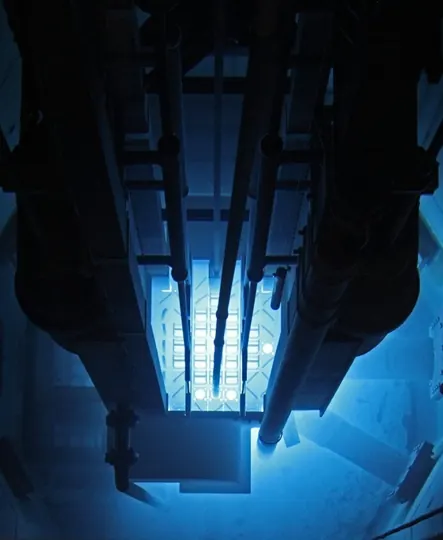
India’s workhorse is the Pressurised Heavy Water Reactor (PHWR). It burns natural uranium and is cooled and moderated by heavy water, which is water whose hydrogen atoms carry an extra neutron. NPCIL contrasts this with Chernobyl, whose combustible graphite moderator contributed to the explosion in its core (NPCIL FAQ).
Power reactors do not need weapons-grade fuel. PHWRs use natural uranium, and other designs use only slightly enriched uranium. Enrichment means raising the share of the easily split uranium-235. So in 2023, Statement-I (India, despite having uranium deposits, depends on coal for most of its electricity production) is correct, but the claim that uranium enriched to at least 60% is required for the production of electricity is wrong (Prelims 2023: answer (c)). Nuclear power gave about 3.1% of India’s electricity in 2024-25 (PIB).
Consider the following statements :
Statement-I : India, despite having uranium deposits, depends on coal for most of its electricity production.
Statement-II : Uranium, enriched to the extent of at least 60%, is required for the production of electricity.
Which one of the following is correct in respect of the above statements?
- Both Statement-I and Statement-II are correct and Statement-II is the correct explanation for Statement-I
- Both Statement-I and Statement-II are correct and Statement-II is not the correct explanation for Statement-I
- Statement-I is correct but Statement-II is incorrect
- Statement-I is incorrect but Statement-II is correct
Show answer
Answer: (c) · UPSC official key
| Part | Job | Examples |
|---|---|---|
| Fuel | Fissions to give heat | Natural uranium (PHWR); U-Pu MOX (PFBR) |
| Moderator | Slows neutrons | Heavy water, light water, graphite, beryllium |
| Control rods | Absorb neutrons; control or stop | Boron, cadmium |
| Coolant | Carries heat away | Heavy water (PHWR); liquid sodium (PFBR) |
Sources: BARC Newsletter 2021, NPCIL, PIB on PFBR (2026).
What UPSC asks: Prelims: decay types, moderator, PHWR. Mains: fission at 200 MeV, fusion at 10^8 K.
Mains box: analysis and answer points
- Basics: fission vs fusion, chain reaction control.
- Safety: PHWR heavy water vs Chernobyl's graphite.
Practice
Practice MCQs (8)
Which one of the following kinds of radiation emitted by radioactive nuclei is stopped by a sheet of paper, yet ionises matter most strongly along its short path?
Answer (c) & explanation
The answer is alpha particles. An alpha particle is a helium nucleus (two protons and two neutrons): it is heavy and doubly charged, so it loses its energy quickly by ionising the atoms it passes and is stopped by paper or the outer dead layer of skin. Beta particles (electrons or positrons) need a few millimetres of aluminium, and gamma rays (high-energy photons) need thick lead or concrete. The flip side is that alpha emitters are most dangerous when swallowed or inhaled, which is why polonium-210 and radon are internal hazards.
Consider the following statements:
1. In the core of the Sun, energy is produced mainly by the fusion of hydrogen nuclei into helium.
2. Fusion of light nuclei needs extremely high temperatures because positively charged nuclei repel one another and must be brought very close together.
Which of the statements given above is/are correct?
Answer (c) & explanation
Both statements are correct. The Sun's energy comes from thermonuclear fusion: in its core (about 15 million kelvin) hydrogen nuclei are fused, step by step, into helium, and the small loss of mass appears as energy. Nuclei are positively charged, so they repel each other (the Coulomb barrier); only at very high temperatures do they move fast enough to come within the very short range of the strong nuclear force and fuse. That is why fusion on Earth needs plasma at well over 100 million degrees in devices such as tokamaks.
Consider the following statements regarding radioactive decay:
1. The half-life of a radioactive isotope can be shortened considerably by heating it to a very high temperature.
2. After three half-lives, about one-eighth of the original radioactive nuclei of a sample remain undecayed.
3. Radiocarbon dating with carbon-14, whose half-life is about 5,730 years, is not suitable for finding the age of rocks that are billions of years old.
Which of the statements given above is/are correct?
Answer (b) & explanation
Statements 2 and 3 are correct. Radioactive decay is a property of the nucleus and is not changed by ordinary heat, pressure or chemical combination, so statement 1 is wrong: the half-life is fixed for an isotope. Each half-life halves the remaining nuclei: 1/2, 1/4, then 1/8 after three half-lives. Carbon-14 (half-life about 5,730 years) is useful only up to roughly 50,000 years, after which too little remains; billion-year-old rocks are dated with long-lived isotopes such as uranium-238 or potassium-40.
Consider the following nuclides:
1. Uranium-235
2. Plutonium-239
3. Uranium-233
4. Thorium-232
How many of the above are fissile, that is, able to sustain a chain reaction with slow (thermal) neutrons?
Answer (c) & explanation
Three are fissile. Uranium-235 (the only fissile nuclide found in useful quantity in nature), plutonium-239 and uranium-233 split readily when they absorb slow neutrons. Thorium-232 is fertile, not fissile: on absorbing a neutron it turns, through thorium-233 and protactinium-233, into fissile uranium-233. In the same way uranium-238 is fertile and breeds plutonium-239. This fertile-to-fissile conversion is the logic of India's three-stage programme.
With reference to India's three-stage nuclear power programme, consider the following statements:
1. The first stage uses Pressurised Heavy Water Reactors fuelled by natural uranium, which also produce plutonium.
2. In the second stage, thorium is the main fuel loaded in the core of fast breeder reactors to generate power.
3. The third stage is designed to use uranium-233 bred from thorium.
Which of the statements given above is/are correct?
Answer (c) & explanation
Statements 1 and 3 are correct. Formulated by Homi J. Bhabha, the programme links India's modest uranium and large thorium resources. Stage 1: PHWRs burn natural uranium and convert part of the uranium-238 into plutonium-239. Stage 2: fast breeder reactors (PFBR at Kalpakkam) use plutonium-based mixed oxide fuel in the core; a blanket of uranium-238 breeds more plutonium than is consumed, and thorium blankets can later breed uranium-233. Statement 2 is wrong because thorium in stage 2 sits in the blanket to be converted, not in the core as the main fuel. Stage 3: reactors based on the thorium–uranium- 233 cycle.
With reference to the Prototype Fast Breeder Reactor (PFBR) at Kalpakkam, consider the following statements:
1. It is a 500 MWe reactor built by Bharatiya Nabhikiya Vidyut Nigam Limited (BHAVINI).
2. It attained its first criticality in April 2026.
3. Being a fast reactor, it uses heavy water as the moderator to sustain the chain reaction.
Which of the statements given above is/are correct?
Answer (a) & explanation
Statements 1 and 2 are correct. The PFBR is a 500 MWe sodium-cooled, pool-type fast breeder designed by IGCAR and built by BHAVINI, a DAE public sector company set up for fast reactors. The Prime Minister witnessed the start of core loading on 4 March 2024, and the reactor attained first criticality on 6 April 2026 at 8:25 PM after AERB clearance (DAE and PIB, 7 April 2026). Statement 3 is wrong: a fast reactor has no moderator at all, because it needs fast neutrons; the PFBR uses uranium-plutonium mixed oxide fuel and liquid sodium as coolant.
Consider the following statements:
1. The binding energy per nucleon is highest for nuclei of medium mass, around iron-56.
2. For this reason, energy is released both when a very heavy nucleus splits and when very light nuclei combine.
3. In both nuclear fission and nuclear fusion, the total mass of the products is slightly greater than the total mass of the reactants.
Which of the statements given above is/are correct?
Answer (a) & explanation
Statements 1 and 2 are correct. NCERT's binding-energy curve rises steeply for light nuclei, peaks at about 8.8 MeV per nucleon near iron-56, and falls slowly for heavy nuclei such as uranium. Moving towards the peak from either side gives more tightly bound products, so both fission of heavy nuclei and fusion of light nuclei release energy. Statement 3 is the reverse of the truth: the products are slightly lighter, and this mass defect appears as energy according to E = mc².
Consider the following statements:
1. Gamma rays originate in the atomic nucleus, whereas the X-rays produced in an X-ray tube arise from electrons.
2. In beta-minus decay, a neutron in the nucleus turns into a proton, so the atomic number of the nucleus increases by one.
3. A free neutron outside the nucleus is stable and does not decay.
Which of the statements given above is/are correct?
Answer (c) & explanation
Statements 1 and 2 are correct. Gamma rays and X-rays are both high-energy photons, but they are named by origin: gamma rays come from an excited nucleus, while X-ray tubes produce X-rays when fast electrons are decelerated or when inner-shell electrons change orbits. In beta-minus decay a neutron changes into a proton, an electron and an antineutrino, so Z rises by one (carbon-14 becomes nitrogen-14). This decay is driven by the weak nuclear force. Statement 3 is wrong: a free neutron is unstable and decays in about fifteen minutes on average (half-life about ten minutes).
0 / 0 correct
Write an answer
In 150 words, explain the significance of Nuclear Technology with one recent example.
Flashcards (7)
Three types of radioactive decay?
Alpha, beta, gamma.
Energy per uranium fission?
About 200 MeV.
Fuel temperature aimed at in controlled
fusion? About 10^8 K.
Function of heavy water in a reactor?
Moderator: slows neutrons.
Materials used in control rods?
Boron, cadmium.
Moderator in Chernobyl's reactor?
Graphite.
PFBR coolant?
Liquid sodium.
Read more: related explainers
In the news
- 25 Oct 2026DRDO’s indigenous AIP for Kalvari-class submarines reaches the Setting to Work Phase-2 stage
- 24 Oct 2026NVS-03 launch on 30 October: can ISRO’s new satellite bring NavIC back to life?
- 22 Oct 2026Army’s new Land Warfare Doctrine: what it is and why the Army is rewriting it now
- 21 Oct 2026Japan’s MMX mission lifts off for Mars to bring back a sample of Phobos by 2031
 Next topic · 8.2 →Nuclear Technology: Three-stage programme and nuclear
Syllabus: GS-III · Achievements of Indians in science & technology; indigenization of technology an…