
Chapter 15 · Topic 15.3 · Prelims + Mains3 of 3
Arab-Israel Conflict: The peace process
Key points
- Camp David (1978) led to the Egypt–Israel treaty (1979); Jordan signed in 1994.
- The Oslo Accords (1993) brought mutual recognition of Israel and the PLO and created the Palestinian Authority.
- Israel never signed the Arab Peace Initiative (2002); the Abraham Accords (2020) linked it with the UAE, Bahrain, Morocco and Sudan.
Prelims box: facts and traps
- Prelims 2023: Statement-I true, Statement-II false, answer (c).
- Abraham Accords: UAE, Bahrain, Morocco, Sudan.
- Oslo: Rabin and Arafat, 1993.
The peace process
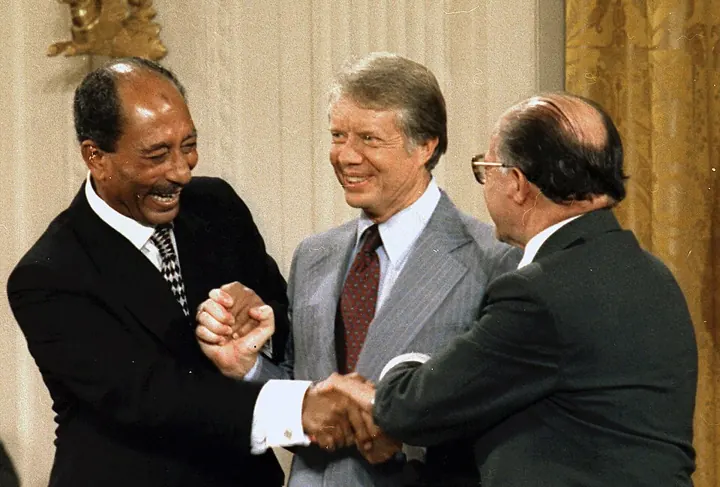
Peace-making here is like fixing a long family feud. You can make peace with one cousin at a time, but the main quarrel, over the family house, stays open. Israel made peace with many Arab states, while the core Palestinian issue stayed unsolved.
| Agreement | Detail |
|---|---|
| Camp David Accords (1978) | Egypt–Israel peace treaty (1979); Sinai returned |
| Oslo Accords (1993) | Mutual recognition of Israel and the PLO; Palestinian Authority created |
| Israel–Jordan treaty (1994) | Second Arab peace treaty |
| Arab Peace Initiative (2002) | Saudi plan endorsed by the Arab League; Israel did not sign it |
| Abraham Accords (2020) | Israel normalised ties with the UAE, Bahrain, Morocco and Sudan |
Each deal, explained
- Camp David: US President Jimmy Carter hosted Egypt’s Anwar Sadat and Israel’s Menachem Begin. Egypt became the first Arab state to make peace with Israel and got back Sinai. Sadat was later killed in 1981 by extremists who opposed the deal.
- Oslo Accords: secret talks in Norway led to a handshake between Yitzhak Rabin and Yasser Arafat at the White House. The Palestinian Authority, a Palestinian self-government, was set up to run parts of the West Bank and Gaza. The hard issues, like Jerusalem and refugees, were left for later. Rabin was killed in 1995 by an Israeli extremist.
- Israel–Jordan treaty: Jordan became the second Arab state to sign peace.
- Arab Peace Initiative: the Arab League, a group of Arab states, offered full ties with Israel if it withdrew to the pre-1967 lines and allowed a Palestinian state. Israel never signed it.
- Abraham Accords: “normalise” means to open normal ties: embassies, trade and flights. The UAE, Bahrain, Morocco and Sudan did this with US help, without first solving the Palestinian question.
Prelims 2023 tested this pairing. Israel does have diplomatic ties with some Arab states, so Statement-I is correct. Israel never signed the Arab Peace Initiative, so Statement-II is incorrect (answer c).
Consider the following statements :
Statement-I : Israel has established diplomatic relations with some Arab States.
Statement-II : The ‘Arab Peace Initiative’ mediated by Saudi Arabia was signed by Israel and Arab League.
Which one of the following is correct in respect of the above statements?
- Both Statement-I and Statement-II are correct and Statement-II is the correct explanation for Statement-I
- Both Statement-I and Statement-II are correct and Statement-II is not the correct explanation for Statement-I
- Statement-I is correct but Statement-II is incorrect
- Statement-I is incorrect but Statement-II is correct
Show answer
Answer: (c) · UPSC official key
Why peace keeps failing
- Neither side agrees on Jerusalem, borders or refugees.
- Israeli settlements keep growing on land Palestinians want.
- Palestinians are split: the Palestinian Authority in the West Bank, Hamas in Gaza.
- Violence on both sides destroys trust.
- Leaders who made peace, such as Sadat and Rabin, were killed by extremists.
Common doubts
Did the Abraham Accords help Palestinians? Not directly. Critics say they let Arab states and Israel move ahead while leaving Palestinians out.
Where does India stand? India backs a negotiated two-state solution and has good ties with Israel, Palestine and the Gulf states.
What UPSC asks
Prelims: Camp David, Oslo, Arab Peace Initiative, Abraham Accords. Mains: why the peace process stalled and what it means for India.
Mains box: analysis and answer points
- Why peace stalled: Jerusalem, settlements, refugees, Palestinian split.
- India's balance: ties with Israel, Palestine and the Gulf.
Practice
Write an answer
In 150 words, explain the significance of Arab-Israel Conflict with one recent example.
Flashcards (4)
Camp David Accords?
1978, Egypt and Israel.
Oslo Accords?
1993.
Arab Peace Initiative?
2002, Saudi plan; Israel did not sign.
Abraham Accords?
2020.
Read more: related explainers
 Next chapter · 16. South Africa →South Africa: Apartheid and resistance
Syllabus: GS-I · History of the world will include events from 18th century such as industrial re…